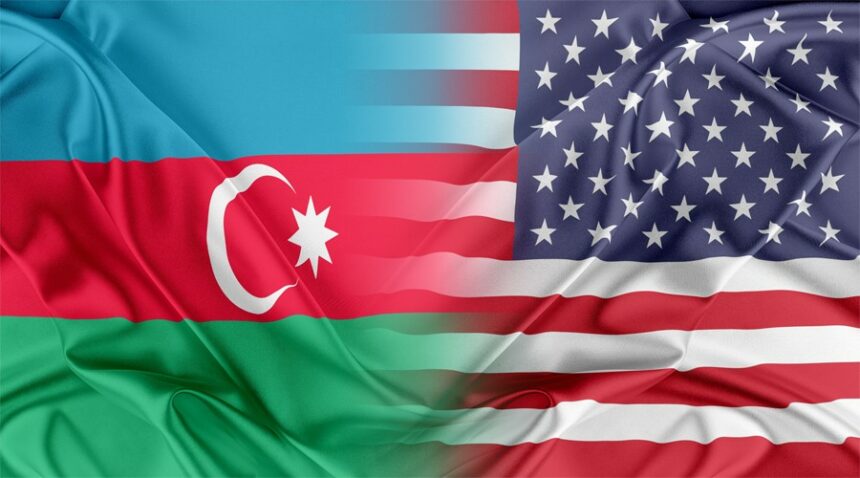
Such a strategy includes strengthening its geopolitical interest and facing up to any challenges from regional powers. To this end, the Republic of Azerbaijan played an important role in shaping of regional economic integration thanks to its geographical position and the availability of energy resources. It is not surprising that Zbigniew Brzezinski, who was U.S. National Security Adviser from 1977 to 1981, called Azerbaijan a “geopolitical pivot” which is very important for the U.S.’s security interest.
It should be noted that the Second Garabagh War has changed the whole geopolitical landscape in the South Caucasus. Azerbaijan ended the long-lasting Armenian occupation, which opened up new opportunities for sustainable peace and full regional economic integration. However, despite positive signals from Baku, Yerevan continued to support illegal armed forces in Khankendi and destabilize the situation on the ground. Following Azerbaijan’s anti-terrorism measures against illegal Armenian armed forces in Garabagh region of Azerbaijan between 19 and 20 September 2023, Baku managed to restore its full sovereignty. The local anti-terrorist activities undertaken by the Azerbaijani armed forces within its sovereign territory were in full compliance with international law, including international humanitarian law.
On the background of such developments, the current Biden administration started to criticize Azerbaijan and even support the separatist ideology in Garabagh region of Azerbaijan. It is worth noting that on 15th November 2023, during a Subcommittee Hearing on the future of Garabagh, James O’Brien, Assistant Secretary, Bureau of European and Eurasian Affairs U.S. Department of State openly condemned Azerbaijan and made a clear pro-Armenian statement. The thoughts that “Azerbaijan’s use of force eroded the trust and raised doubts regarding Baku’s commitment to a comprehensive peace with Armenia” derail the peace process.
In fact, the biased position of the U.S. Congress towards Azerbaijan stared at the beginning of the 1990s by enacting in 1992 Section 907 of the Freedom Support Act, which restricted certain types of direct U.S. assistance to Azerbaijan. Later on January 25, 2002, President Bush waived Section 907 of the Freedom Support Act for 2002, thereby lifting restrictions on US Government Assistance to the Government of Azerbaijan.
This year, the Senate votes unanimously to suspend Azerbaijan’s military assistance, and the Biden administration did not issue a new Section 907 waiver needed to unlock Azerbaijani security assistance. It is worth noting that US administrations have repeatedly issued the waiver since the exemption was introduced in 2002, citing national security concerns. But this time, Washington ignored US geopolitical interests and supported “the Armenian Protection Act of 2023” under pressure from the Armenian National Committee of America (ANCA).
Today, the problems in the U.S.-Azerbaijan relations can be also characterized as Washington’s ambition to control Armenia during Moscow’s temporary absence in the region. The visit of the U.S. House Speaker Nancy Pelosi to Yerevan on September 17th, 2022 in support of Armenia showed clearly that Washington is talking a side in the conflict between two South Caucasus countries.
On the contrary, Azerbaijan, for the most part, has developed a pragmatic and stable relationship with Washington. The president Ilham Aliyev and former president Heydar Aliyev supported bilateral ties between Baku and Washington. Looking back, despite all efforts of the strong Armenian diaspora, the US supported the “Contract of the Century” signed on 20 September 1994, as well as critical energy infrastructure projects such as the Baku-Tbilisi-Ceyhan oil pipeline and the Southern Gas Corridor. These important inter-regional energy projects increased and diversified the US ally’s energy supplies by bringing crude oil and natural gas from the Caspian Sea to the global energy markets.
To this end, Israel, which is a traditional US ally, receives up to 40% of its oil supplies from Azerbaijan. Another example is the Azerbaijan-EU energy cooperation, which is highly important due to the ongoing Russia-Ukraine war. Azerbaijan supports Europe’s diversification efforts and ensures the EU’s energy security.
Under President Ilham Aliyev’s leadership, Azerbaijan has also emerged as America’s reliable regional partner at the world’s uniquely critical crossroads. The Azerbaijani government has always appreciated Washington’s role in the peace process between Armenia and Azerbaijan. Baku welcomed the US mediation when the Secretary of State Antony J. Blinken met jointly with Azerbaijani President Ilham Aliyev and Armenian Prime Minister Nikol Pashinyan in Germany to advance the bilateral peace negotiations between the two sides. Also, on 1st May the Armenian Foreign Minister Ararat Mirzoyan and Azerbaijani Foreign Minister Jeyhun Bayramov met with Antony Blinken in Washington to advance peace talks.
Despite Washington’s anti-Azerbaijani position, it is very important to understand the core of the US-Azerbaijan relationship; Azerbaijan supported the American-led peace operations in the world. Azerbaijani servicemen serve shoulder-to-shoulder with American soldiers for a peace-keeping mission in Afghanistan. Also, since the beginning of the American-led peace operation in Afghanistan, Azerbaijan made its infrastructure available to these operations, and its transport infrastructure was used for transiting of non-lethal cargo for coalition forces in Afghanistan. As a key component of the Northern Distribution Network, Azerbaijan for many years has provided uninterrupted multi-modal transit for the coalition forces in Afghanistan. Working closely with the U.S. Transportation Command and the Air Mobility Command, Azerbaijan extended important over-flight clearance, medical evacuation flights as well as landing and refueling operations for U.S. and NATO flights to support ISAF and RSM.
By themselves, all the aforementioned facts clearly show Azerbaijan’s approach to bilateral relations with Washington. Currently, the concern is not that Washington did not issue a new Section 907 waiver, but that the Biden administration causes growing irritation and challenges partnership. The US military aid to Baku mainly aimed to improve Azerbaijan’s maritime security against threats from Tehran. From the American perspective, the Caspian Sea is particularly strategically sensitive because it borders Iran. To be brief, Azerbaijan managed to establish strong and modern armed forces without the US financial aid and became the most powerful army in the region.
In the end, the ongoing Russia-Ukraine war changed the geopolitical landscape in Eurasia. Hence, Washington should support strategic interests in the region rather than support the Armenian diaspora interests. Azerbaijan, with its valuable geographic location and regional diplomacy, is an important actor supporting the US interests in the region. Now, a core principle in bilateral relations should be to structure the negotiations as a win-win for both countries. As argued by George Friedman, geopolitical forecaster and strategist on international affairs and the founder and chairman of Geopolitical Futures: “The U.S. needs Turkey as a counterweight to Iran. The U.S. needs Georgia as a demonstration of its will. The U.S. needs Azerbaijan as its linchpin.”
Shahmar Hajiyev, Senior Advisor, Center of Analysis of International Relations