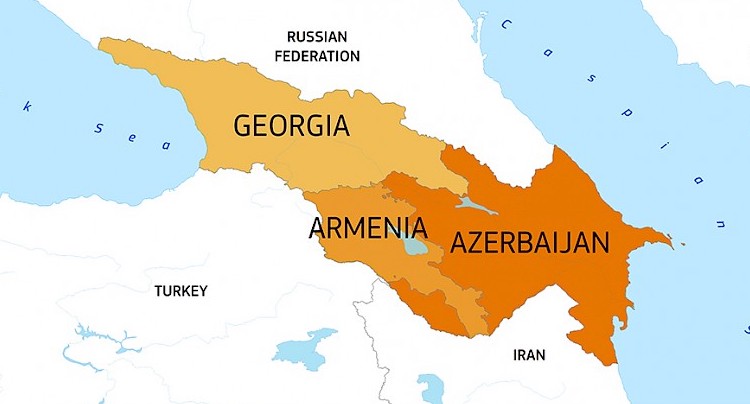
On June 27–29, Armenian and Azerbaijani foreign ministers Ararat Mirzoyan and Jeyhun Bayramov met in Washington to discuss a draft of the peace treaty that might end the thirty-year-long conflict between the two South Caucasus countries. This meeting followed a summit meeting of the Armenian and Azerbaijani leadership, mediated by EU Council president Charles Michel, in Brussels on July 15. Similarly, this summit followed two previous meetings by Mirzoyan and Bayramov in September 2022 and May 2023, which were initiated by U.S. secretary of state Anthony Blinken to support the peace process. The U.S. State Department’s spokesperson, Matthew Miller, stated that the United States “continue[s] to believe that peace is within reach and direct dialogue is the key to resolving the remaining issues and reaching a durable and dignified peace.” Michel, for his part, takes the view that “real progress depends on the next steps that will need to be taken in the near future”.
One of the core issues between the two countries is the fate of historical Karabakh, part of which was, during the Soviet era, an autonomous region within Azerbaijan and was later recognized by the entire international community as its sovereign territory. The modern conflict between the two countries began in 1987–1988 with the Armenian nationalist slogan miatsum, associated with demands for the unification of the former autonomy with Armenia. The slogan references a particular Armenian historical narrative, very much akin to what Russia is promoting with regard to Ukraine—a claim that a broad swathe of territory is part of its rightful imperial domain.
What Is at Stake: Peace
There is a lot of resistance towards efforts to conclude a peace treaty, especially from Armenia’s powerful and politically influential diaspora. This diaspora is so opposed to the notion that it promoted a campaign against Armenian prime minister Nikol Pashinyan because of his willingness to recognize Karabakh as a part of Azerbaijan.
The drastic reversal of Pashinyan’s past claims—he had once said that “Karabakh is Armenia”—came after the country’s shocking defeat in the so-called Second Karabakh War in the fall of 2020. The brief conflict enabled Azerbaijan to liberate, in line with UN Security Council resolutions made in 1993, its former territories that were occupied in the First Karabakh War in 1992–1994. During the intervening years, Armenia enjoyed what American scholar Thomas Ambrosio termed “a highly permissive or tolerant international environment that allowed its annexation of some 15 percent of Azerbaijani territory.”
Throughout this period the mainstream international (Western) media focused on Armenia’s grievances due to a variety of factors ranging from the powerful Armenian diaspora and lobbies in many Western countries to the fact that the conflict fit in nicely with established Western narratives: it was a fight of “Christians versus Muslims,” laced with typical Orientalist stereotypes. In truth, the conflict has been a tragedy for both peoples, but reports concerning widespread destruction within Azerbaijani territories, ethnic cleansing of Azerbaijanis from Armenia and Karabakh, landmine contamination, and the desecration of mosques has never achieved the level of international attention as seen with regards to the insecurities of Armenians or the fate of Armenian religious heritage.
What is now on the negotiating table might put an end to the cycle of violence that was instigated by Armenian irredentist land claims to Karabakh. The peace treaty revolves around the mutual recognition of the two countries’ territorial integrity—a principle that has acquired paramount significance in light of the Russia-Ukraine War. Certainly, historical narratives in both Armenia and Azerbaijan remain hostile and in opposition to each other. Reconciliation will not be an easy undertaking considering past tragedies. But the mutual and genuine respect for each country’s territory is the only way to establish a durable peace, and this concept is prevalent among the American and European policymakers who have advanced the peace negotiations for the past two years.
Factors to Consider
Discussions by experts and the press regarding what a durable future peace could look like ought to include only what Armenians narrate, but also what Azerbaijanis endured and their sense of vulnerability to possible future assaults.
For example, take the current focus on the Lachin Road connecting Armenia and the Karabakh region of Azerbaijan—widely regarded as an important link to its Armenian inhabitants. In recent discussions, it is rarely mentioned that Lachin was occupied and burned by Armenian armed forces in May 1992, which paved the way for the future occupation of Azerbaijani territories in 1993. It is thus imperative to Azerbaijani national security to control the Lachin Road and ensure it is not used for the transfer of military equipment and personnel but instead for humanitarian purposes, as in accordance with the Trilateral Statement (the armistice agreement between the two countries) of November 9, 2020. In the meantime, Azerbaijan offered Armenia the use of an alternative road through Aghdam. For those who really care about the Karabakh Armenians, this should be a perfectly valid option. However, local Karabakh Armenian leaders maintain their desire for independence and miatsum, rejecting any opportunity for a productive dialogue.
Likewise, concerns about negative foreign influence ought to be taken into account. Consider how the territorial nationalism in the South Caucasus, in a peculiar way, unites disparate figures. These include Russian-Armenian oligarch Ruben Vardanyan, who moved to Karabakh to derail the dialogue between Azerbaijan’s central authorities and local Armenians, American Democratic Party senator Bob Menendez, the German far-right movement Alternative for Deutschland, and Iranian clerics. Many Azerbaijanis view such an alliance through the prism of cultural Turcophobic bias or worse—a combining the selfish interests of geopolitical actors and elected officials who benefit from constituency voters who thrive on conflict and division. A lasting peace in the South Caucasus must recognize that these external forces do not necessarily represent the views or interests of the region’s native inhabitants.
A Call for Truth
The attempts to impose on Azerbaijan in whatever form any international mechanisms with regard to Karabakh reveal the impotent and bankrupt status of the OSCE Minsk Group, co-chaired by France, Russia, and the United States—a mechanism that, according to American member ambassador Richard Hoagland, was a platform for fine dining and procrastination.
For the sake of peace, all parties must do better than that. There is a small window of opportunity for achieving peace, and the international media has a role to play to promote such and debunking primordial nationalist narratives about the “thousand years of Christian presence” or the prospect of imminent ethnic cleansing. Contrary to these views, the facts on the ground point to a more complicated picture, which includes the ethnic cleansing of Azerbaijanis and of massive destruction in the formerly occupied territories of Azerbaijan.
If there is to be peace, we must first reckon with realities rather than subjective narratives.
Farid Shafiyev is the Chairman of the Baku-based Center of Analysis of International Relations