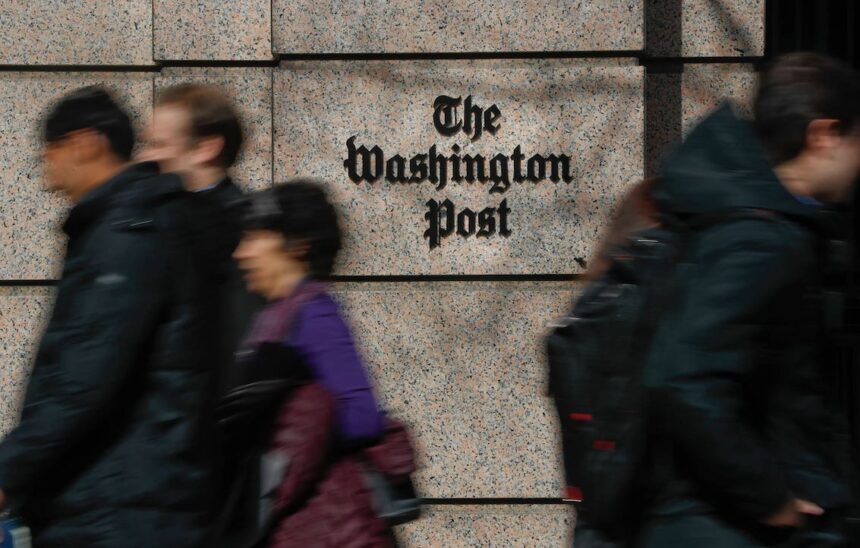
Media researchers are concerned that classical journalism has fallen victim to propaganda. Not only are they not wrong, but they put their finger on the crux of the matter, bringing obvious truths into the public eye. It is par for the course when unfolding political and military campaigns are preceded by high-profile media attacks. Sometimes massive information attacks are launched when it is necessary to bash sovereign states. The same technique is used to brainwash users, when attempts are made to overthrow the legitimate authorities of third countries.
There are also localized campaigns when there is a need to exert targeted pressure on the elites or ruling forces of sovereign countries. This is what happened with Azerbaijan in the case of Gubad Ibadoglu. It is not some tabloid that speaks in his defense, but The Washington Post, an unofficial publication of the US Department of State. However, information attacks of the popular publication on the leaders and governments of other states are a common thing. In politically motivated speeches, the authors usually beat the drums of the Cold War, moving the entire Western community towards informational mobilization.
The Washington Post often acts as a platform from which groundless accusations and slanderous attacks on other countries are voiced. Once again, it has targeted the Azerbaijani authorities, making unlawful claims against them regarding the detention of opposition activist Gubad Ibadoglu in Baku. Without getting to the bottom of things, the newspaper makes hasty conclusions, calling the charges brought against the detainee “absurd”. But this is only half the problem. The newspaper also gives an ultimatum to the Azerbaijani authorities, saying that the detainee “should be freed”.
The creative vanguard of the influential newspaper likes the role of a democratic publication, it is honorable and flattering, but by meddling in the affairs of others and slipping into arrogance, The Washington Post trivially mutates into its opposite. Can a self-respecting publication use a commanding tone when addressing political elites in other countries? A newspaper is an informing body, even if it has solid analytical content. As periodicals, they have no supervisory or binding mandate. By pressuring politicians in other countries, they are crossing the line and setting a bad precedent.
With no grounds whatsoever, The Washington Post demands from the Azerbaijani authorities “an unbiased investigation and a fair trial”. Is this acceptable? Crossing red lines and flagrantly violating journalistic ethics, The Washington Post is putting pressure on the course of the investigation, which is also unacceptable in the context of legal standards.
Impartial Western journalists, who advocate democratic norms, always avoid being pushy in their efforts to be objective. Laws and rules of the profession are their reference points. For this reason, they tighten professional control in their stories in order to avoid subjectivity.
The Washington Post article, on the other hand, deliberately uses confusion as a technique. The topic of Armenia-Azerbaijan settlement is mixed with the story of Gubad Ibadoglu’s detention, and it is intentional. The authors deliberately fall into populism in order to create a negative perception of the country in the readers’ minds. This kind of cheap tricks hurts the reputation of the publication, even if it is popular and appreciated by a wide audience.
The vulgar information fast food like the Washington Post article is a trademark of provincial tabloids that fulfill their potential through haphazard and cheap methods. The illogical combination of two different components in the Washington Post article exposes the low level of its political resource. Or rather its complete non-existence. If the authors’ goal was to put pressure on Baku in order to get political preferences in the context of the settlement of the situation with Armenia, they have made a mistake. The availability of diplomatic leverage does not always yield the expected result and even leads to a dead end, if it is used in combination with building up hysteria.
The Washington Post, most likely, intended to raise a scandal around the Azerbaijani issue, but missed the target. At best, it revealed the dullness of its views. It is no secret that certain political circles with lobbyists in the Senate and Congress thrive in America on the grounds of anti-Azerbaijanism. Unsuccessfully playing a soft power game, they often go to extremes, turning truths upside down. The reason is well known: a common moral decline and a lack of improvisation. Add political illiteracy to the mix, and the net result is zero resource.
The American newspaper’s blank shot once again revealed the real reason for the pressure campaign against Azerbaijan in light of the tangible breakthroughs of Ilham Aliyev’s diplomacy.
The achievements of official Baku in Karabakh and around the peace process, when no one is any longer able to impose their will on the Azerbaijani establishment, when the assets and liabilities of all participants are known, the ill-wishers are trying to use the last chance. But a new wave of attacks on Azerbaijan will result in nothing but a fog of uncertainty in the relations between the parties.
The selective approach of Western circles in the context of the Armenia-Azerbaijan settlement has always been evident. It is still at play today, otherwise the circles that consider themselves influential would not resort to using weak leverage. Those who openly support Armenia, demanding “sanctions” against Azerbaijan, have completely lost their moral resource, otherwise they would not build influence amplifiers out of empty resources.
The case of Gubad Ibadoglu is a purely internal issue of Azerbaijan, and it is up to the justice system to deliver a verdict on it. No need to expose symptoms of insanity: they betray helplessness.
Tofig Abbasov
Translated from Minval.az