According to his version, Azerbaijan “illegally blocks the Lachin corridor,” the long-suffering “self-determined people of Karabakh” are deprived of supplies of “all kinds of goods,” and even the peacekeepers cannot deliver goods to them. He did not specify why the logistics could not be switched to Aghdam or why the cargoes could not be registered in accordance with all the customs regulations. He also gave no explanation as to how the photos of lavish parties and picnics of “starving people of Karabakh” on social media fit in with the cries of a starvation of Biblical proportions.
He accused Azerbaijan of not supplying gas and electricity to Karabakh, even though both are supplied from Armenia. Further, according to the “kebab premier”, it turns out that Azerbaijan makes “unfounded accusations” against Armenia and demands the withdrawal of Armenian troops from the area of temporary deployment of the Russian peacekeeping forces. According to Pashinyan, there are no Armenian troops there, but the “defense army of Nagorno-Karabakh”. And yet he failed to explain why the bodies of the Karabakh soldiers killed in Karabakh had to be returned to Armenia. Once again, he refused to provide Azerbaijan with a possibility of communication between the mainland and Nakhchivan, saying that “Armenia has never undertaken any commitments regarding a corridor, neither written nor verbal, and will never accept such comments”. It would appear that he did not bother to read the text of the Trilateral Statement before spouting nonsense from the stand. Or he thought that it would “fly”: Pashinyan learned nothing from the Munich experience with quoting the UN Security Council resolutions from Wikipedia as expounded by Kazimirov.
Not surprisingly, the Ministry of Foreign Affairs of Azerbaijan has already responded to Pashinyan’s buffoonery and advised the “kebab Führer”: “If the Armenian side is truly interested in peace, it should respect the territorial integrity and sovereignty of Azerbaijan not only in words but also in deeds and immediately withdraw the Armenian armed forces from the territory of Azerbaijan.”
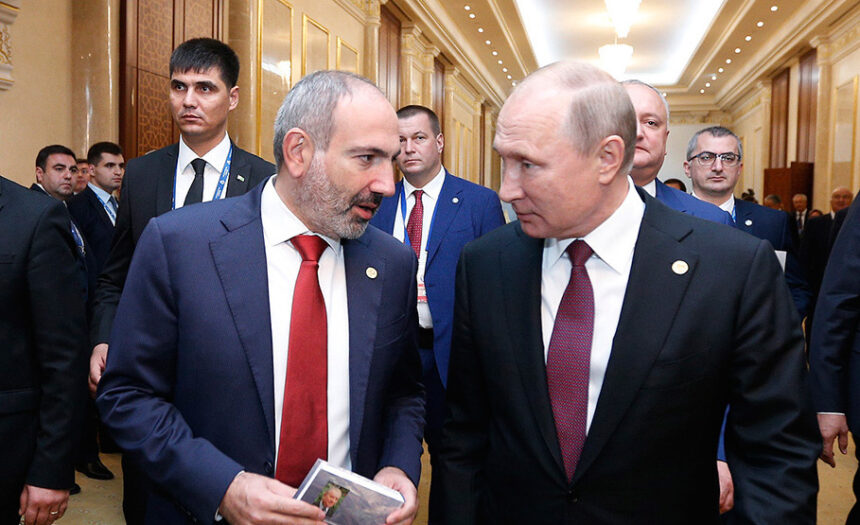
But there are curious details behind the scenes. The day before his cheap show, Nikol Pashinyan had a phone conversation with Vladimir Putin at the request of the Khankendi separatists. A few days earlier, Arayik Harutyunyan had also sent a letter to Vladimir Putin. And now the leader of the Khankendi puppets, according to Yerevan-based Hraparak, once again gathered his “inner circle” (minus those who have already fled to Armenia) and openly declared: they, that is, the Khankendi puppets of the Yerevan revanchists, are ready for a dialogue with Baku on one condition: if Russia assumes the role of a mediator. It turns out that the US mediation is rejected in Khankendi because “they push the Karabakh Armenians towards integration with Azerbaijan, and with the Russians there is still a chance to avoid it.” Now Hraparak is voicing the hopes of Harutyunyan and his inner circle: “Taking into account Arayik Harutyunyan’s letter to Putin, it is not impossible that the negotiations with Baku will be carried out with the mediation of the Russian Federation”.
What is there to say? Let’s leave aside speculation as to how much—or whether—Vladimir Putin encouraged Nikol Pashinyan in that conversation. After all, it is a well-known fact that the Armenian leadership is good at seeking proof of its dreams and projects where there are none and have never been any. Although, if we recall that Moscow suggested “postponing” the issue of Karabakh’s status and leaving it for the future generations at the meeting in Sochi, it is not surprising that Yerevan and its Khankendi puppets like Russian mediation more than they like American one.
One wonders, of course, what Yerevan thinks about the mediation by the European Union, especially against the background of the forthcoming meeting between Pashinyan and Aliyev on the European platform. The difference in the approaches of different mediators and the sides’ attempts to choose which mediator suits them better is something that we already saw in the course of the negotiations before the 44-day war.
But now Armenia, and even more so Khankendi, must understand: they have to negotiate with Azerbaijan, and not with the United States or Russia. If before the war they could still count on the results of “voting with bullets”, now, as a result of “voting with Bayraktars”, both Yerevan and its puppets represented by Harutyunyan are not in a position to be too picky with their options, to petulantly stomp their feet and demand something for themselves. Otherwise, there is a risk of losing even those of Azerbaijan’s proposals that are being brought to the Armenian side through mediators, including the United States. And when Bayraktars, Akıncı and Kızılelma rise in the air again, it will be too late to cry over the missed chance to come to an agreement.