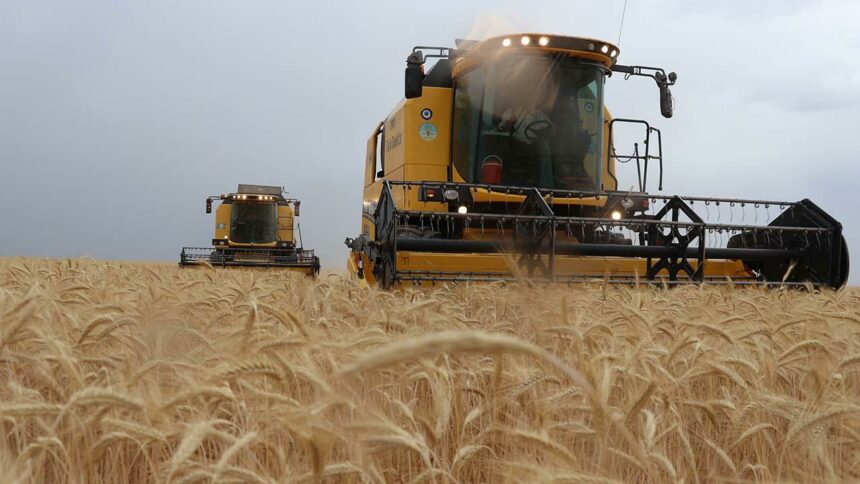
Currently, it is quite difficult to make a forecast about what will be the final harvest of 2023, however, according to information released recently by Azerbaijan’s Ministry of Agriculture, the country has harvested 65 per cent of the winter barley area and about a quarter of the wheat area, and the average yield exceeds the last year.
Reliance on import substitution in grain production is a key trend in the country’s agricultural policy: this is extremely important given the high volatility of world prices over the past two years and the actual rupture of the “grain deal” with Ukraine.
As of June 25, Azerbaijan has harvested a little less than 1.316 million tonnes of grain, and according to the Ministry of Agriculture, 61 regions of the country are involved in this work, where cleaning was completed on 410,237 hectares or 38.9 tonnes of all grain areas.
In particular, 65 tonnes of winter barley area (over 792,400 tonnes) and about a quarter of wheat area (over 523,300 tonnes) have been harvested. Barley harvesting is nearing completion in the lowlands and will start in the foothills in the coming days, followed by spring wheat, oats and corn harvesting from July to August. In order to optimize the harvesting process, 1,491 combines (harvesting vehicles), as well as many trucks, etc. will be involved.
The open joint-stock company Agroservice’s farming equipment accounted for just over a quarter of the harvested fields to date, mostly belonging to small farms, and about three-quarters of the harvest was collected by private combine harvesters, including those belonging to half a hundred large agroparks and specialised grain farms.
The average yield in this June harvest was 30.4 quintals of barley and 34.9 quintals of wheat per hectare. This compares favourably with previous years, which were marked by drought and a shortage of irrigation water, which had a detrimental effect on yields.
On the contrary, this spring, during the vegetative growth period of cereals, the fields had abundant moisture, which was very favourable for the growth of crops. Unfortunately, the Shaki-Zagatala, Mountainous Shirvan and Karabakh economic regions received excessive rainfall, which continued into May and June during the grain ripening period. According to the “Agrarian Insurance Fund”, this month, as a result of heavy rains, mudflows, strong winds and hail farms in 15 regions of the country have been damaged to a greater or lesser extent.
Hail fell particularly on wheat, barley and cotton fields in Aghdam region, and a strong wind blew down trees on the fields. Farmers in Gadabay, Dashkasan, Tovuz, Ganja, Goygol, Naftalan, Yevlakh, Gusar, Guba, Goranboy, Shabran, Shaki, Gakh and Jalilabad regions were also affected by natural disasters. The Fund has insured about 400,000 hectares of sown area (about 40 per cent of the total sown area) this year: the process of damage assessment is underway, based on which the final yield of winter crops can also be determined.
To recall, the final harvest in 2022 was about 2.85 million tonnes of grain, including almost 1.732 million tonnes of wheat, which accounted for about 60.8 per cent of all production. Alas, the agrarians were unable to repeat the successes of 2018 and 2019, when the country had record harvests of grain – 3.3 and 3.4 million tonnes, respectively.
It is clear that climatic factors play a very significant role in the South Caucasus region, where all the negative manifestations of global desertification, including persistent water shortages, have been observed in recent decades. Nevertheless, in recent years, Azerbaijan has taken a number of steps to mitigate the negative natural factors: The reconstruction of water reservoirs and irrigation canals has begun in order to reduce technical water loss, economical irrigation methods, including beer systems, have been introduced, the use of modern pesticides and herbicides to protect crops from pests and weeds has expanded, and farmers’ access to fertilizers, including nitrogen fertilizers produced at the urea plant in the Sumgayit Chemical Industrial Park (SCIP) has increased.
These and other steps taken in the framework of the execution of President Ilham Aliyev’s July 19, 2022 decree “On a number of measures to improve the level of self-sufficiency in food wheat,” contribute to increasing productivity in the field of fur farming, increasing the yields even in the face of adverse climatic conditions.
In particular, according to the presidential decree, within the pilot project, starting from 2023 and for the period of five years, subsidies will be provided to grain farms, which use modern irrigation systems and signed the relevant contracts for the delivery of grain to “State Reserves Agency” and to milling companies in accordance with the contract concluded with the Ministry of Agriculture.
In particular, grain farms are given food subsidies in the amount of 100 manats ($59) for each ton of wheat. The purpose of this decree is to encourage through subsidies large and medium-sized specialized grain farms and agro-parks to increase the production of high-yielding durum wheat varieties.
“In view of external challenges, wheat has become the most subsidised agricultural crop in Azerbaijan in recent years. According to the order of the Cabinet of Ministers last June, measures were taken to increase the level of self-sufficiency in food wheat and to provide state support to local producers. We increased the amount of subsidies for each ton of flour and flour products sold in the domestic market. Wheat imports have also been increased, and the production and sale of wheat flour and bread is exempted from VAT,” Prime Minister Ali Asadov said recently.
The head of the Cabinet of Ministers stressed that large importers of grain are given loans at very low-interest rates, and measures are also being taken to increase the size of the state grain fund and ensure food security.
The need for the above steps is still urgent, as about 40 per cent of durum baking wheat in our country has to be imported from abroad, mostly from Russia and Kazakhstan. Today Azerbaijan produces on average just less than 3 million tonnes of grain per year: the country largely covers the demand for fodder grain, but provides only 60 per cent of the level of domestic consumption of baking wheat.
Such high dependence on imports carries significant risks of force majeure, as actually happened in 2022, when wheat prices almost doubled amid the Russian-Ukrainian war, making it difficult to regulate prices in the domestic market and resulting in a sharp rise in the price of flour, bread, pasta and other products.
The global market situation has stabilized somewhat this year: according to the June bulletin of the Food and Agriculture Organization of the United Nations (FAO), the food price index in May 2023 was 124.3 points, 35.4 points (22.1 per cent) lower than the record high reached in March 2022. The Cereal Price Index in May also fell by 4.8 per cent compared with April this year, with a year-on-year decline of 25.3 per cent.
However, this positive momentum is very fragile and could be replaced by another round of price increases at any moment. “The grain deal has no chance de facto, Moscow sees no reason to extend it, as the negotiated points concerning the interests of the Russian Federation have never been fulfilled,” Russian presidential spokesman Dmitry Peskov said recently.
According to him, Russia has on several occasions shown goodwill, made concessions and extended the deal. However, tougher measures against Russia, including the 11th package of sanctions recently adopted by the European Union, do not give reason to hope for progress in the grain agreements. It should be recalled that the agreement on the safe transportation of grain from Ukrainian ports, which was signed in Istanbul on July 22, 2022 with the participation of the UN, Russia, Ukraine and Türkiye to resolve the global food crisis, played an important role in lowering the price of wheat, including that sent to the world’s most needy countries – Yemen, Somalia, Kenya, Ethiopia, Bangladesh, Sudan, etc.
The situation has been exacerbated by the fact that the agrarian authorities of Hungary and Poland recently came out again in favour of extending the embargo on grain and oilseed supplies from Ukraine to the EU. The ban was imposed by Bulgaria, Hungary, Poland, Romania and Slovakia and is valid until 15 September this year, but Budapest and Warsaw intend to “convince” the European Commission to extend the embargo until the end of the year in order to protect local producers from Ukrainian dumping.
Either way, the situation in the grain market is highly volatile, and further inconsistencies in the Black Sea and Eastern European food logistics region could be a catalyst for higher wheat prices.
In fact, this is why Azerbaijan has placed a clear bet on the expansion of specialised grain farms with a high level of commercial wheat production. Over time, it is planned to develop such high-tech agricultural parks in the Karabakh and East Zangazur economic regions, where there are a total of 1 million hectares of suitable areas for agricultural production, including 128,000 hectares of irrigated land.
It is also planned to sharply increase grain production through a joint project with Israel, which will provide our country with the latest agricultural technology for wheat cultivation, in order to ensure not only domestic consumption by 2025 but also to gradually establish the supply of grain to the Israeli market.
Khazar Akhundov
Caliber.Az