These have shown a certain limited mutual complementarity, yet crucial issues still await authoritative resolution. At present, only the U.S. would appear to have the goal of a final peace treaty firmly in sight. The process presided by Council of the EU President Charles Michel in Brussels may potentially still be helpful, but the activity of other EU institutions has become obstructive. U.S. diplomacy should not allow the current momentum to dissipate.
BACKGROUND: The U.S. has stepped up its participation in the South Caucasus peace process this year. In March, after two years of confusion over bureaucratic titles following the 2020 war (including whether anyone should represent the U.S. as “co-chair” of the long-defunct Minsk Group), the newly appointed U.S. Senior Advisor for Caucasus Negotiations, Louis Bono, visited Baku, Yerevan, and Tbilisi. The purpose was to consolidate the results of the February 18 meeting in Munich between Armenian Prime Minister Nikol Pashinyan and Azerbaijani President Ilham Aliyev.
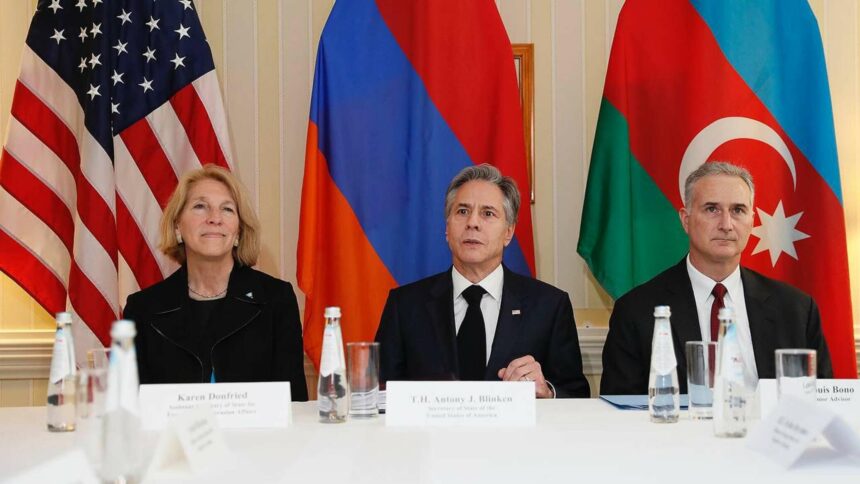
The February meeting had been initiated by U.S. Secretary of State Antony Blinken. It was attended by Assistant Secretary of State for European and Eurasian Affairs Karen Donfried as well as by Bono. It was the first time that Aliyev and Pashinyan had spoken face-to-face since October 6, 2022, when they met during the launch of the European Political Community (EPC). That meeting, in turn, was chaired and mediated by Charles Michel, President of the European Council.
Because the EPC was created following an initiative by French President Emmanuel Macron, he was invited to attend Michel’s trilateral meeting in Prague as a special guest. The two sides, Armenia and Azerbaijan, had been scheduled to meet again, this time in Brussels, at the end of October last year. This meeting was postponed until November 7 and then cancelled, after Pashinyan posed the extraordinary condition that, since France in the person of Macron had attended the one-off Prague discussions, therefore he should become a member of the Brussels-based process.
Azerbaijan ruled out Macron’s presence, maintaining that he could not be neutral broker. Indeed, Macron’s repeated public pro-Armenian statements during and after the Second Karabakh War, as well as votes in the French Parliament in favor of recognizing the so-called “Republic of Nagorno-Karabakh”, justify Baku’s reticence. Moreover, the Brussels process had been trilateral with Michel since its first meeting in December 2021 and had made tangible progress in that format through regular continued meetings in February, April, May, and August 2022.
Bono’s meetings in the South Caucasus, together with new prospects for another face-to-face meeting in Brussels mediated by Michel without Macron, raised the prospect of European-American coordination on diplomatic strategy in the South Caucasus. Such a development appears to be welcomed by both Armenia and Azerbaijan. It provides a good opportunity for trans-Atlantic cooperation that could lead to still bigger things. Such cooperation is especially needed in view of a new, strong Russian-Iranian alliance—not limited to military cooperation against Ukraine—that not only policy-observers but also official Washington are beginning increasingly to notice.
IMPLICATIONS: Following the October 2022 quadrilateral at the first summit of the European Political Community (EPC) in Prague, in which Macron took part, the EU with Azerbaijan’s agreement sent a temporary observation mission to the region of the still-undefined border with Armenia. This decision was implemented under the European External Action Service (EEAS), which is not under Charles Michel or the European Council but is instead directed by Josep Borrell, who is European Commission Vice-President and High Representative of the Union for Foreign Affairs and Security Policy. The mission had a temporary, two-month duration, from October to December, at the end of which period its mandate was unhelpfully and unilaterally extended indefinitely without consulting Baku.
After an EU-arranged summit in Brussels on May 14 between the Armenian and Azerbaijani leaders, a Russian-mediated meeting at the foreign-ministerial level took place on May 19. Following this, Pashinyan reaffirmed publicly Armenia’s recognition of Karabakh as part of Azerbaijan, after which a trilateral meeting of Armenian, Azerbaijani, and Russian leaders took place in Moscow on May 25, on the sidelines of the summit of the Eurasian Economic Union (EEU), which Aliyev attended as a guest. The most significant result of this meeting was the reconvening of the trilateral expert group, presided at the deputy prime-ministerial level, on unblocking communications through the Zangezur corridor.
This group had been created soon after the Moscow-mediated November 2020 Trilateral Declaration, in order to implement its Point 9. Azerbaijan has already implemented its Point 6, which concerns the construction of a new Lachin road and the provision that Baku “shall guarantee the security of persons, vehicles and cargo moving along the Lachin Corridor in both directions.” After over two and half years of delay, following the May meetings in Moscow, agreement was finally and quickly reached on practical steps for the Zangezur corridor.
Russia has especially wanted this corridor to be open because it will give Moscow rail access to Turkey through Azerbaijan. Through Georgia there is no such access; indeed, there is basically only one mountain road that ices up in winter. Russia’s proposals on Karabakh during trilateral mediation, on the other hand, amounted to an indefinite postponement of the resolution of the issue. Yet Azerbaijan will not extend the mandate of the Russian “peacekeeping” troops in the un-deoccupied area of Karabakh beyond 2025, when it expires. The U.S. has praised the Azerbaijani offer to consider amnesty for ethnic-Armenian separatists in the region, if they should resign from their positions of self-constituted authority and disestablish the political structure there.
The EEAS has just formalized and expanded its presence in Armenia from three to six posts near the border. And yet the EEAS turns a blind eye to the presence of 10,000 Armenian troops on the still un-deoccupied land in Karabakh. These are regular soldiers from the army of the Republic of Armenia, and not “self-defense forces” of the illegal ethnic-Armenian authority in Karabakh. There is no delimitation of territories, no demarcation of the border, indeed therefore no border posts. Determining what constitutes a “violation” is therefore problematic. Armenian forces have begun to use the EU representation as cover to fire upon Azerbaijani forces in Azerbaijan, much as Palestinian forces often usedthe posts of UN peacekeepers in southern Lebanon as cover to fire upon Israeli forces in Israel.
On June 1, Macron and German Chancellor Olaf Scholz sat in on a meeting organized by Michel with Aliyev and Pashinyan at the second EPC summit, which was held in Chisinau. The co-optation of Macron and Scholz (who also overtly supported the Armenian side during the war and its aftermath) into these one-off side meetings at the EPC summits has vitiated the constructive process initiated by Charles Michel. Indeed, the EEAS involvement, which seems to be partly a French-motivated machination and partly a maneuver by Borrell to increase his profile against Michel’s. Despite positive contributions to reaching a peace settlement made under the auspices of his good offices, it has become difficult to expect fully constructive engagement by the EU as a whole in the settling of the conflict.
CONCLUSIONS: All this puts the American mediation at a critical juncture. The State Department continues institutionally to insist that Azerbaijan should allow unrestricted travel on the New Lachin Road, while Secretary of State Antony Blinken seems personally to have made the greatest contribution to mutual understanding between the sides, particularly at the early-May Washington meeting. Continuing pretensions by Armenian-American interest groups that there is an Azerbaijani “blockade” against Karabakh are simply false. The fact that Armenians freely usethe new Lachin border crossing is testimony to this fact. Azerbaijan requires only proper documentation and normal passport control in accord with normal standards of international law.
A planned meeting in Washington on June 12 at the foreign-ministerial level had to be postponed because of newly-reelected Turkish President Recep Tayyip Erdogan’s visit to Baku, which required the presence of the Azerbaijani foreign minister. There is a risk that the momentum achieved so far may diminish over the summer. Yet the summer is when Europeans go on vacation while Americans continue to work. The U.S. therefore has the opportunity to continue its practical work of mediation and to prepare increased momentum, to be taken up by all parties in autumn for a push toward signature of a final peace treaty before the end of the year. There is no time like the present.
Robert M. Cutler is Senior Research Fellow at the NATO Association of Canada and Director of its Energy Security Program.