On 22 May, Armenian Prime Minister Nikol Pashinyan said that he was finally prepared to accept that the long-disputed province of Nagorno-Karabakh is the sovereign territory of Azerbaijan. If Pashinyan proves good on his word, this concession will one day be remembered as the moment of a historic thaw in relations between Armenia and Azerbaijan, which have fought for control of Karabakh for over a century. “Azerbaijan’s territory includes Nagorno-Karabakh,” he was quoted as saying.
Whilst some celebrated this as a momentous diplomatic breakthrough in a dispute that has produced two separate wars in the last 32 years, activists in the international Armenian diaspora reacted with fury.
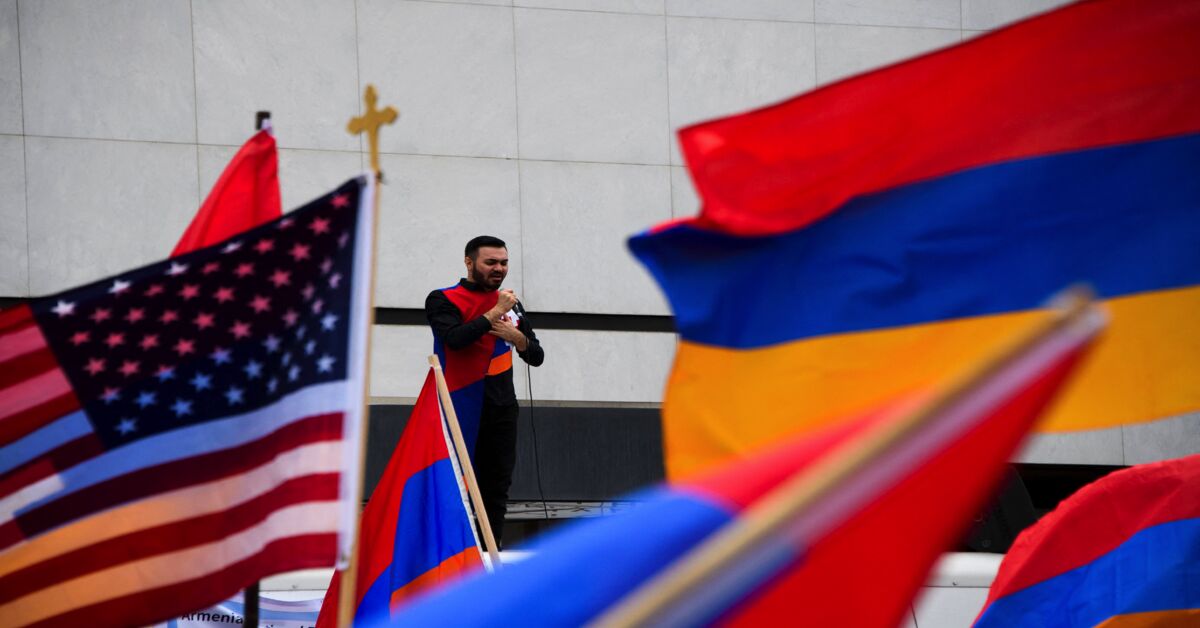
Alex Galitsky, the program director of the Armenian National Committee of America [ANCA] wrote on Twitter, “Despite what the U.S. would have you believe, Pashinyan’s surrender of Artsakh [an alternate Armenian name for Nagorno-Karabakh] to the whims of a genocidal dictatorship isn’t a ‘first step’ towards anything other than the end of Armenian sovereignty.” Meanwhile, the British wing of the ANCA issued a statement claiming that “any control exerted by the authoritarian and systematically racist Azerbaijani regime over the native Armenian population of Nagorno-Karabakh will inevitably result in ethnic cleansing” and “a second Armenian genocide”.
It’s impossible to foresee the future, but the likelihood that these predictions might come true are incredibly slim — not least because they would carry devastating consequences for the Republic of Azerbaijan. The international community will be watching intently to see whether the government in Baku fulfils its obligations in protecting the ethnic Armenian community in Karabakh. These people will, once a formal peace treaty has been signed, become citizens of Azerbaijan. Indeed, Pashinyan’s main prerequisite for recognising Baku’s sovereignty over Karabakh hinges upon extracting firm guarantees that Azerbaijan will protect the security of the Armenian minority in the province.
Far from threatening Armenian sovereignty, as Galitsky claims, peace would in fact reinforce it. Armenia remains regionally isolated. Over 80 per cent of its borders to the outside world are closed. Azerbaijan to the East shut theirs after the first war, and Turkey to the West followed suit in solidarity with its ally. Consequently, Armenia is almost entirely dependent on Russia for its energy and economy. Decisions in government must therefore be made on the basis that it does not irk the benefactor, as demonstrated for instance by Armenia voting alone against Russia’s expulsion from the Council of Europe following its invasion of Ukraine. A peace deal would pave the way for regional reintegration, away from sovereignty-compromising dependence on Moscow.
Armenia’s recognition of Karabakh as part of Azerbaijan would also uphold international law and the concept of territorial sovereignty as outlined by the United Nations Charter. The inconvenient truth for the ANCA and other Armenian lobby groups across the world is that not a single member of the UN recognises Karabakh’s independence — not even the Republic of Armenia itself.
The UN security council even passed four separate resolutions demanding that the Armenian military end the occupation and withdraw its forces. Yet these demands were consistently ignored until, one day in September 2020, Baku lost patience and launched the Second Nagorno-Karabakh War to regain control of its internationally-recognized borders.
The war, which occurred in the depths of the global Covid pandemic, made international headlines. Yet, the conflict is profoundly misunderstood internationally. Many Western news consumers saw Azerbaijan as the aggressors when, in terms of international law, Baku was militarily reasserting its control over its territory in much the same way that Ukraine is trying to do today in the Donbas. Much of this perception stems from the lobbying efforts of organisations like Galitsky’s ANCA, which have been central in shaping international opinion on the Karabakh issue.
“American policy makers are much more likely to listen to U.S. citizens and U.S. political activists that happen to have a certain ethnicity than to someone who has even a formal government position or an official position elsewhere,” says Saul Anuzis, a Republican politician from the state of Michigan. “And in some cases that may not be in the best interest of the United States.”
In the case of the South Caucasus, a formalised peace treaty would bring the Karabakh dispute to a close and begin the process of normalising relations between Armenia and Azerbaijan. This would serve U.S. interests in a number of ways. It would bring peace to a region through which Azerbaijani gas flows to Europe, plugging its shortfall post-Ukraine and helping keep the Western alliance unified against Russia. It would also remove the 2,000 Russian soldiers stationed in Armenian-held Karabakh — ostensibly to guard the peace, but in reality serving to project Moscow’s power beyond its borders. Yet the Armenian diaspora pushes the U.S. to take positions that are inimical to the role it is playing as a neutral mediator — such as recognising the self-declared independence of “Artsakh”.
“A big part of affecting foreign policy is to get political allies in the process, and I think the Armenians have been very good at doing that,” explains Anuzis. “What is unique with the Armenians is that I think they have settled in local communities [in the U.S.], which, as a group, gives them more power from an electoral standpoint. And they have been very active in the political world in regards to fundraising and supporting candidates. Then they share their view of the world and their view of what should happen in the region with these elected officials that may not actually be tied with what’s happening on the ground or what the United Nations has accepted as the official policy on who’s right and who’s wrong.”
The Democratic California congressman Adam Schiff illustrates how effective the Armenian diaspora has been in winning American politicians over to its cause. Schiff serves as Vice Chair of the Congressional Armenian Caucus and boasts of his long record of backing pro-Armenian causes. He has gone so far as to introduce resolutions recognizing Karabakh’s independence. Figures like Schiff send confusing signals to Baku and diminish trust when the Democratic administration is trying to mediate a peace deal based on territorial integrity.
The methods that groups like Galitsky’s ANCA use to achieve their aims are actually fairly simple; they mainly consist of well-planned and highly-organised grassroots activism.
“It’s a combination of grassroots engagement in your local communities, with your local congressman, US senators,” he explains. “Then it’s fundraising … They engage in raising money for these politicians and money still remains to be the mother’s milk of politics here in the U.S., which means it’s an important factor. So when you have a group that’s willing to put their votes and their money behind politicians that are willing to support them, that’s a very difficult thing to compete with from a policy perspective.”
Anuzis puts the Armenian diaspora’s success in lobbying U.S. politicians down to simple enthusiasm and engagement: they are simply more active than many other immigrant communities. By investing more effort into their activism, they achieve greater results.
Indeed, the former U.S. national security advisor Zbigniew Brzezinski has previously written that he would “rank the Israeli-American, the Cuban-American and the Armenian-American lobbies as the most effective in their assertiveness”. Yet this hasn’t always been in the interests of their ethnic kin back in the old country: the actions of the international Armenian diaspora arguably undermine the interests of the nation and the ethnic Armenian community in Karabakh.
Between the end of the First Nagorno-Karabakh War in 1994 and the beginning of the second one in 2020, the province of Karabakh effectively functioned as an illegal parastate. It was de facto independent from the jurisdiction of Baku, but completely dependent on the military and economic support of neighbouring Armenia. When none of the world recognises your independence, it’s very difficult to develop as a functional state by building bilateral relations, attracting foreign investment and developing your economy to the benefit of your population.
Furthermore, the regional isolation caused by the conflict has severely hampered Armenia’s economy. This bleak outlook lies behind Armenia’s high emigration numbers. That brain drain has in turn made economic development more difficult, locking Armenia into a vicious cycle of further decline. This underscores that the absence of conflict isn’t the only benefit of peace.
The late Georgi Vanyan was one Azerbaijani-born Armenian activist who recognised this fact. He spent much of his life campaigning for reconciliation between the two nations, for which he faced political persecution from past nationalist governments. Being on the ground, Vanyan had to live with the consequences of the enduring conflict in the south Caucasus. Diaspora communities in the U.S. and elsewhere are free to campaign against peace knowing that they won’t be personally affected.
“Engaging in foreign policy is always a tricky thing because once you emigrate you’re not on the ground, you don’t have the same implications or reactions or potential challenges as the people who have been left behind or are living there,” says Anuzis. “And this is where the divorce from reality comes in. There’s a disconnect in some ways, so people can afford to be more philosophical, afford to be more nostalgic. But that’s not necessarily reflective of where their home communities are at.”
There has been academic research into how the activism of diaspora communities around the world affect conflicts in their homelands, and it has been found that the impact isn’t always positive. Benedict Anderson has argued that diasporas can act as “long-distance nationalists”, prone to advocating irresponsible actions that they cannot be held accountable for due to their distance from the epicentre of the conflict. Anuzis agrees with this perspective.
“What I think is important for people to realize is that the first generation, second generation of the diaspora are very nationalistic, patriotic, even nostalgic, with their view of their homeland,” he says. “So they come over with a bigger-than-life view of what they left and, unfortunately, often-times they’re very unrealistic in regards to their political expectations in regard to today’s political realities and the political realities on the ground.”
Perhaps this activism can be seen as an attempt by the diaspora to reconnect with the homeland that they left behind and might feel diminishing ties to. Nonetheless, this worldview is more sentimental than realistic and willfully ignores political reality. For this reason, Pashinyan should move fast on striking a formal peace deal with Azerbaijan. Once Karabakh is officially resolved, Anuzis says that the influence of the Armenian diaspora will likely drain away.
“If a deal is cut on the ground and ratified, especially at the UN, I suspect that the U.S. accepts it and that becomes much less of a wedge issue that the Armenian diaspora can use against politicians or push anybody because then the deal’s done.”
Aleks Eror