On the morning of October 22, Armenian forces fired SCUD missile at various locations inside Azerbaijan, including the city of Gabala, the Azerbaijani Ministry of Foreign Affairs reported (Twitter.com/HikmetHajiyev, Azerbaycan24.com, October 22). Gabala is an important hub along the Oguz–Gabala–Baku water pipeline, which was built in 2011 in order to supply the region of Absheron and the Azerbaijani capital (see EDM, January 7, 2011).
The missile barrage was, at that time, the latest in a series of such strikes targeting cities and strategic infrastructure outside the Karabakh conflict zone (see EDM, October 19, 2020). Among others, long-range attacks have been previously aimed at Mingachevir, which hosts an important water reservoir and a hydroelectric power plant, itself the objective of an October 11 strike (TASS, October 11).
Water shortages and the risk of drought have long been major sources of concern in Azerbaijan, which is heavily dependent for its supplies of water for drinking and irrigation on the Kura-Araks river basin, shared with Georgia and Armenia. The main exception is, in fact, the Oguz–Gabala–Baku pipeline, which pumps water sourced entirely from local springs in norther Azerbaijan. The authorities have made multiple attempts over time to try to address the country’s water security issue, mainly by drilling wells. And over the summer, President Ilham Aliyev reiterated this topic, characterizing it as a top-agenda item for his administration (President.az, July 23).
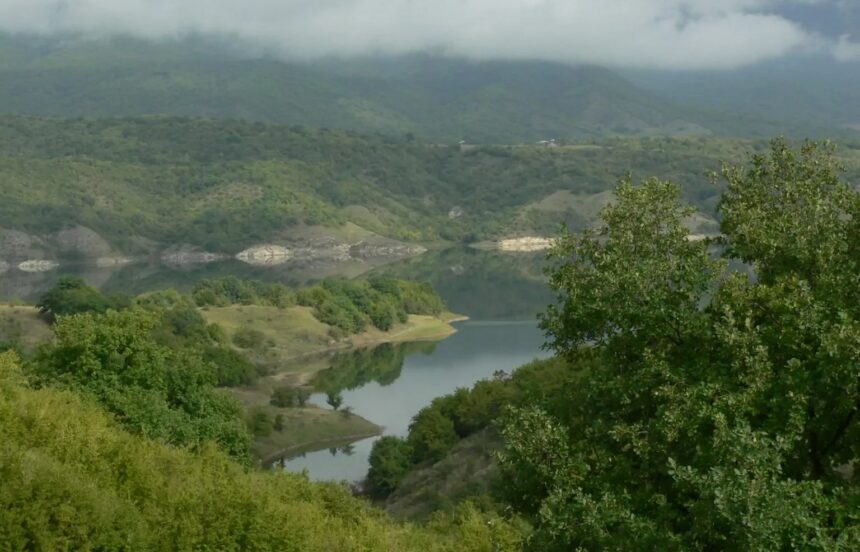
In fact, one of the first moves that followed Azerbaijan’s reclaiming of territory as a result of the ongoing weeks of fierce fighting in Karabakh was the announcement of a tender for the maintenance and amelioration of water facilities in the former occupied lands (Azertag.az, October 19). Among the retaken territories, many have strategic importance for water management, including Khudaferin and Sugovushan (formerly Madagiz). In particular, Sugovushan hosts a water reservoir that is central to the operation of the Sarsang water facility complex. The Sarsang reservoir on the Terter River was built by Soviet authorities to serve the area of lower Karabakh. It is located in the mountains, currently de facto controlled by the Yerevan-backed separatist forces. Sarsang is used both to generate electricity and provide drinking and irrigation water. The smaller Madagiz reservoir is located 20 kilometers downstream and feeds irrigation canals that were meant to serve the regions in the lowlands (Aghdam, Aghjabedi, Barda, Goranboy, Terter, Yevlakh). Prior to 1994, annual water use in the region was estimated at around 700 million cubic meters. But until the current advancement of Azerbaijani forces, the use of over 90 percent of the 22-km-long canal from Sarsang was denied to Azerbaijan’s nearby lowlands.
Armenian control of the area permitted Yerevan to use Sarsang as political leverage during the non-combat phases of the three-decades-long Karabakh conflict. In fact, by holding the upstream, main branch of the water complex, Karabakh’s de facto authorities could alternatively regulate periodic outflows of water or turn off the taps. A 2015 investigation by the Parliamentary Assembly of the Council of Europe (PACE) highlighted the multiple environmental and social consequences an uncooperative management of the reservoir. According to the report, water flow from Sarsang was reduced during the summer months, when it is most needed, resulting in insufficient supplies for agricultural purposes. Moreover, the lack of maintenance of the reservoir and denial of access to independent experts not only spurred concerns over the damaged structure but also impeded the use of Sarsang water as potable, due to concerns it could be contaminated. Consequently, Azerbaijan had to put in place a system of groundwater pumps and wells, which is more costly and environmental destructive, can lead to salinity intrusion of the soil, and result in lower agricultural productivity (Assembly.coe.in, December 12, 2015). Following the 2015 report, PACE approved a resolution in 2016 that framed the situation as a humanitarian problem and requested that the Armenian Armed Forces withdraw from the area to allow access to independent engineers and international supervisors to oversee an equitable operation of the facility. Moreover, the pan-European democratization and human rights body defined the present situation as “environmental aggression,” referencing the 1992 United Nations Water Convention (Assembly.coe.int, January 26 2016).
On October 22, President Aliyev sent a tweet accusing Armenia of perpetrating “ecological terror” and called for the development of agriculture in the retaken areas (Twitter.com/presidentaz, October 22).
Throughout the long-lasting so-called “frozen conflict,” the water dispute has been an important underlying factor. And by, now, trying to attack water facilities, in particular the vital Oguz–Gabala–Baku pipeline, Armenian forces aim at undermining civilian Azerbaijani morale and creating unrest within the country, where support for the military operation and the current favorable momentum in the war constitute a unifying factor and boost support for Aliyev (Aqreqator.az, July 13).
In the previous outbreak of serious clashes, this past July, experts and observers expressed concern for the security of Azerbaijani oil and natural gas facilities, which permit the country to export its energy resources to the global market. This time, Armenian forces are concentrating on water facilities to affect the Azerbaijani people exclusively, thus significantly reducing the likelihood that these strikes might push third parties with an interest in stable energy flows to interfere in the conflict on the side of Baku.
Given the Azerbaijani military’s overwhelming successes in recent weeks in progressively overpowering the Armenian forces, Yerevan’s strategy has been to wage an asymmetric war, aimed at sapping the enemy’s morale and endurance by depriving it of a basic good. This strategy represents a continuation of the past three decades of such activities, during the non-combat phases of the conflict, but heretofore largely limited to the occupied territories. Now, with the use of ballistic missiles, Armenia’s strategy is specifically to expand those activities beyond the occupied regions in order to even put the residents of the Azerbaijani capital at risk of manufactured drought.