Despite all of Ukraine’s accusations, even the United States, an ally of official Kyiv, has not confirmed Russia’s involvement in the destruction of the dam, which raises vague doubts about the statements made by the Ukrainian side.
The UN is also in no hurry to accuse Russia, because the evidence base is weak. The main argument in this whole story is “this whole situation would not have happened if not for the war and the invasion.”
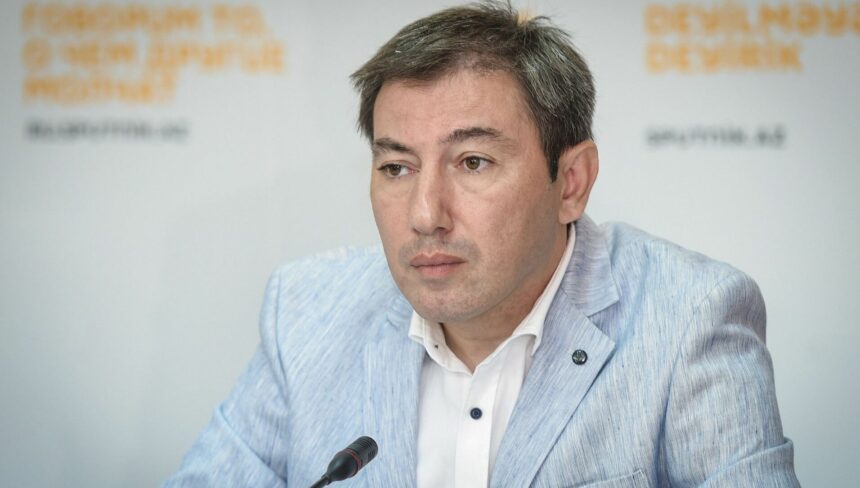
In a conversation with Minval.az about the situation around the Kakhovka hydroelectric plant, political scientist Ilgar Velizade said that “everyone now proceeds from the fact that if there had been no war, there would have been no explosion.”
According to him, everything that is happening in Ukraine is caused by the war.
“If we proceed from this point of view, Russia is responsible in any case. According to one version of the incident, it was Ukraine that blew up the hydroelectric power plant in order to weaken Russia’s defense positions, because Russian fortifications, minefields, dugouts, weapons depots and so on also went under water,” he said.
Another version is that the hydroelectric power plant was blown up in order to stop the Ukrainian counterattack, he believes.
“Because blowing up the dam complicates the attack for Ukraine as well. In short, we have a situation where anything is possible. This incident may not be the last trend on the background of the counterattack that has already begun or is yet expected. This process will be more extensive with associated destruction and consequences,” he said.
Velizade added that we cannot say for certain that the destruction of the Kakhovka hydroelectric power plant is the last disaster of this magnitude in the course of this military campaign.
“There are also nuclear power plants, the ammonia pipeline, and so on. The sides can run all sorts of critical scenarios. This shows that we cannot predict anything specific and we cannot be dramatic either,” he added.
The political scientist noted that part of the hostilities has shifted to the territory of Russia, the war is expanding: “Yes, Ukraine remains the main theater of hostilities, but we cannot rule out that the war may spill over to the territory of Russia as well.”
Speaking about international law, Velizade said that the international humanitarian law, in particular the 1949 Geneva Convention relative to the Protection of Civilian Persons in Time of War, which addresses these issues, condemns violation of the rules of warfare in very strong terms.
“The Kakhovka hydroelectric power plant is a civilian, non-military facility, and its destruction causes environmental and humanitarian damage. It was the same with the Mingachevir Reservoir, which was subjected to missile attacks by Armenia during the 44-day war. Fortunately, our air defense systems did their job then, but the disaster would have been no smaller, and maybe even greater than what we see at Kakhovka. Such actions are condemned by the convention. The demolition can also be qualified as an act of terrorism,” he said.
Nijat Hajiyev
Translated from Minval.az