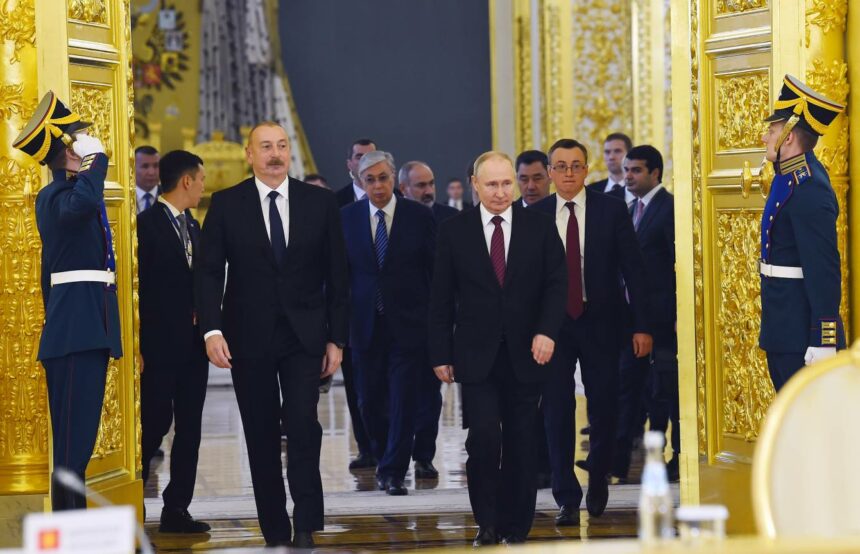
First, there was the brilliant, laconic and succinct speech of President Ilham Aliyev at the summit of the Eurasian Economic Union.
It was mostly an account of the work that has been done in our country in the economy and transport infrastructure. As expected, there were no hints of integration, not even most transparent and vague ones. Instead, we have a “concentrated expression” of economy and logistics. The head of state also mentioned export diversification, the fact that foreign currency reserves of Azerbaijan exceeded its foreign debt by 11 times, and an independent foreign policy, including the four-year presidency of Azerbaijan in the Non-Aligned Movement. It was exactly the level of independence of foreign policy that many post-Soviet capitals do not even dare to dream of. The head of state essentially delivered a master class in building real independence, even though the starting conditions for our country were far from great: war, occupation, a million refugees, far from favorable sentiments towards Azerbaijan both in the West, where they adopted Amendment 907, and in Moscow, where they sent the Pskov Airborne Division to seize Lachin for Armenia…
But this was not the most important part. Ilham Aliyev mentioned that “Azerbaijan’s turnover with the EEU countries increased by 31 percent last year and amounted to $4.7 billion,” and “in January-April this year, the growth of mutual trade increased by another 38 percent.”
As Ilham Aliyev recalled, “Azerbaijan is located at the geographical crossroads of the East-West and North-South transport routes. The transport and logistical infrastructure of our country enables transportation in any direction.” In his speech the President also mentioned the largest merchant fleet on the Caspian Sea—more than 50 ships!—which Azerbaijan has at its disposal today, and the new seaport of Alat, with a handling capacity of 15 million tons and projected handling capacity of 25 million tons after the reconstruction, and a modern shipyard, where ships of any type can be manufactured, and the Baku-Tbilisi-Kars railway with access to the Mediterranean Sea and the ports of Türkiye. Azerbaijan has come to the “logistics catastrophe” caused by the Ukrainian war with every possible alternative transit option at hand.
The President of Azerbaijan spoke about the projects Russian media until recently had portrayed as something reprehensible. For example, the construction of the Baku-Tbilisi-Kars railway was reported under the headline “Railroad Bypassing Russia.”
But today these projects are already being discussed at an EEU summit. And Azerbaijan offers the countries of the region exactly what they need most: a physical access to the European market. Because the old and, for some, familiar routes are blocked as a result of Russia’s war with Ukraine and the sanctions, and budgets need to be replenished, pensions need to be paid and projects need to be financed today. The fact that Azerbaijan has implemented these projects, but at the same time has maintained relations with Moscow at such a level that it can now talk about the Baku-Tbilisi-Kars railway at the EEU summit… this is another master class, this time in diplomacy. And the overall impression is reminiscent of that from the CIS summit of December 2020, hot on the heels of the 44-day war. Where Ilham Aliyev was already a triumphant winner. Today, Azerbaijan has other victories under its belt: in economy, logistics, and diplomacy. But this does not change the core of the matter.
And it seems that Nikol Pashinyan could not bear Azerbaijan’s new triumph on the “field” that the “varchapet” considered his own.
We can only speculate whether it was the mentioning of the Zangezur corridor, of the airports built, as the President of Azerbaijan stressed, on the lands liberated from Armenian occupation that set him off, but he acted completely in line with the not very politically correct joke: “How do you distinguish an Armenian in any company? — Wait five minutes and he will distinguish himself.”
Frankly speaking, Nikol Vovayevich with his “stumbling” speech and countless um’s, mmm’s, uh’s and so on should think twice before engaging in a polemic with Ilham Aliyev with his polished language, quick reactions and clear-cut stance. If he is impatient, Pashinyan should have at least something resembling arguments in his stock. And most importantly, he should remember that he is not at a meeting of Civil Contract MPs but at an EEU summit. As a result, the attempt of the “kebab varchapet” to target the phrase “Zangezur corridor” provoked a harsh and well-reasoned response from the President of Azerbaijan: “You have to try very hard or have a wild imagination to see territorial claims in my words. As for the word ‘corridor’ that I used, I used the same word for the North-South corridor, just as the same word is used for the East-West corridor. The word ‘corridor’ is in no way an encroachment on someone’s territory. This is an international term, and I think people who are familiar with international terminology would probably not attach the meaning that the Prime Minister of Armenia attaches to it today.”
That is, translated from the diplomatic language, he openly and publicly called Pashinyan an incompetent character with a wild imagination. After that, Pashinyan should have shut up and stopped embarrassing himself, but he kept “attacking” and was rebuked every time, and in the end it was Putin who stopped the discussion. And he stopped it virtually in favor of Azerbaijan.
Putin had his own reasons, besides his obvious exasperation with Pashinyan’s behavior. The Russian president had to save his Russian mediation project. A meeting with Aliyev and Pashinyan was scheduled after the EEU summit, and after the talks between Aliyev and Pashinyan in Brussels and Bayramov and Mirzoyan in Washington, the Kremlin could not afford for the talks in Moscow not to happen or to end with nothing at all.
But the meeting lasted only 20 minutes. And it ended without the adoption of a new trilateral statement, revealed by Kommersant at the level of leaks. It is easy to see why. Nikol Pashinyan demonstrated with his hysterics not only his intractability but a complete lack of understanding of the situation, so it made no sense to discuss anything at all. After all, if Pashinyan is ready to recognize Azerbaijan within its existing borders, what are we to make of his hysterics about the “blockade of the Lachin corridor”? Don’t they understand in Yerevan that a border checkpoint is not a “blockade”, but a normal operation of the state border? If Pashinyan himself signed, even if in some “secret place”, the Trilateral statement which envisages opening of Zangezur corridor, and now he does not even want to hear about it, what is the point of negotiating with him?
Of course, Armenia has been using the tactic of torpedoing negotiations for more than a quarter of a century. But it is one thing to play these games against the backdrop of the occupation of Azerbaijani lands and refuse to withdraw troops. It is quite another thing to torpedo negotiations after one’s military defeat. The conditions for Armenia will only keep getting tougher. Including on “platforms” which Pashinyan may consider his own. The Moscow round of negotiations leaves no doubt here.
Nurani
Translated from Minval.az