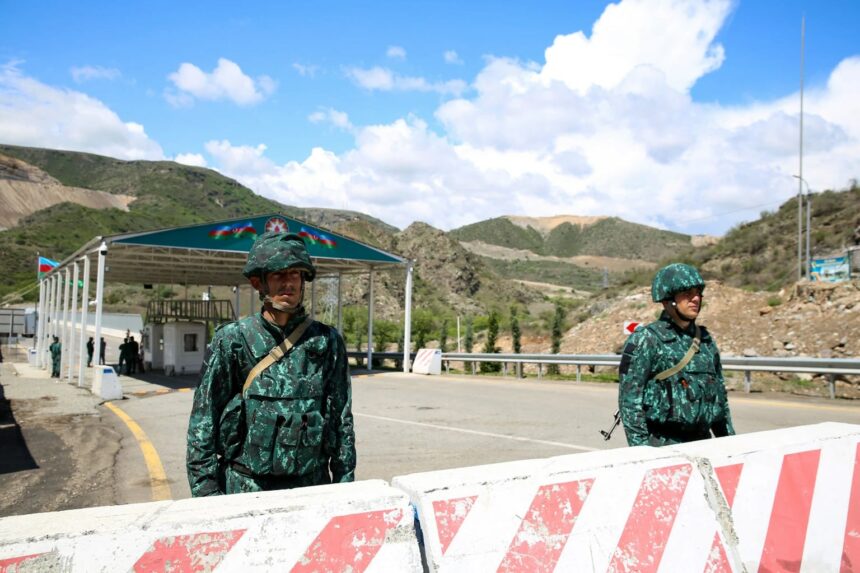
With so much of its attention consumed by the war in Ukraine, Russia has been unable to attend to much of its historic sphere of influence—particularly in the South Caucasus, where Moscow’s hold is fraying at the seams. On April 11, a new outbreak of violence in the 35-year-old, unresolved conflict between Armenia and Azerbaijan in Nagorno-Karabakh left four Armenian and three Azerbaijani soldiers dead as the two sides exchanged artillery and machine gun fire.
The province, recognized as the sovereign territory of Azerbaijan under international law, was occupied by the Armenian military for 26 years following the end of the First Nagorno-Karabakh War in 1994. Under the terms of the United Nations charter, Nagorno-Karabakh is Azerbaijani territory. But the province is also home to a large ethnic Armenian population that, as the Soviet Union was crumbling in 1988, unilaterally declared its independence from Azerbaijan.
After the first war in the province in the 1990s, which ended in Armenian victory and the expulsion of the Azeris, support from Yerevan allowed the separatists to enjoy a form of de-facto independence even though no country in the world, not even Armenia itself, officially recognized them. In 2020, Azerbaijan reclaimed most of the territory that Armenia had occupied for the preceding quarter-century. After 44 days of fighting, the Second Nagorno-Karabakh War ended in November 2020 with a cease-fire agreement brokered by the Russians.
The cease-fire was, on the surface, meant to make room for a formal peace agreement between the two neighbors. But many experts suspect that Russia, which is allied with Armenia, wanted to keep the conflict frozen—with a fragile cease-fire but no durable peace settlement. Any peace treaty was likely to favor Azerbaijan and weaken the Kremlin’s influence in the South Caucasus.
Last November, these suspicions were heightened following the appointment of the Armenia-born, Kremlin-linked oligarch Ruben Vardanyan as the unofficial “first minister” of the ethnic Armenian separatists in Nagorno-Karabakh. Under Vardanyan, peace talks stalled. However, his role as a spoiler came to a premature close in February, when he was unexpectedly sacked from his position by the separatists’ president, Arayik Harutyunyan.
The exact circumstances of his removal are unclear, but it was widely interpreted as a setback for Moscow. April’s clashes serve as further evidence that Russia is losing ability to maintain control over the region, where it has stationed 2,000 armed peacekeepers as per the terms of the cease-fire agreement. In an attempt to arrest this decline, the Kremlin appointed general Alexander Lentsov as the new head of its Nagorno-Karabakh peacekeeping force last week.
His appointment matters because Lentsov is one of Russia’s most experienced military figures, with his arrival a signal that Moscow is serious about reasserting its grip on the Caucasus. He has previously served as the head of the so-called joint center for cease-fire control, coordination, and stabilization in the Donbas following the first conflict in Ukraine in 2014, and has also been involved in Russia’s military operations in Chechnya, South Ossetia, and Syria in the past.
From a Western perspective, this is a worrying development: Each of those conflicts have ultimately ended on terms that favor Russia and run counter to Western values and interests. Lentsov’s arrival in Nagorno-Karabakh should therefore set off alarm bells in Washington, London, and Brussels.
It is widely accepted among regional experts that Russia seeks to act as a spoiler in the South Caucasus. A frozen conflict suits Moscow. It can lean on the unresolved grievances between Baku and Yerevan to heat up the standoff whenever such actions feel opportune. A peace agreement would also remove the need for Moscow’s peacekeepers in the province, which the Kremlin sees as essential to its projection of power over its near neighbors. Were the West to broker a settlement, it would also expand U.S. and European influence in a region that Moscow regards as its own backyard.
“Peace between Azerbaijan and Armenia will have many beneficial consequences for the United States and for Europe,” said Michael Doran, the director of the Center for Peace and Security in the Middle East at the Hudson Institute. “It will contribute to the energy security of Europe because it will open up the possibility of increasing oil and gas supplies from Azerbaijan and, potentially, from central Asia through Azerbaijan.” Doran adds that such an outcome would also “strengthen Georgia, which is in the interest of the United States. In general, peace carried out under the auspices of the United States is going to shift the balance against Russia in the South Caucasus.”
The timing of Lentsov’s appointment was telling: It came just four days before the foreign ministers of Armenia and Azerbaijan were due in Washington for meetings with U.S. Secretary of State Antony Blinken. The “tangible progress” made at the talks is due to be followed up this weekend with another meeting between Azerbaijani President Ilham Aliyev and Armenian Prime Minister Nikol Pashinyan in Brussels, rehabilitating the U.S.-EU twin track process that made some gains last year before stalling.
The Americans are evidently aware of the benefits of reconciliation. However, inconsistent signals from European mediators have in the past led to accusations of bias from Azerbaijan, leaving the door open for Russia to obstruct the process. But with Moscow consumed by its war in Ukraine, which is expected to intensify this spring when Kyiv launches a new counteroffensive, the West needs to seize the opportunity to overstretch Russia on two fronts, pushing through a peace deal before Lentsov’s maneuvers muddy negotiations.
Such a peace deal must proceed from Armenia’s recognition that Nagorno-Karabakh is the sovereign territory of Azerbaijan. Indeed, Pashinyan has recently signaled he is willing to do so —despite some flip-flopping owing to domestic nationalist pressure—removing the biggest obstacle to a peace deal since the end of the first conflict. In the past, Russia has tempted Armenia to Kremlin-led mediation by suggesting the status of the province should be left off the table for the foreseeable future. But this would be a red line for those in Baku.
However, following the 2020 conflict, the separatists in Nagorno-Karabakh are under pressure to negotiate their reintegration into the Azerbaijani state with Baku. The current peace process centers around how to do that and what assurances can be offered to the Armenians so that their rights as a minority group within Azerbaijan will be respected.
But having demonstrated its military superiority, almost all the leverage in negotiations rests with Azerbaijan—particularly as it knows that its position stands up under international law. In 1993, the U.N. Security Council passed four separate resolutions (numbers 822, 853, 874 and 884) demanding the withdrawal of Armenian troops from Azerbaijan. These resolutions were ignored by Yerevan. Baku, somewhat understandably, sees its victory in the Second Nagorno-Karabakh War as a justified corrective measure that ended an illegal violation of its sovereignty. So, in that sense, it will be difficult to convince Azerbaijan to concede much in the negotiations—especially anything seeming to grant a special status for Armenians within the territory.
International actors must convince Armenia it should not miss the forest (a sustainable peace deal) for the trees (special status for the region’s Armenians), which is something it has no realistic—and certainly no legal—prospects of achieving.
Aside from snuffing out the danger of renewed violence, peace would bring economic benefits to both the Republic of Armenia and the ethnic separatists. Since the First Nagorno-Karabakh War, Armenia has remained regionally isolated, with more than 80 percent of its borders closed—those with Azerbaijan to its east and those with Baku’s ally Turkey to its west. This has left Armenia’s only connections to the outside world being the border with Georgia to its north (its conduit to Russia) and a narrow border with Iran through mountainous territory to its south.
Mat Whatley, a former British Army officer and the former head of the Organization for Security and Co-operation in Europe in Donetsk, Ukraine.