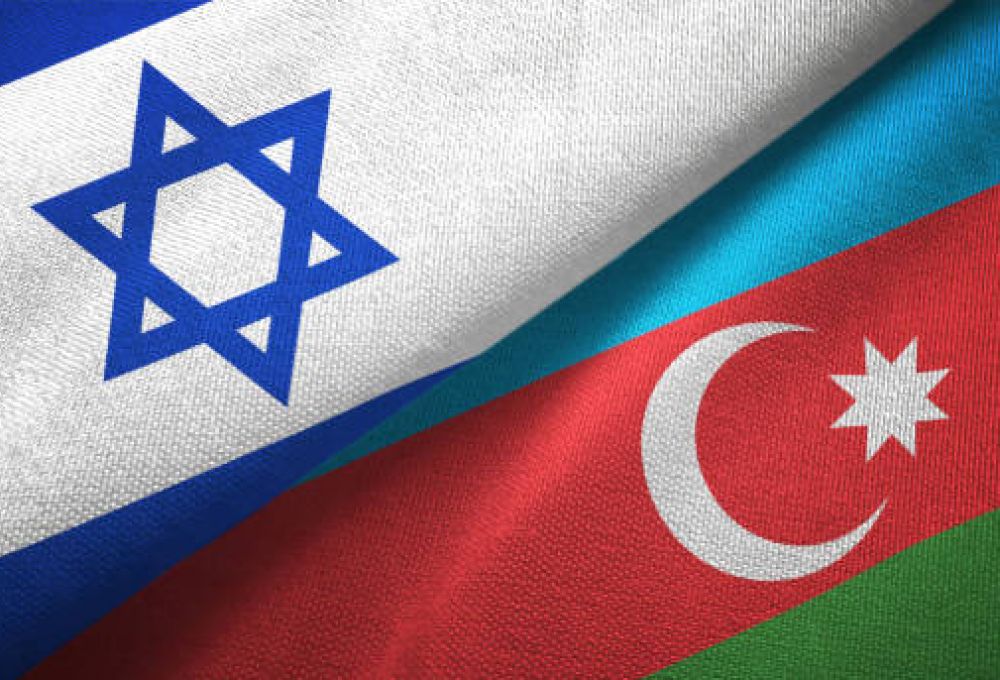
Israeli Foreign Minister Eli Cohen’s visit to Baku last week could be a harbinger of things to come beyond bilateral relations between Israel and Azerbaijan.
After his meeting with Azerbaijani President Ilham Aliyev on April 19, Cohen said the leaders discussed “the strategic regional challenges we share, chief among them regional security and the fight against terrorism.”
Although Cohen’s comments did not directly reference Iran—Azerbaijan’s Shia Muslim neighbor—recent developments in the region amplify the significance of not only Israeli-Azerbaijani ties but also the need for America to participate in a trilateral alliance that counters Iranian aggression.
To date, the Biden administration has clung to hopes of diplomacy with Iran. Yet when it comes to negotiating with the mullahs, the current approach in Washington begs the question: When will the administration actually listen to the persistent and disturbing signals that the Iranians are sending to the United States and its allies?
The most recent threat came on April 10, when Iran accused America of “war-mongering” after the deployment of the USS Florida submarine in the Middle East. Earlier this month, Iran stood on the brink of shooting down a U.S. Navy aircraft that was allegedly close to violating Iranian airspace over the Gulf of Oman. In March, the deadly Iranian drone strike against a U.S. base in Syria had already called the Biden administration’s Iran strategy into question.
These incidents came on the heels of the latest report from the International Atomic Energy Agency, in which the U.N. nuclear watchdog found that Iran had enriched uranium particles up to 83.7% purity—perilously close to weapons-grade—at its Fordow plant.
Now, U.S. policymakers would be well-served by widening their lens to take into account Iran’s continued threats to American allies in the Middle East and Eurasia.
On April 3, Azerbaijan arrested four people in connection with the attempted assassination of Member of Parliament Fazil Mustafa. Although Iran’s involvement in the shooting has not been confirmed, it is natural to at least begin connecting the geopolitical dots. Mustafa has been strongly critical of Iran, and the attack came on the heels of Azerbaijan becoming the first Shia-majority nation to open an embassy in Israel.
Further, in late January, an attack on the embassy of Azerbaijan in Tehran resulted in the death of the head of the embassy’s security service, as well as injuries to two guards. And in March, an Iranian military plane flew along the border with Azerbaijan, prompting Baku to file a note of protest with Tehran.
Aside from being Shia-majority countries, the similarities between Azerbaijan and Iran end there, particularly when it comes to their values, attitudes towards the West and relations with Israel. As such, the proximity of the attacks and threats against Azerbaijan in the early months of this year should not be viewed in a vacuum; their proximity with Baku’s opening of an embassy in Tel Aviv cannot be ignored.
The recent events hearken back to the 2021 “Conquerors of Khaybar” exercise near Iran’s border with Azerbaijan. At the time, the drill marked the first military exercise Iran had held in its northwest border area in almost 30 years, when Azerbaijan gained independence from the former Soviet Union.
In his criticism of the drill, Aliyev asked: “Why now and why near our borders?” The question was rhetorical, yet Iran still revealed its true motive. Foreign Ministry spokesman Saeed Khatibzadeh asserted that Tehran “will not tolerate the presence of the Zionist regime near our borders.” Khatibzadeh was referring to the deep and multifaceted ties between Israel and Azerbaijan since 1992.
The drill’s name referred to a legend surrounding the Jewish stronghold of Khaybar in the Arabian Desert, which fell into the Prophet Muhammad’s hands in 628 C.E. This military exercise, therefore, represents Iran’s affirmation of its ultimate goal to annihilate the Jewish people. Iran repeatedly makes clear that it will not tolerate Jews; the drill was part of the same narrative as Iranian threats to wipe Israel and Jews off the map through its nuclear program.
It is all too instinctual for Western observers to dismiss such developments—and even the frequent “Death to America!” and “Death to Israel!” chants emanating from the Iranian street—as typical pomp and circumstance. Yet these are far from garden-variety events. They are genuine threats that can translate into concrete actions against the United States and its allies, and they should be squarely on policymakers’ radar when they evaluate Washington’s broader approach to Tehran.
Just this week, for example, The Wall Street Journal reported that Iran has supplied Russian forces in Ukraine with more than 300,000 artillery shells over the last six months, along with a million rounds of other types of ammunition, thus moving the arena into Eastern Europe.
America, Israel and Azerbaijan—united by their shared values and the growing threats they face—possess the opportunity to act together as a trilateral alliance against Iranian aggression. Given its status as a world leader, it is incumbent upon the United States to spearhead this alliance before it is too late.
Paul Miller is a media and political consultant based in the Chicago area. His commentary has been published in “USA Today,” “New York Daily News,” “New York Post,” “Newsweek” and “The Hill.”