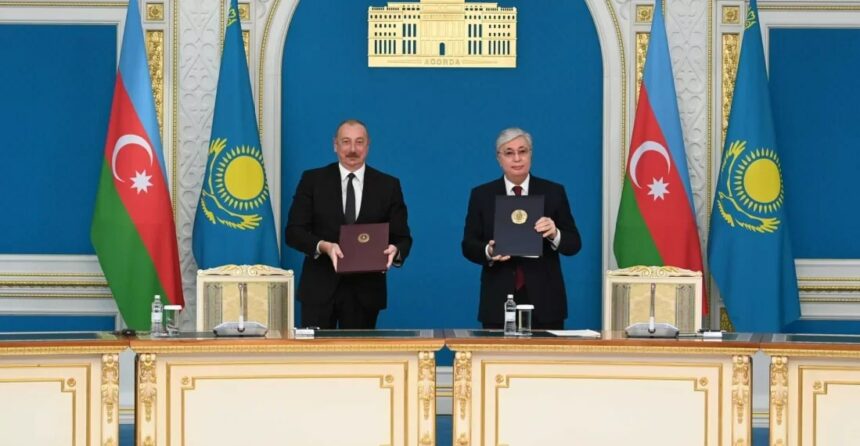
On April 10, Azerbaijani President Ilham Aliyev paid a one-day official visit to Kazakhstan (President.az, April 10). This visit took place about six months after the first official visit of Kazakhstani President Kassym-Jomart Tokayev as the head of state to Azerbaijan in August 2022 (The Astana Times, August 24, 2022). Projects related to the Trans-Caspian International Transport Route (TITR), or Middle Corridor, and energy transit from Kazakhstan to Europe via Azerbaijan topped the agenda, though a number of documents were signed in other areas as well, including in the fields of telecommunications and science (President.az, April 10; Dailysabah.com, April 10).
During a joint press conference with his Azerbaijani counterpart, Tokayev emphasized the significance of fully leveraging the potential of the Middle Corridor. According to the Kazakhstani president, for this purpose, Astana underlines the need for the enhancement of logistical services, the creation of unified transport operators, the modernization of technical and tariff conditions, the elimination of administrative barriers and the emergence of a closed logistical cycle (President.az, April 10). The two countries are motivated by the growing demand for further development of this passageway, which emerged in recent months as European companies have pivoted away from the Russian-dominated transit routes due to Western sanctions imposed on Russia for its invasion of Ukraine.
According to ADY Express, a subsidiary of Azerbaijan Railways, container cargo transported through the TITR increased by 45 percent in the first ten months of 2022, compared to the same period in 2021 (Adycontainer.com, November 18, 2022). The increase in cargo transport between Azerbaijan and Kazakhstan was even higher. ADY Express reports that the total weight of rail freight transported between Azerbaijan and Kazakhstan increased by eightfold, reaching 950,000 tons between January and October 2022. Notably, 96 percent of this freight was categorized as transit traffic (Trend, November 30, 2022). Additionally, cargo transport between Azerbaijan and Georgia has increased dramatically (75 percent) in the past year (Trend, October 24, 2022).
Yet, despite these figures, the Middle Corridor still lags behind the capacity of the Russian-controlled routes to the north, though the former is 2,000 kilometers shorter. While the Middle Corridor is estimated to have carried up to 80,000 twenty-foot equivalent units (TEUs) in 2022, the northern routes carried 1.5 million TEUs in 2021, which accounted for approximately 4 percent of all cargo transported between China and Europe (the rest was carried via maritime routes) (Ebrd.com, November 7, 2022).
Azerbaijan and Kazakhstan, in coordination with other participating countries, including the other Central Asian states and Turkey, have taken a wide range of measures to optimize the Middle Corridor (see EDM, August 4, 2022). These measures aim not only to attract a larger segment of shipments transiting between Asia and Europe but also, perhaps more importantly, to improve connectivity among the countries along this route, which is of great geopolitical importance in offsetting Chinese and Russian influence in the region. The efforts in this direction include projects to upgrade ports along the Caspian Sea and to improve highways and railways that would be utilized along this route. The process was coordinated within the “Roadmap for 2022–2027 for the Development and Operation of the Middle Corridor,” which was adopted at the second trilateral meeting of foreign and transportation ministers from Azerbaijan, Kazakhstan and Turkey in Aktau, Kazakhstan, on November 25, 2022 (Mincom.gov.az, November 25, 2022).
To this end, Azerbaijan has also launched the technical work to expand the capacity of the Baku-Tbilisi-Kars (BTK) railway. According to Aliyev, $120 million will be invested for this purpose and the work is envisioned to be completed sometime next year (Trend, March 14). This expansion will increase the capacity of the BTK line from 1 million tons per year to 5 million—which is a significant and ambitious development considering that only around 1.5 million tons of cargo in total has so far been transported via BTK since its launch in 2017 (Caspiannews.com, January 16).
Meanwhile, Azerbaijan also plans to increase the capacity of the Baku International Sea Trade Port, the largest maritime port on the Caspian Sea, from 15 million to 25 million tons. Similarly, Kazakhstan has embarked on a campaign to upgrade its Caspian ports. In July 2022, Tokayev instructed the government to turn Kazakhstani seaports into a major hub in the Caspian Sea region (Interfax, July 7, 2022). The Kazakhstani president declared, “Kazakhstan has never been a sea power and has never used the opportunity of marine transportation to the fullest extent. … We will need to strengthen the fleet and establish a container hub in the Port of Aktau.” Additionally, as a result of optimization efforts, Astana has been able to reduce the time for the transit of goods through Kazakhstani territory via the Middle Corridor from 12 days to six (Azernews, March 3).
In the course of the Azerbaijani president’s visit to Kazakhstan on April 10, Aliyev and Tokayev reached additional agreements regarding the shipment of Kazakhstani oil via Azerbaijani pipelines, which adds a new dimension to the Middle Corridor. The need for this appeared due to the complications Kazakhstan faced with transiting its oil via the trans-Russia Caspian Pipeline Consortium, which carries two-thirds of Kazakhstani oil to global markets, in 2022 (Kazinform, November 10, 2022). In March 2023, the State Oil Company of the Republic of Azerbaijan (SOCAR) announced the initiation of transporting Kazakhstani oil via the Baku-Tbilisi-Ceyhan pipeline.
The first and second shipments via this route arrived on March 23 and 27, respectively, and were transported under a master agreement between SOCAR and Kazakhstani national energy company KazMunayGas (Caspianpolicy.org, March 23). This agreement envisions the annual transit of 1.5 million tons of oil, with 12 to 14 tanker voyages scheduled between Baku and Aktau until the end of 2023. Aliyev and Tokayev also agreed to increase the amount of oil transported to Europe via Azerbaijani territories (President.az, April 10). Although trans-Azerbaijan transport of Kazakhstani oil is not likely to reach the amount transited via the CPC in the foreseeable future, Tokayev is hopeful that it will eventually increase to 20 million tons per year (Vlast.kz, November 7, 2022).
Thus, the Middle Corridor, connecting the two shores of the Caspian Sea, has a special role in the Kazakhstani-Azerbaijani bilateral relationship. The significance both states place on the development of this route, improvement of logistical services, upgrade of infrastructure and other related factors indicate that the positive trend in increased transportation along this route over the past year has the potential to persist, and even increase, in the future. And this further underlines the shifting geopolitical sands in the region as the states of the South Caucasus and Central Asia seek to become more independent in their transit and trade needs.
Vasif Huseynov