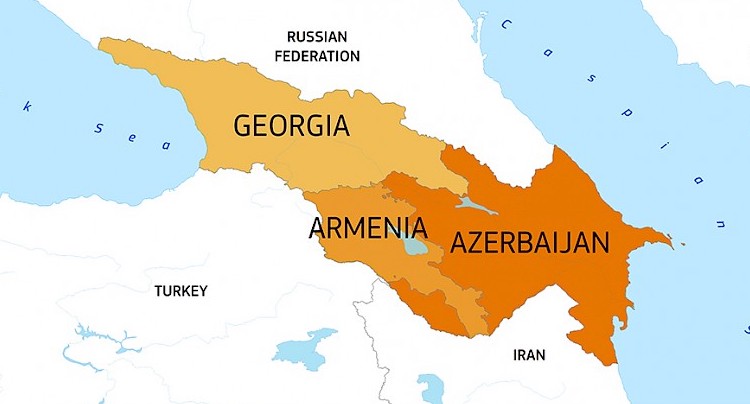
While the world’s attention is primarily concentrated on Russia’s ongoing invasion of Ukraine, other worrying developments are unfolding along Russia’s periphery. In the South Caucasus, Iran is concentrating military forces along the border with Azerbaijan and preparing to hold military exercises near the country’s exclave of Nakhchivan. There are reports of visits by high-ranking officials, including the commander of the Iranian Revolutionary Guard Corps Ground Forces, General Sardar Mohammad Pakpur, and the commander of the Iranian Border Troops, Ahmad Ali Gudarzi, to the border zone. In addition, on March 11, Azerbaijan was also alarmed by an Iranian military aircraft making a non-stop flight along the Azerbaijan-Iran state border from the direction of Zangilan District to Bilasuvar District and backward.
These provocative developments represent a marked departure from the regional status quo—if these Iranian exercises were to go ahead, for example, it would be the third time such have been conducted in the past two years, which never occurred in this region prior to the Second Karabakh War of 2020.
Yet these developments are not occurring in a vacuum. The reality is that Iran’s growing assertiveness in relations with Azerbaijan, along with its other attempts to obtain a stronger influence over the South Caucasus, is due to the gradual decline in Russian hegemony over this region. Washington, which is already concerned about recent developments with regard to Iran, should pay close attention.
A Potential Azerbaijani-Iranian Conflict?
Iran’s military moves are not the only signs of recently increased aggression. The developments along the Azerbaijani-Iranian border come on the heels of a violent January attack in Tehran against the Azerbaijani embassy that resulted in the death of a security officer and the injury of two others. Azerbaijan officially characterized this as a terrorist attack and evacuated its diplomats from the Iranian capital.
On the other side of the border, Azerbaijan’s security agencies have been working overtime, conducting multiple operations over the past months in response to significantly greater Iranian espionage and covert activities. Dozens of people, who reportedly carried out assignments for Iranian special services, have been detained. In this context, the assassination attempt against an Azerbaijani parliamentarian, Fazil Mustafa, who is rather critical of Iran on March 28, was interpreted by many in Azerbaijan as being linked with Iran. The fact that both attacks took place after Azerbaijan decided to open an embassy in Israel, and the latter attack happened on the same day when Azerbaijan’s foreign minister visited Tel Aviv to inaugurate the Azerbaijani embassy, appeared suspicious. Most damningly, as of today, March 31, Azerbaijan’s foreign ministry confirmed that the “initial traces of the investigation of the terrorist act against Fazil Mustafa point to Iran.”
Understandably, these various developments have heightened the tensions between the two countries significantly, and raised concerns that a violent confrontation may occur.
Why is Iran doing this? The answer is simple: regional geopolitics are changing, and not necessarily in Tehran’s favor.
For Iran, the “encroachment” of external players into the South Caucasus is inadmissible. The Russia-Ukraine war complicated the region’s geopolitics for Iran, as the European Union (EU) and the United States have increased their influence by strengthening their mediating role in the Armenia-Azerbaijan peace process. This has effectively sidelined Russia, and was followed by the deployment of a monitoring mission to the Armenia-Azerbaijan border in the aftermath of the Prague summit on October 6. Against this background, increasingly closer relations between Israel and Azerbaijan, and the emerging possible Israel-Turkiye-Azerbaijan trilateral cooperation platform, further worries Iranian authorities. Tehran also views Azerbaijan’s and Turkiye’s plans to launch a transportation corridor via the southern Armenian territory as a threat, as this would allegedly cut off Iran’s borders with Armenia and deal a severe blow to Iran’s regional standing.
Russia’s Declining Regional Influence
This geopolitical turbulence is in large part because Russia’s regional hegemony, which it has enjoyed over the region since the early nineteenth century, is fading away and the security order it built in the region—i.e., its hegemonic stability—is eroding.
Until recently, Iran had to recognize the South Caucasus as part of Russia’s sphere of influence. This has been the region’s state of affairs ever since the Treaty of Turkmenchay, which ended the Russo-Persian War of 1828 and established Russian control over the South Caucasus. Russian dominance in the region continued to be acceptable for Iran following the collapse of the Soviet Union, as Moscow managed to prevent the “incursion” of rival powers like the United States and Turkiye.
Yet in the wake of Russia’s 2022 invasion of Ukraine, Moscow’s dominance in the South Caucasus is weakening, thereby opening up opportunities for other powers. For example, Azerbaijan is now able to more vehemently criticize Russia’s support for what it considers to be (and the international community broadly agrees is) a separatist regime in its Karabakh region, tries to end the mission of the Russian peacekeeping contingent, deepens its strategic alliance with Turkiye, increases its contributions to European energy security, and relies more on the EU’s mediation in the peace process with Armenia. Armenia, meanwhile, increasingly defies Moscow’s authority by distancing itself from Russia’s military bloc, is building closer relations with the European countries and the United States, and has invited an EU mission to monitor the security situation along Armenia’s border with Azerbaijan.
America Must Pay Attention
These are worrying developments for Iran. Some of its interests overlap with Armenian, in that both countries seek to counterbalance Azerbaijan and its alliance with Turkiye and Israel. The recent growing military and economic ties between Yeveran and Tehran have provided an opportunity for Iran to more assertively involve itself in the region and form a de-facto alliance against the two Turkic states. Part of this includes increasing bilateral trade, with a turnover from $700 million to $3 billion. Iran is also discussing supplying combat drones to Armenia.
Iran’s regional ambitions, prompted by Russia’s regional decline, are thus increasingly regarded as a security threat, especially by and for Azerbaijan. Notably, the United States is also concerned by these developments.
In Washington, where prominent voices are once again voicing concern over Iran’s nuclear program and Iranian actions in Syria, Tehran’s recent moves into the South Caucasus are cause for conversation. In a recent Senate committee hearing, Secretary of State Antony Blinken stressed the importance of supporting Azerbaijan with military education and training funds, noting that “Azerbaijan has a long border with Iran, which needs defending.”
Yet more needs to be done if Washington and its allies wish to ensure that this vital yet underrecognized region of the world remains stable. This is especially pertinent given the war in Ukraine: Azerbaijan is not only now an important alternative supplier of energy for the West, but also a critical link in East-West international trade. The best thing that the Biden administration can, and should continue doing, is playing a mediating role in the Armenia-Azerbaijan peace process. Without such an agreement between those two countries, there can only be turbulent times ahead of the South Caucasus.
Vasif Huseynov is Head of Department at the Center of Analysis of International Relations (AIR Center).