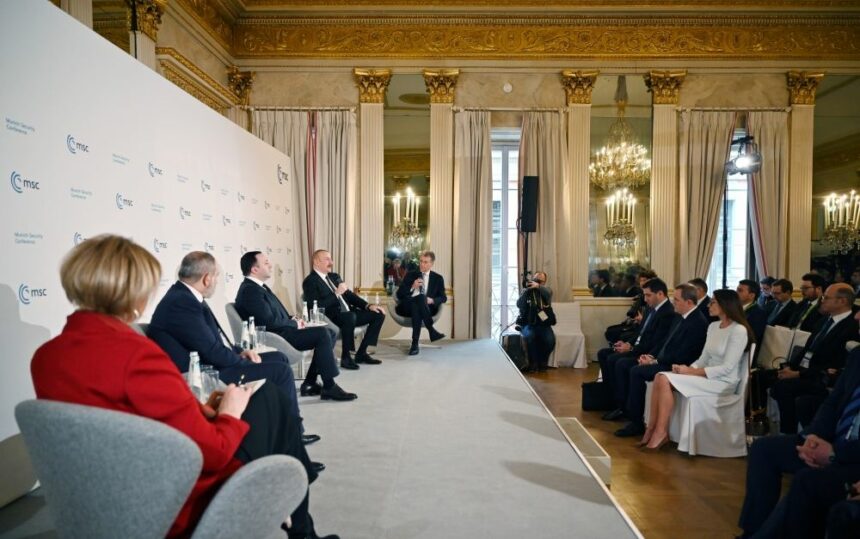
This meeting had been much-anticipated as it was the first one between Azerbaijani and Armenian leaders since their scheduled summit in Brussels in December was cancelled. It was also surrounded by the international noise over the situation along the Lachin Corridor, that has been largely called a “blockade” despite uncertainty about the true state of affairs on the ground.
President Aliyev made several statements that should be considered conciliatory and compromise-oriented. He clearly dispelled the accusations of nurturing territorial claims against the southern Armenian province of Syunik (Zangezur in Azerbaijani), and clarified Baku’s position on critical border issues. He called for a reciprocal installation of border control units at the crossings from Armenia to Karabakh through Lachin, and along the Meghri road from mainland Azerbaijan to Nakhchivan through Armenia. He also emphasised “certain shifts in the Armenian position”, adding they were not yet enough for achieving a comprehensive agreement.
Yerevan has an unclear position on some fundamental issues
The Azerbaijani President expressed readiness for direct communication with Karabakh Armenians, but excluding the oligarch Ruben Vardanyan, who, Aliyev alleged, had been “smuggled” in and out of Karabakh. Actually he used Vardanyan’s arrival in Karabakh to argue the absence of a real blockade of the region since otherwise these trips would have been impossible. Given that Vardanyan is widely considered Moscow’s agent of influence, Aliyev’s statements were aimed at sending a clear signal to Russia about Baku’s unwillingness to further tolerate this state of affairs, and point to Moscow as the major cause of complications in the peace process.
Despite a significant softening of Azerbaijani rhetoric, Yerevan’s response was at best lacklustre. Instead of discussing the proposals, Pashinyan mostly exercised in parlance about democracy and human rights in Armenia without addressing the major problems that are currently dragging the negotiations down. The bone of contention between the countries has recently been Yerevan’s unclear position on some fundamental issues, such as the unambiguous recognition of Azerbaijan’s territorial integrity and the opening of communications.
Moreover, since Baku has repeatedly committed to fully respecting the rights of the Armenian minority and readiness to communicate to them directly, it perceives Pashinyan’s use of this narrative as an attempt to find a pretext to disrupt negotiations rather than a genuine concern.
The Prime Minister’s reaction to Aliyev’s point about the destruction of Azerbaijani heritage in the previously occupied territories was strange as well, as he began invoking the destruction of mosques in Soviet Azerbaijan. As Pashinyan said Azerbaijan must ensure that the Lachin Corridor remains open at all times, he in fact touched upon the problem of interpretation of the Point 6 of the 9 November agreement. While the treaty puts an obligation onto Azerbaijan to “guarantee safe movement” of the passage, the Armenian side reads it as an unimpeded access without any checks, which doesn’t clearly follow from the wording, and which Baku denies.
The leaders also spoke about the influence that Russian aggression against Ukraine had on the whole South Caucasus region. While Pashinyan evaded a broad response, Aliyev was very outspoken, emphasising the tragedy and devastation brought by the war and referring to it as a reminder for the international community about the urgent need to ensure fair and robust peace in the region, clearly implying that the current approaches are not encouraging Yerevan to make necessary compromises.
Following Munich: towards a more proactive approach
Two weeks after the panel in Munich, it became clear that it represented a certain shift in the direction of the conflict resolution process. It is important to mention that on the same day, Aliyev and Pashinyan held closed negotiations moderated by the U.S. Secretary of State Blinken, which attests to the level of international attention. On 23 February 2022 Ruben Vardanyan, who caused so much bitterness in Baku, was finally dismissed, although he is still said to remain in Karabakh.
Soon after, Azerbaijan appointed an MP, Ramin Mammadov, as a representative for the contacts with the Armenian population of Karabakh, and one meeting has already taken place in Khojaly, while an invitation was extended to the Armenian delegation for the further meetings in Azerbaijan. This development came on the back of the President’s statement in Munich. Though Baku has never denied its willingness to communicate directly with the Armenian community, since the end of the 44-day war mutual rhetoric was too sour.
Meanwhile, Russian peacekeepers have also consistently tried to hobble efforts to that end, for example by organising provocative classes at Karabakh schools that taught kids to view Russia as “the permanent protector of Armenians”, or barring an entry for a Karabakh Armenian woman to Shusha where she hoped to find employment. A number of Azerbaijani experts praised the latest initiative as a move intended to build confidence without Russian mediation that hasn’t seen any success thus far.
It makes sense for Azerbaijan to demonstrate willingness for compromises and agreements
Certain changes in Baku’s approach can be explained by Washington’s growing activity on Karabakh. Earlier, President Aliyev had mentioned high expectations from new U.S. involvement in the peace process, so it makes sense for Azerbaijan to demonstrate willingness for compromises and agreements. Beyond its red line that Karabakh is not granted any official territorial status, Baku can be pretty flexible on this issue. The intensification of tensions around the region, particularly an increasing confrontation with Tehran and the risk of a regional conflict involving Iran in general, should also push Baku to be more proactive and aim at reaching an agreement with Armenia more quickly.
However, a lot of things depend on Yerevan, and its real intentions now seem to be less than clear. Although Pashinyan constantly claims commitment to peace and territorial integrity of Azerbaijan, some of his recent statements, particularly those made at the Thursday (2 March) meeting with German Chancellor Scholz about the need to bring international observers to the Lachin Corridor, are quite provocative and send a strongly negative signal to Baku. Efficient pursuit of the peace track will require a more consistent foreign policy from Yerevan that is less dependent on daily domestic developments.
Murad Muradov is the co-founder and deputy director of the Topchubashov Center in Baku, Azerbaijan. He graduated with a Bachelor of Arts degree in International Relations from the Academy of Public Administration of the Republic of Azerbaijan (2011), a Master of Arts in Diplomacy and International Affairs from the Azerbaijan Diplomatic Academy (2013) and a Master of Science in Comparative Politics from the London School of Economics (2015). He participated in a number of training programs, summer schools and fellowships both in Azerbaijan and abroad, including the John Smith Trust Fellowship for Wider Europe (2017). His areas of expertise cover British politics, security and geopolitics of post-Soviet countries and international political economy.