In Munich Ilham Aliyev essentially voiced an ultimatum: Azerbaijan is not going to discuss anything with the Moscow-“exported” oligarch. One may believe the “leaks” of Armenian mass media saying that Ararat Mirzoyan agreed to get rid of Vardanyan at a meeting with Mevlut Çavuşoğlu or not, and even consider them a “dirty laundry war” against Pashinyan. But a little more than two years ago, both Armenia and the Khankendi separatists had an opportunity to see for themselves that Azerbaijan’s ultimatums are not to be ignored.
Hectic activity in Khankendi ensues. Vardanyan himself marks his “hundred days” as “state minister” and raves enthusiastically about “Artsakh”. Lusine Hovhannisyan, Arayik Harutyunyan’s spokesperson, screeches in a conversation with Khankendi reporters: “Ruben Vardanyan’s presence and work in the ‘Republic of Artsakh’ is an internal matter of ‘Artsakh’ and can in no way be a subject of discussion by the Azerbaijani government.”
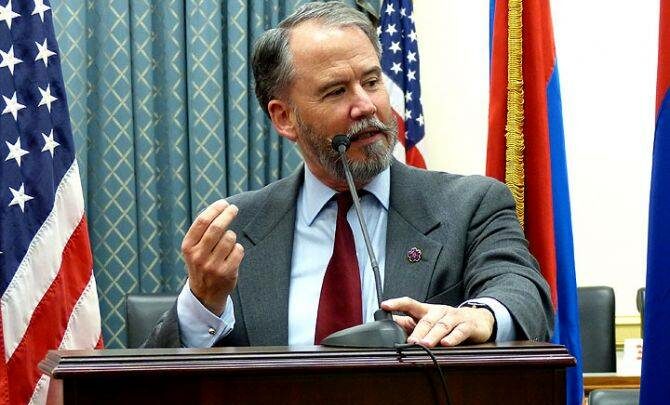
And now John M. Evans, the former United States ambassador to Armenia, has joined the publicity campaign for the criminal oligarch. He tweeted: “Evidently Ruben Vardanyan is seen in Baku as a strong and effective leader who has connections in Moscow and the West.” One wonders what Mr. Evans believes to be evidence of “effective leadership”. Is it pasta coupons? And why is he so sure that Vardanyan is seen in Baku as a “strong leader”? We feel compelled to disappoint the ex-diplomat: Vardanyan is and always has been seen in Baku as a petty and not very clever provocateur. Who knows how to puff up his cheeks, but no more than that.
However, a more interesting question is: why did the ex-US ambassador get involved in the PR of the Kremlin “envoy” Vardanyan? Did he honestly fail to grasp the situation? Is he not aware of who Vardanyan works for? Or was his statement an excuse to dust off Senator Joseph McCarthy’s sensational speech about over two hundred “hidden Communists” in the US State Department, which had ushered in the era of McCarthyism?
Alas, the explanation is cruder and simpler. Here is a reminder of who John M. Evans is. In the noughties, he represented the United States in Armenia. And in 2005, at a meeting at the University of California, Berkeley, he voiced his personal opinion: the events of 1915 should be recognized as the “genocide of Armenians”. He was immediately dismissed from the diplomatic service: an ambassador has no right to personal opinion. Thus, for the Armenian lobby, Evans became a “suffering hero”. With which he works very actively, not least because Mr. Evans is of little interest to anyone outside of it.
And this very “Armenian lobby”, in case anyone forgot, has been long and very actively used by Moscow. First to destabilize Türkiye’s relations with its Western allies and to undermine the unity of NATO. Today, it is being deployed against a much too independent Azerbaijan. It was thanks to the Kremlin’s financial injections and not through the unique “patriotism”, “unity” and “organization” of the American Armenians that it was able to grow to its current size in the first place. Given all this, it is not surprising that the former US ambassador is catering to the interests of the Kremlin. As practice shows, it does not necessarily require painting the letter Z on one’s car and pinning the ribbon of St. George to one’s lapel. These can be easily substituted by Armenian symbols. The question is whether Evans’s homeland understands that.
Nurani
Translated from Minval.az