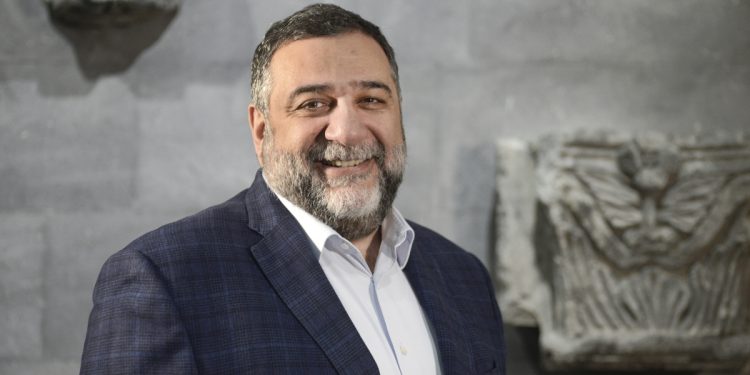
With his provocative activity Ruben Vardanyan is assiduously undermining the post-war settlement process in the region.
Baku has repeatedly pointed out, including at the highest level, that Vardanyan’s arrival to Karabakh was a project of the Kremlin, and that he himself follows instructions from you know where. Western politicians take pains to ignore these statements.
But Vardanyan is considered a “Kremlin project” not only in Azerbaijan. Ruben Karlenovich is included in Ukraine’s sanctions lists, for his support of the Russian invasion, from October 19, 2022.
This decision was made by the National Security and Defense Council of Ukraine and approved by a decree of President Vladimir Zelenskyy. The War & Sanctions portal, set up with the support of the Ukrainian Foreign Ministry and the National Corruption Prevention Agency, specifies the exact reason for imposing sanctions on Ruben Karlenovich: “Top management of the backbone Russian company, which is involved in material (transport, logistics and other) support of actions that undermine or threaten the territorial integrity, sovereignty and independence of Ukraine”. This refers to Volga-Dnepr Group, one of the largest cargo airline holding companies in the Russian Federation. And it is easy to guess that this is about the use of the aircraft fleet of the supposedly civil Volga-Dnepr for the delivery of military cargoes. This leaves the Azerbaijani audience with a persistent feeling of déjà vu: both before and during the 44-day Patriotic War, weapons were delivered to Armenia under the guise of either building materials or “humanitarian aid”. Simply put, Ruben Karlenovich did not get on the Ukrainian sanctions lists for simply wearing the St. George ribbon in the shape of the letter Z on his jacket—we are talking about logistical support.
But now this person, who is under Ukraine’s individual sanctions, puts on a farcical show of renouncing his Russian citizenship, moving to Karabakh… and yet he has no intention of giving up his shares in Russian companies, resigning from the boards of directors, etc. The Russian peacekeepers help him in every way they can. And this is a sure sign that the area of temporary deployment of the Russian peacekeeping contingent is turning into a sort of “gray zone”, or, more precisely, a “black hole”, used by this kind of businessmen to circumvent sanctions, at least at the level where politics and psychology are intertwined. The motives of the peacekeepers’ actions are quite understandable. But why do these juicy facts of Vardanyan’s biography escape the attention of political players in the West?
What is this, clinical naiveté? The proverbial “pink pony syndrome”? There is that, too. But the most important thing is that the “Armenian lobby” in its present form has been industriously nurtured by the Kremlin, as the latter hoped to use it against Turkey and actively pumped money into Armenian lobbying groups. No wonder they are dominated by the likes of Valérie Pécresse.
The question is: How much longer will the truly serious political players in the West “look the other way”?