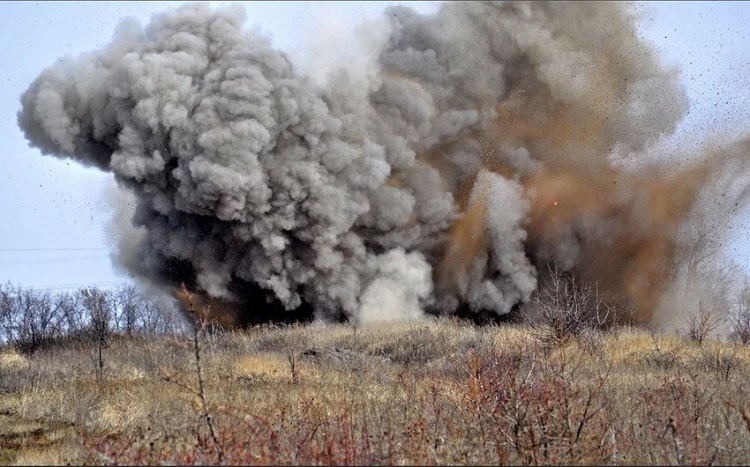
Baku recalls that in the two years since the end of the Patriotic War, 276 people have been blown up on mines, of whom 123 were civilians and 153 military personnel. 231 people received injuries of varying degrees of severity. Experts point out that mine blast injuries most often entail amputation of extremities. 45 people, 10 of them military personnel and 35 civilians, were killed. Among them were our colleagues, journalists and a film crew from AzTV, whose bus blew up on a mine in the village of Susuzlug. It was also there, in Kalbajar, that Azerbaijani military personnel found a mine, literally at the last minute, on the route of the bus in which displaced persons from Kalbajar were travelling to their home village, or rather what was left of it.
In theory, there are always mines and unexploded ordnance left after hostilities. But Azerbaijan has faced real “mine terror” from Armenia. As the Ministry of Defense of Azerbaijan now stresses, the mine that exploded in the village of Chiragli had been planted by Armenian occupiers in December 2020.
The date is paramount here. First, the hostilities had already ended by that time, and the mining of the village of Chiragli did not and could not have any military purpose. Second, there were no defense lines running through the village of Chiragli. Lastly, Armenia begged and got from Azerbaijan extra 10-15 days for withdrawal of its troops from Karabakh and Eastern Zangezur. But it used this time for “mine terror” which had other aims: to make the return of civilians to the liberated lands impossible. So that media outlets like RIA Novosti would ask with feigned sympathy: “Land mines instead of a home. Will Azerbaijanis return to Karabakh?”, and Armenian “experts” would try to promote the idea of “look, Azerbaijanis said that refugees must return, so why isn’t anyone coming back?” Knowing exactly why.
Furthermore, it is worth recalling that the fighting in the Kalbajar section of the border in September this year also began with attempts by Armenian subversive groups to mine the border area in Azerbaijan.
All of this must have a different political price and a different degree of responsibility. The Armenian mine terror must become a matter of international investigation and receive its political and legal assessment. Simply because crimes of this kind must not go unpunished. Otherwise, such “delayed-action mines” will go off more than once in the future—under the feet of those who believe this is a problem of Azerbaijan that has nothing to do with them.