The result has been Armenian procrastination in the pursuit of the peace process. These Russian attempts to derail the peace process led by the EU are adding to increased tensions in the region. In this op-ed for commonspace.eu, Vasif Huseynov says that “Baku is not planning to engage in extended negotiations with Armenia and its external patrons with no clear prospects for a successful conclusion. Azerbaijan can now more confidently counter the threats to its territorial integrity and its efforts to reintegrate the Karabakh region.”
The peace negotiations between Baku and Yerevan have faced serious challenges following the Valdai speech of Russian President Vladimir Putin on October 27. Nikol Pashinyan, Prime Minister of Armenia, has apparently read Putin’s messages as a warning against his “flirting” with the Western countries in the peace process. It is worth noting that in a similar vein to Putin’s Valdai speech, in early December, Foreign Minister Sergei Lavrov explicitly stated that the Russian version of a peace treaty envisages the postponement of any decision about the Karabakh region to the future, in contrast to the version supported by Azerbaijan and the West, according to which, this region would be recognized by Armenia which puts it as part of Azerbaijan. By saying that the Armenian government tended towards the “Western version”, and by voicing the Russian objection to this, Lavrov, like his leader, made Pashinyan a target of the nationalist groups in Armenia and its diaspora.
This resulted in a volte-face in the policies of the Armenian government with respect to the peace negotiations and to the role of the mediators, as Pashinyan apparently felt that his rule is under threat. First of all, he declared unequivocal support to the Russian version of the peace treaty discarding the alternative model. In the run up to the next planned summit of the Armenian and Azerbaijani leaders in Brussels with the mediation of the European Council President Charles Michel, as scheduled in the previous meeting of August 31, Pashinyan’s government made a provocative move by demanding the participation of French President Emmanuel Macron which resulted in the cancellation of the summit.
Many experts are of the opinion that Pashinyan was well aware that the Azerbaijani side would not agree with the involvement of President Macron in this format, which was established on December 14, 2021 and in the framework of which three very important summits were held this year. Thus, Pashinyan’s decision is seen in Azerbaijan more as a move to sabotage the Brussels format of the negotiations. This was followed by Armenia downgrading its participation at the ministerial meeting of the Eastern Partnership held on 12 December. In parallel, it was announced that the European Union’s monitoring mission to the Armenian territory would be terminated on 19 December, as per its original mandate, despite Armenia’s wish that it be extended.
These developments negatively affected the peace efforts between the two countries of the South Caucasus. While the representatives of both sides were talking positively about the prospects of a peace treaty by the end of this year, now this is becoming increasingly unlikely. Armenia is not willing to sign such an agreement on the basis of the model proposed by Azerbaijan and supported by the West even if previously, until the Russian intervention, it appeared ready to do so. Azerbaijan on its part is unwilling to sign a peace treaty that would leave the future of the Karabakh region unclear: an outright recognition of its territorial integrity is an uncompromisable demand of the Azerbaijani side for a peace treaty. Under these circumstances, we might be on the verge of another deadlock in the negotiation process.
In particular, reports that the Lachin corridor has been abused by Armenia and used to introduce military supplies including landmines, as well as to deployment new military servicemen as well as fighters from Iran to the Karabakh region, alarmed the Azerbaijani government. These reports made it clear that there are coordinated policies between Russia and Armenia as well as with Iran to militarize the separatist regime and ensure its resilience. In parallel, the looting of the natural resources of the Karabakh region by the separatist regime and massive environmental damage they incur to the environment is another redline for Azerbaijani government and society.
Certainly, unlike the period before the Second Karabakh War, Baku is not planning to engage in extended negotiations with Armenia and its external patrons with no clear prospects for a successful conclusion. Azerbaijan can now more confidently counter the threats to its territorial integrity and its efforts to reintegrate the Karabakh region.
Hence, following Armenia’s sabotage of the Brussels format and the country’s rejection of the Western-supported peace model, Baku sought to apply pressure as part of its efforts to recover its control over the Karabakh region and the Lachin corridor that connects this region with Armenia. Baku has also started to more confidently deal with the peacekeeping mission of Russia that is temporarily deployed to this region. The demands of the Azerbaijani government to the peacekeepers and the Russian government for the use of Azerbaijani names of the settlements in the Karabakh region and the louder criticism of their support to the separatist regime exemplify this position.
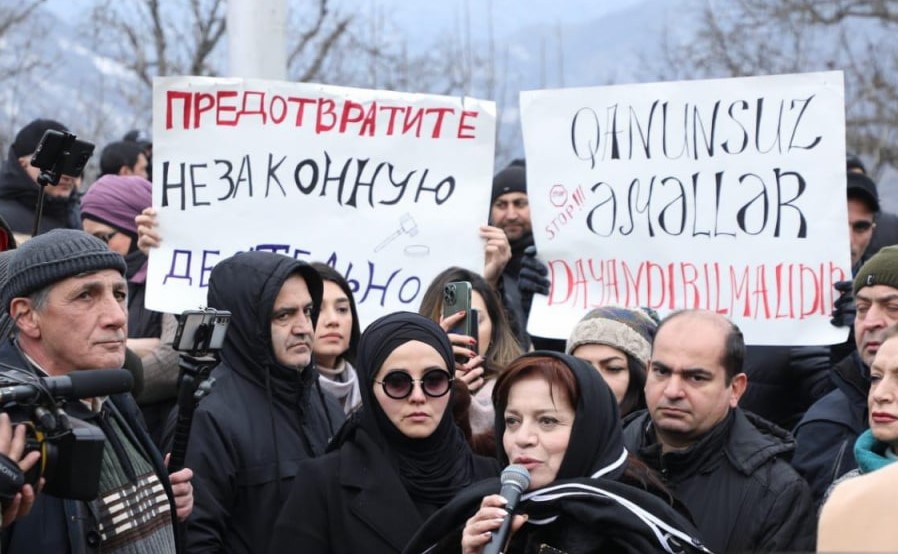
Hence, the closure of the Lachin corridor periodically by the Azerbaijani ecologists and the civil society representatives in recent days and the government’s support to their campaigns, clearly demonstrate that Azerbaijan is not planning to give up the region and leave its status to the future.
Vasif Huseynov