
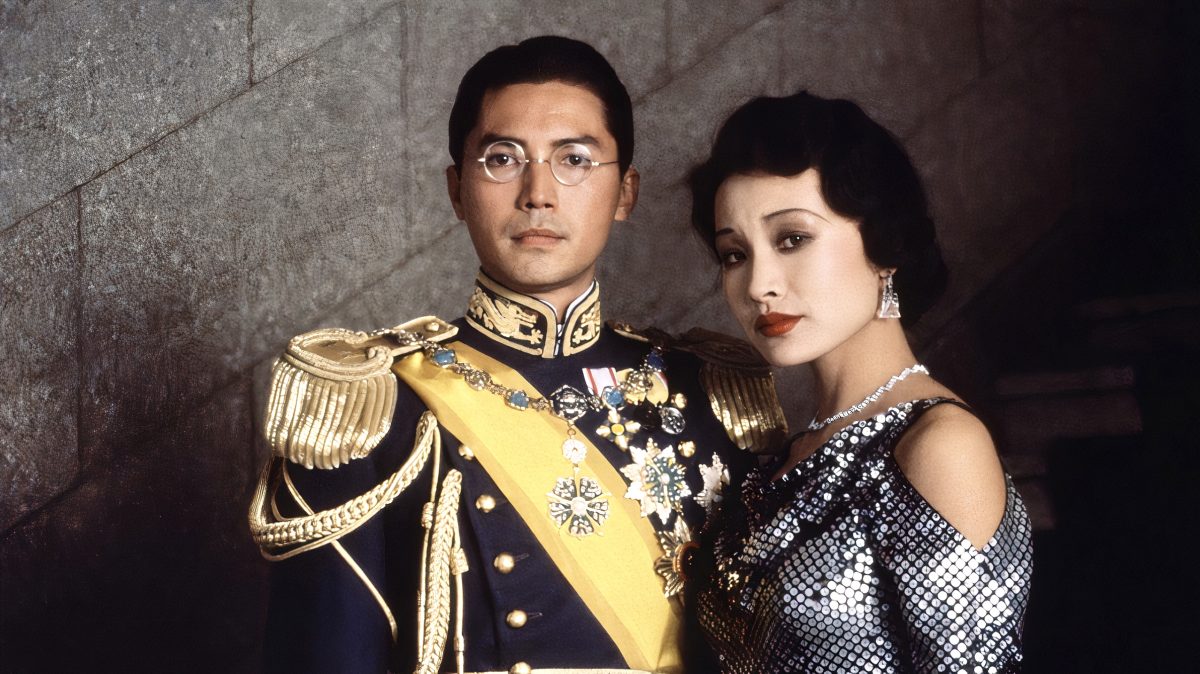
The Qing dynasty (1644-1912), which ruled China for nearly three centuries, was founded by rulers of Manchu origin. The Manchus are an ethnic group living compactly in the northwestern part of China; they are completely different from the Chinese ethnically. The Qing dynasty is remembered as the second and last non-Chinese dynasty to rule all of China after the Mongols (Yuan dynasty, 1271-1368).
Little Puyi, who grew up surrounded by thousands of eunuchs and servants in the Forbidden City, one of the largest palace complexes in the world, home to the emperor and his family, located in Beijing, the imperial capital, was brought to power with the blessing of Empress Dowager Cixi at age two in 1908 after the death of his uncle, the Guangxu Emperor (1878-1908). It should be noted that Empress Dowager Cixi, one of the most important political figures in the Chinese court history, was a woman with the strongest standing in the ruling family.
The beginning of the twentieth century was a period when the social and political life of China, as well as the whole world, underwent radical changes, the ancient way of governance was abolished and a modern state was established. Prior to that, the years-long Opium Wars with the Western empires (1839-42/1856-60), the Taiping Rebellion (1850-64), the First Sino-Japanese War (1894-95), the technological backwardness, the slowdown of the modernization process, a weakened economy, a corrupt bureaucracy, the Manchus falling out of spotlight of the Chinese after a series of military defeats, and other military-political and socio-economic factors of that time shook the foundations of the Great Qing Empire and accelerated its decline, at the same time giving an impetus to the spread of national revolutionary movements. Although the Guangxu Emperor wanted to launch large-scale radical reforms to save the monarchy, the reforms were prevented by the intervention of Empress Dowager Cixi. More than that, Cixi effectively seized power and put Guangxu under house arrest, eventually poisoning him. Puyi, the last emperor of the Chinese Empire, brought to power at a rather chaotic time after their death (the Guangxu Emperor and Empress Dowager Cixi died a few days apart), would during his 60-year life be a captive of the Chinese, the Japanese, and the Russians, would be proclaimed emperor and dethroned three times, exiled twice and imprisoned once.
After the Xinhai Revolution (also known as the 1911 Revolution), which took place in 1911 under the leadership of Sun Yat-sen and ended 2,000 years of imperial tradition in China, the newly formed Nanjing Nationalist government not only allowed Puyi to live in his mansion in the Forbidden City, but also granted the former emperor a hefty annual subsidy. Despite the establishment of a unified Republic of China, however, the political strife for power continued. The republican leadership failed to seize total control across the country, and the young republic became a battleground between imperial-era warlords.
Zhang Xun, one of the warlords seeking to revive the Manchu dynasty, seized Beijing with his subordinate army and returned Puyi to the Chinese throne, but Puyi was able to remain in power for only 11 days. Pursued by rival factions in Beijing, he was forced to take refuge at the Japanese embassy in China in 1924 (the British embassy, whose help Puyi had asked before the Japanese, rejected his request). A year later Puyi was taken to Tianjin, one of the Japanese-occupied coastal cities of China, from where, after a six-year stay, he wrote a letter to the Japanese War Minister in 1931 asking for aid in establishing Manchurian rule. Japan, which for years had sought to invade China, seized the opportunity to invade the northeast of the Republic of China while the latter was engulfed in domestic turmoil, that is, Manchuria, Puyi’s ancestral lands, and established an authoritarian state known as Manchukuo. Thus, Puyi, deprived of the title of emperor in 1912, was brought back to power in 1932 under the patronage of the Japanese emperor, first as president and later as emperor for a third time. Puyi was not happy about being controlled by the Japanese Empire and ruling only a part of China. Moreover, he was forced to consent to sending his child to Japan should he have an heir. With the outbreak of the Second Sino-Japanese War (1937-1945) in 1937, the situation became even more complicated for everyone.
Manchukuo, the puppet state founded in Manchuria by Japan, defeated in World War II, never recovered after the heavy bombing by US fighter planes (in World War II the US and the Republic of China fought together against Japan) and fell in 1945, and the lost lands were returned to China. Puyi, the first and last ruler of Manchukuo, which had been erased from history with the defeat of Japan, was captured by the Soviet army while trying to flee to Japan by plane. Taken to the International Military Tribunal for the Far East (also known as the Tokyo War Crimes Tribunal), where war criminals were tried, Puyi was held in Siberia in the custody of the Red Army until 1949. During his stay in the USSR, he repeatedly wrote to Joseph Stalin requesting political asylum, but his requests went unanswered. It should also be noted that the Soviet leadership refused to extradite Puyi to the Nanjing Nationalist government, who wanted to execute him for his actions.
Handed over in 1950 to Mao Zedong, victor of the civil war (1927-1949) that lasted more than 20 years in China between the Communists (CCP) and the Nationalists (Kuomintang), Puyi was accused of high treason in World War II and turning a blind eye to the massacre of local civilians committed by the Japanese military in Manchuria (the war crimes of Unit 731 of the Japanese Army) and sentenced to imprisonment as a war criminal in China.
Leading a life of a convict until 1959, Puyi was pardoned by Mao Zedong and released. After his release from prison, he worked for a time in the mechanical repair shop of the Beijing Botanical Gardens. Later, used as a political tool by the Communists, Puyi would demonstrate what Chinese socialism was capable of, being elected a member of the Chinese People’s Political Consultative Conference and the National People’s Congress of the People’s Republic of China.
In the new geopolitical reality, Puyi, once the monarch of one of the largest kingdoms on the planet, could visit the Forbidden City (turned into a museum in 1925), where his ancestors had lived for centuries, only by purchasing a ticket as a local tourist. Puyi died in 1967 and was buried in the cemetery near the Western Qing Tombs, where four Manchu emperors and 74 royal members are buried.