As you approach Georgia’s southern border, the Georgian language becomes of little use. Trying to direct a visitor to the village of Khuldara, locals employ a combination of Azerbaijani, Russian, and sign language.
“I will tell you how to get to Khuldara if you buy my persimmons,” proposed one enterprising elderly woman, in effortful Russian. Sporting a gray headscarf and black garden boots, she held court at the main crossroads in Sadakhlo, a predominantly Azerbaijani village on the border with Armenia. A sly grin that reveals a sparkling gold tooth gives her an air of a fairy-tale witch and, true to form, she gives incorrect directions to those who refuse to buy her fruit.
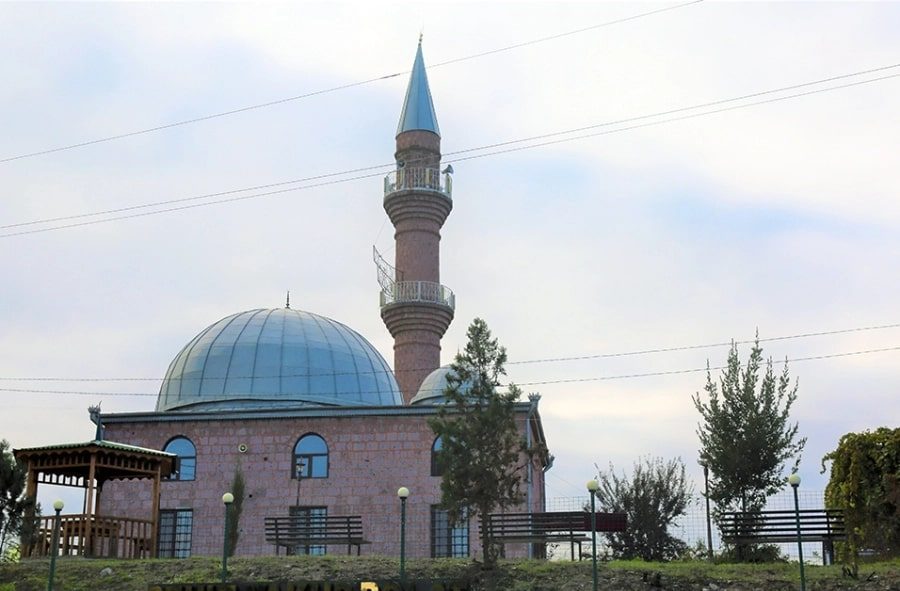
Khuldara, when it is eventually found about 15 minutes from Sadakhlo, turns out to be a sprawling community of about 1,000 people and grapevine-covered gardens. A carefully kept, mauve-tinged mosque serves as the entry point to the village.
The residents are ethnic Azerbaijanis, but from their windows they have a close-up view of the rolling Armenian hills that hem in the village from the south. “This is where Georgia ends or begins, depending on how you look at it,” Kamran Afandiyev says, pointing out a watchtower at the foot of a wooded hill.
Not far beyond those hills, Armenians and Azerbaijanis are locked in conflict. On this side of the border, though, they quietly coexist. In this corner of Georgia most of the towns and villages are populated by ethnic Azerbaijanis – they are the largest minority group in Georgia, more than 6 percent of the total population – but there are also pockets of Armenian communities. The area is oft-cited as an encouraging example of interethnic peace in the conflict-riven Caucasus.
But there is an invisible barrier that keeps locals isolated from the rest of Georgia: the language. Most people here don’t speak Georgian, or speak it poorly. “This is a closed world,” Afandiyev says. “It is hard to get out to study or to work in other parts of Georgia because you need to know the Georgian language to do that.”
“So I decided to do something about it.”
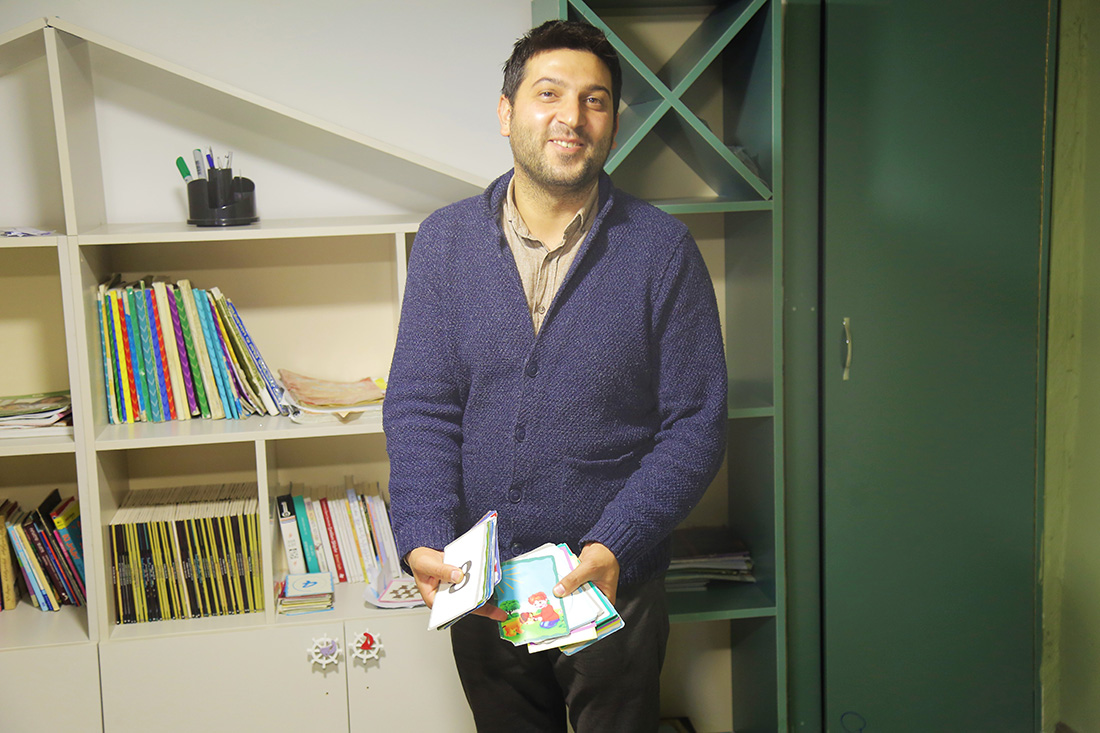
Through large doors with gilded wrought iron ornaments, Afandiyev ushered a visitor into what used to be his garage but now serves as a Georgian learning and resource center for the village. It’s a sleek, office-like room with a large conference table, computers and a printer. A little library offers an eclectic literary selection: the stories of famous Islamic folklore character Mullah Nasreddin in Azerbaijani, T.S. Eliot poetry in English, the Koran in Georgian.
A side room is furnished with a child-sized table and chairs. Here, pre-school village kids come to learn Georgian. “We are trying to make it fun for them, with pictures and games,” says Afandiyev, showing off the colorful flashcards they use as visual aids.
Like most of Georgia’s minority-populated villages, Khuldara does not have a kindergarten. By the government’s own admission, only 25.5 percent of children in minority regions have access to pre-school education, compared to 70 percent in majority Georgian parts.
The municipality of Dmanisi, another majority-Azerbaijani town in this region, has nine kindergartens but none of them are in minority villages – despite the fact that 45 of the 55 villages in the region are majority-Azerbaijani, says Kamran Mammadli, an Azerbaijani Georgian researcher with the Social Justice Center, a non-profit rights advocacy group: “This is a serious issue: Kindergarten is the first point of entry into the education system.”
Garage schools
Afandiyev’s is not the only garage-school in the region.
He went to a Georgian university thanks to a program, known as 1+4, that teaches ethnic minority students intensive Georgian for a year before they start the regular undergraduate curriculum. Launched in 2010, the program opened up Georgia’s university system to minority students. Last year 1,332 ethnic minority students entered university, five times as many as a decade earlier.
But while he was in the university, Afandiyev and his fellow ethnic Azerbaijani classmates felt that they were both scholastically and socially at a disadvantage compared to other students because of their inferior language skills. And they traced the roots back to their experiences growing up.
When he was in school in Khuldara, where Azerbaijani is the main language of instruction, Afandiyev did study Georgian. But it wasn’t enough to get fluent. “For one, you have one teacher instructing a very large class and then, outside the school, children have no place where they can practice their Georgian, so they quickly forget what they’ve learned in the classroom,” he says. “Those who want to proceed to study in university pretty much need to start learning from scratch.”
So he and some of those classmates hatched a plan to “bring Georgian to our villages,” he recalls. “At first, we were not sure about the physical space for doing it, but then we thought, hey, everyone has a garage!”
With funding from several donors, they began opening what they call education centers, where pre-school kids learn Georgian, young people come to study and socialize, and older people can get advice on anything that requires knowledge of Georgian. There are now six such centers, most of them located in private garages.
“We hope that the authorities will eventually start funding these centers and make them part of the education system,” Afandiyev says. “These centers are created by locals and serve local communities, and there is a good match between what they offer and what people here need, and what they need is Georgian.”
The hope is that with better Georgian skills, more Azerbaijanis can participate more fully in life in Georgia and be less inclined to seek jobs and education abroad.
“If you don’t speak Georgian, you can really follow national news, talk to government agencies, get a better job or understand what doctor in Tbilisi is telling you,” Afandiyev says. Partly because of the linguistic barrier, few ethnic Azerbaijanis hold important public offices and Georgia’s 223,000 Azerbaijani citizens don’t have an adequate political representation, minority rights groups say.
One of the earliest Azerbaijani graduates of the 1+4 program was Jeikhun Muhammedali, who is now a television journalist and among the few ethnic Azerbaijanis to enjoy a significant public profile in Georgia. Before going to university, “I spoke street Georgian and my grammar was really poor, which is a particularly big problem when you study journalism and formal Georgian is required,” Muhammedali tells Eurasianet. “One year of Georgian learning really helped, but people in the classroom would still sometimes chuckle when I said something.”
Muhammedali has become well known for his reporting from Marneuli, a majority-Azerbaijani region that did not previously enjoy nuanced coverage in national media. Still, some viewers carp at his language skills. “I get an occasional snide comment on my language, and some complain that I’m not a real Georgian if I don’t speak perfect Georgian,” he says. “To that I just respond that love of your country is what mainly makes you a good citizen, and by that criterion I’m a better Georgian than many.”
There is a widespread belief across Georgia that local Azerbaijanis and Armenians don’t care to learn Georgian and that their loyalties lie with the neighboring countries. That’s not the case, Mammadli said “It is not that minorities don’t want to learn Georgian, it is that the Georgian state is effectively not teaching us Georgian,” he says. “Few Georgians understand to what great lengths minorities go to learn the language.”
Giorgi Lomsadze, is a journalist based in Tbilisi, and author of Tamada Tales.