“I could not artificially write just for the sake of writing…”
“The impact of art on reality can sometimes be very frightening.”
“There are questions that just don’t have answers.”
“Music as an art is going through a crisis.”
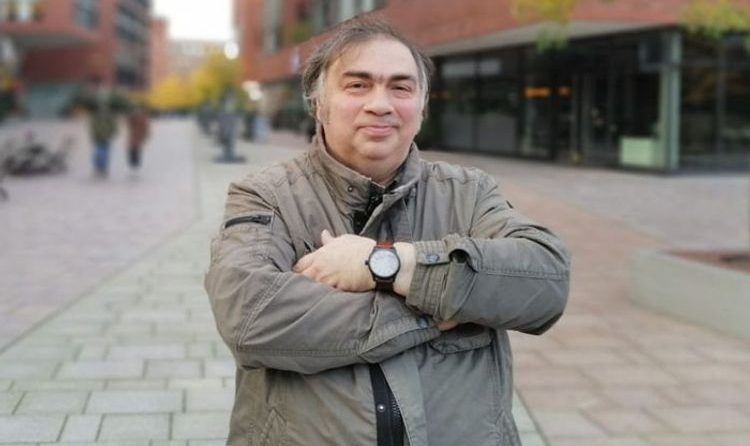
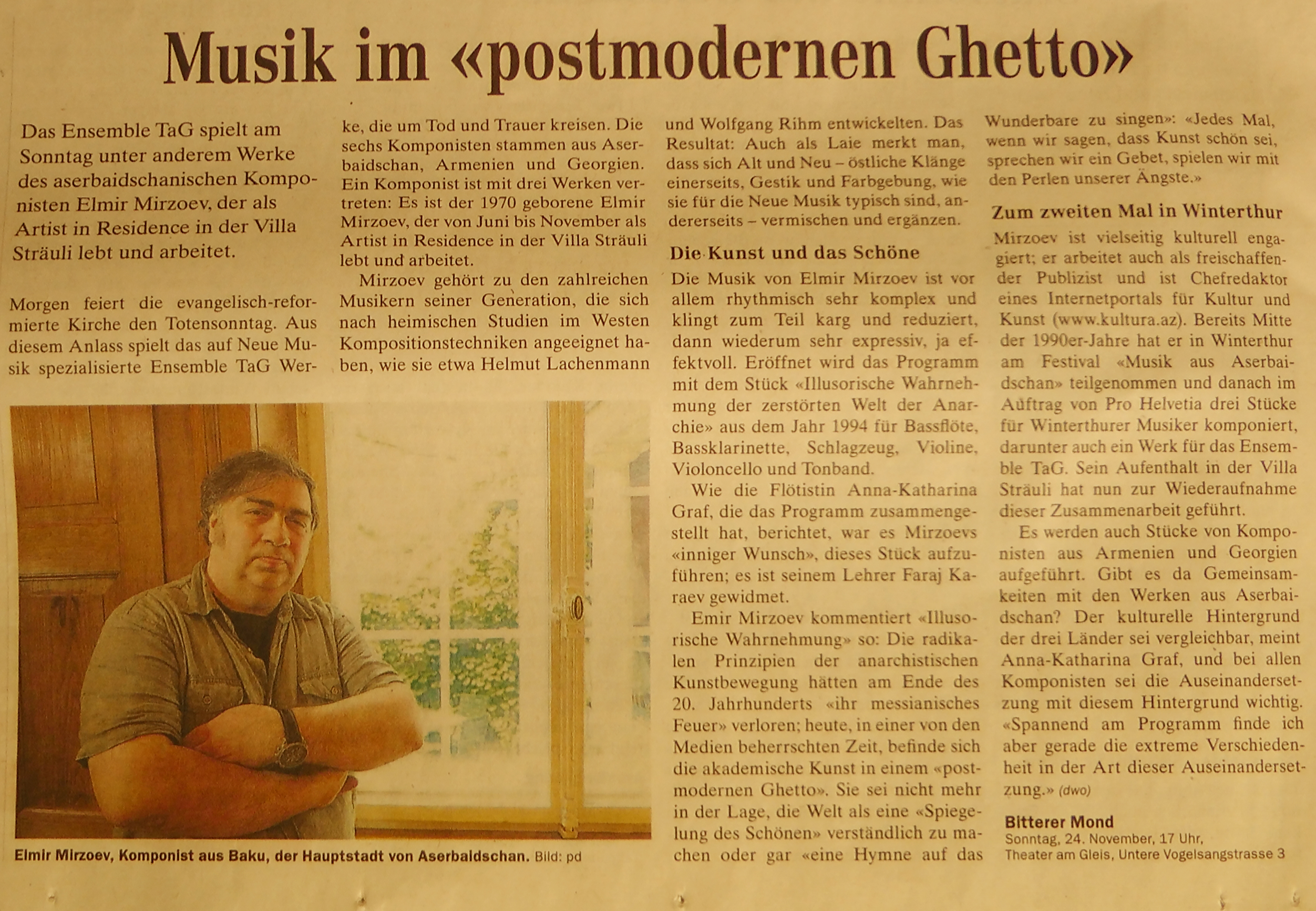
Elmir Mirzayev (b. 1970) is a well-known contemporary Azerbaijani composer, musicologist, culturologist and essayist, professor at the Composition Department of the Uzeyir Hajibeyli Music Academy in Baku. He graduated from the class of Faraj Garayev (1998) and studied composition in many countries in 1994/2006.
He taught at the Baku Music Academy (1998/2001) and Humboldt University of Berlin (2019/2022); in 2007/2008 he taught at the Composition Department of the Cologne University of Music as assistant to Professor York Höller within the DAAD program; in 2013 he was a visiting composer-in-residence at the Villa Sträuli art space in Switzerland. Elmir Mirzayev’s work has been heard in many countries, he has participated in various international festivals and conferences in the CIS, Europe and the United States, delivered cultural studies lectures in many countries and received art commissions from organizations such as Pro Helvetia, Goethe-Institut and others.
Elmir Mirzayev is one of the founders of the SoNoR Contemporary Music Ensemble (1995/2005), artistic director. In 1996/2006 he implemented many international projects.
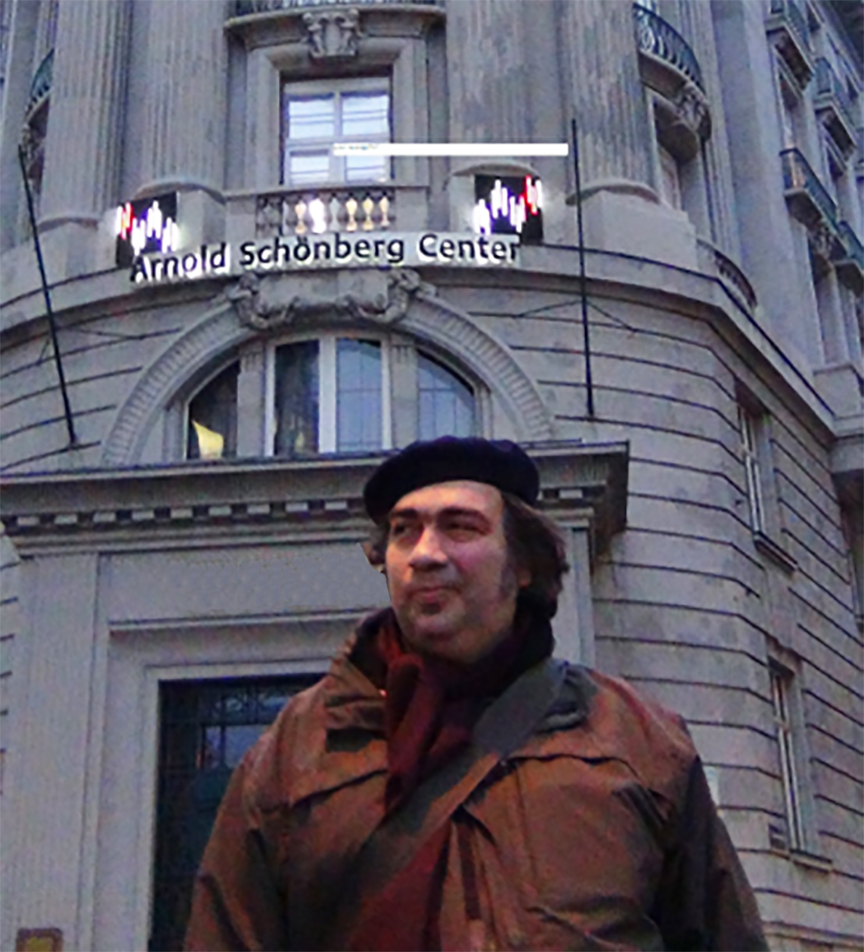
He is the author of symphonic, chamber and instrumental works, music for the films Transcommunication: Invasion of Senses (directed by Teymur Daimi, 2012), The Well (directed by Rufat Ray, 2021); his music has been performed at many prestigious festivals by such ensembles as Tokyo Philharmonic Orchestra, Basel Symphony Orchestra, Lviv Virtuosos Chamber Orchestra, Kharkiv Academic Symphony Orchestra, Accroche Note Strasbourg Ensemble, Ensemble de Ereprijis, Seatlle Chamber Players, Freiburg Percussion Ensemble, TaG Ensemble, Ensemble Reflexion K, Moscow New Music Studio, Ensemble Reconsil and others, on such famous stages as the Kozerthaus Berlin, Tokyo Philharmonic, Konzerthaus Wien, Festspielhaus Hellerau, Seattle Town Hall, Sorbonne University in Paris, Cologne and Moscow Conservatories, Arnold Schoenberg Center in Vienna, etc. He is the author of the collection of cultural essays Totalitarianism and the Avant-Garde (2021).

Elmir, very soon the International Mugham Center will host your original concert Allegoria Sacra (Holy Allegory). Cadenza Contemporary Orchestra, conducted by Orkhan Gashimov, will perform your chamber, instrumental and stage works written in different genres over the span of your 20-year career (1995-2015). I would like to talk about this. What is Allegoria Sacra? Is it a reference to Giovanni Bellini’s famous painting of the same name?
This concert is very symbolic for me. Allegoria Sacra (2015), for two performers and multimedia, was the last piece of music I wrote until February of this year. After this piece premiered in the summer of 2015 in Paris, I stayed away from music for 7 years… I could not artificially write just for the sake of writing, but when I was working on it, of course it did not occur to me that this would happen.
The term ἀλληγορία is of Greek origin and encompasses metaphors and allusions. At the center of every allegory is a symbol, and the expression of this symbol is an allegory.
This work, as you pointed out, is centered around the enigmatic painting of Giovanni Bellini, a brilliant Medieval painter, representative of the Venetian school of painting (Allegoria Sacra, hence the name of the piece), and also a very symbolic 20th century work Black Square (K. Malevich)—the correct word would be “Squares”, because in the video Bellini’s work is covered with black squares. (Actually, the very idea of the “Black Square” dates back to the Middle Ages, at least the first known image of such was given by the English alchemist, astrologer and mystic Robert Fludd in his engraving The Great Darkness (1617)).
The piece features excerpts from the poetry by French surrealist Robert Desnos, contemporary Russian and Polish poets A. Vitukhnovskaya and I. Slivinskaya, our Hamid Herischi, and the outstanding representative of German romanticism Novalis, recited in English, French, German, Russian, Polish and Azerbaijani (the performers’ choice), as well as a quote from the first movement of Four Nocturnes (“Night Music II”) by the classic American contemporary musician George Crumb.
At the end of Allegoria, when Bellini’s painting is fully revealed over the animation, the camera focuses on the four figures of children in the center of the work, symbolically referencing the four parts of the composition. The image of a child has from ancient times been a symbol of sinlessness and innocence, and at the same time it encapsulates the great mysteries of the future.
By the way, after many years, I finally got to see this painting at the Uffizi Gallery in Florence this summer. In fact, I went there with the idea of seeing the original portrait of Shah Ismail, which we have all seen in history books, and I had very little hope, thinking that it was unlikely to be on display in the museum …but it turned out that I was able to find that painting almost as soon as I walked into the museum… I was excited like a kid… …and then I came across the original Allegoria… Is there such a thing as a coincidence or not? No answer to this question either…
The impact of art on reality can sometimes be very frightening… This painting by Bellini is pure magic, it is a mystery to me, in general, the work of this painter was immersed in an aura of medieval metaphysics, which was lost after the Renaissance in art, this atmosphere returns only later, in its full form, in the twentieth century… There are questions that just don’t have answers. People of art can only intuitively seek expression within the limits of the art they do, but answers… No, it is a difficult task, probably impossible. A question full of riddles and metaphysics…
https://presentsounds.bandcamp.com/track/fayum-portraits
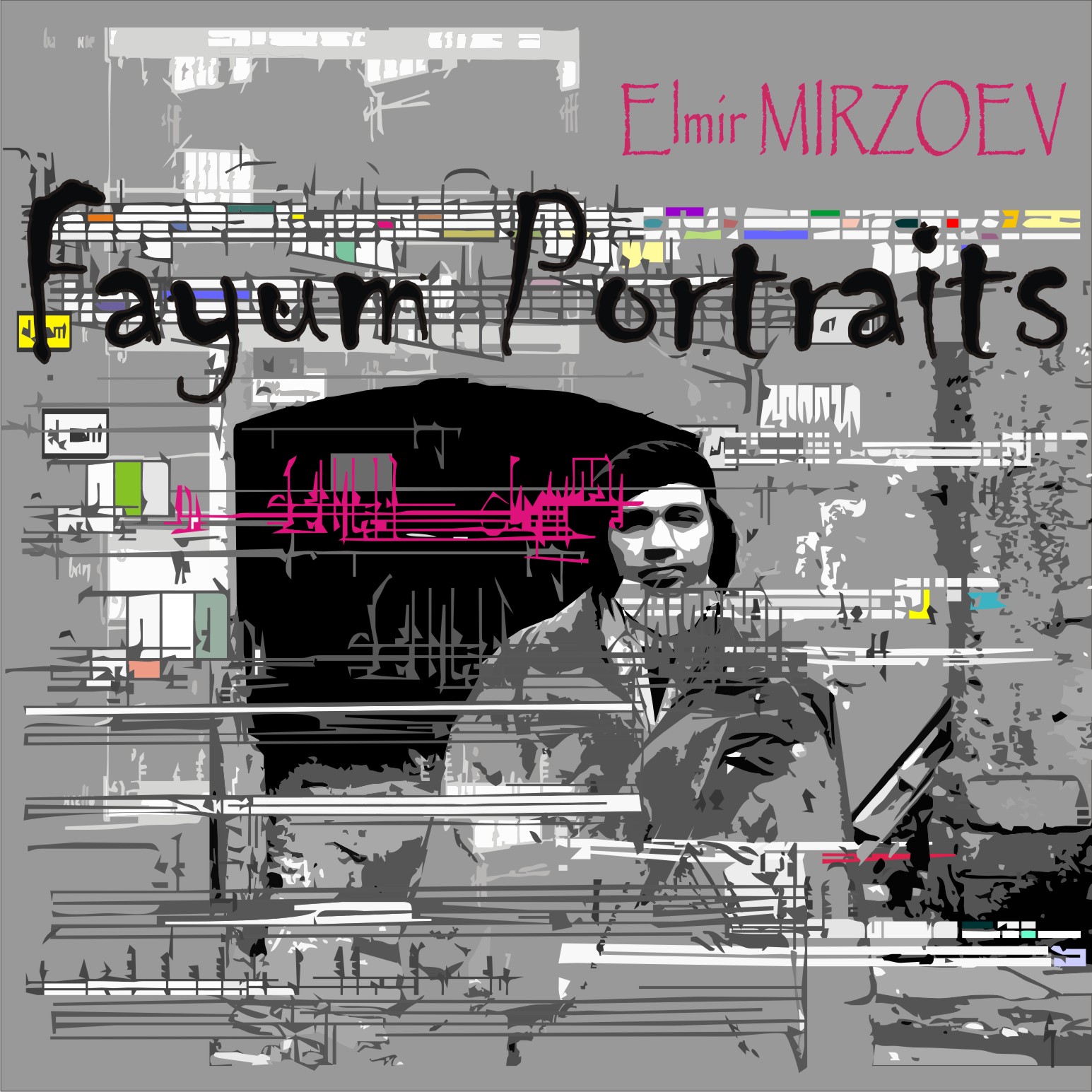
Fayyum Portraits (2004), CD recorded by Present Sounds Recordings in Washington, DC in 2011.
A number of your works urge the listener to think about global, human problems, tuning into a certain state of mind. The resulting images can be understood in a certain mystical context. How do you explain this?
I came to the conclusion that it is impossible to understand the world. Although most of the people around me are, as they say, “evil atheists”, I personally could never become an atheist because I saw with my own eyes what the “ignorance of atheism” meant in Soviet society. During Soviet times, the propaganda of total atheism as the official state ideology led to an idealization of religion (especially Christianity) among the so-called Soviet intelligentsia; many Soviet dissident writers (like Tolstoy and Dostoyevsky a century ago) saw in religion the salvation of man, both as individual and as society, and we are witnessing the consequences of this pernicious trend even now.
However, I came to this idea only after a long way, when I was young I was very fond of Sufism, the wondrous influence of Sufism somehow shielded me from the horrors of the end of the last century, from the terrible characters and plots that seemed to have sprung out of Bosch’s and Dürer’s paintings, making me feel that it was all an illusion or a fantasy.
And those feelings spilled over into your work…
Of course, these thoughts were reflected in several works; when I and my friends founded the SoNoR ensemble in 1995, I wrote for the first instrumental line-up (clarinet, guitar and piano) the piece “Symbolic Triangular Silence” which has already become very symbolic; at the first rehearsal Samir said that “horror was pouring out of the music”. Afterwards, the piece was performed a lot, and at one of the subsequent rehearsals Samir once again jokingly said, “enough of this shamanism”, referring to the last part of the piece, which resembled a ritual.
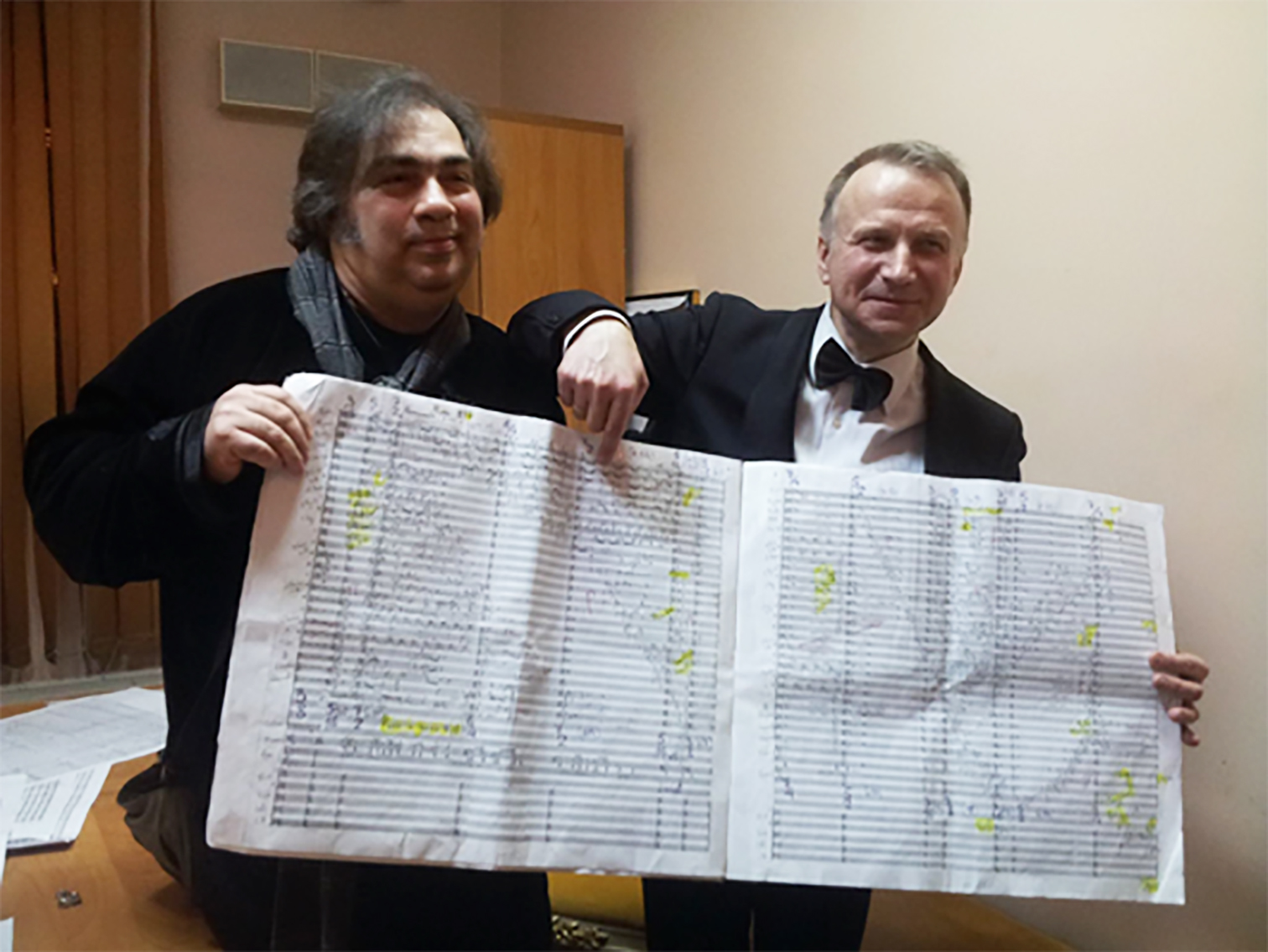
A year after that, in the scorching summer of 1996, I was working on the symphony The Bead Game for the BSO, in which Sufi symbols were shown as geometric figures, a piece based on Hermann Hesse’s novel Glasperlenspiel (The Glass Bead Game), which had made a great impression on me at the time.
Herman Hesse deeply influenced me since my youth, I had read almost all his works, I was fascinated by his illusory world, his magic theater, especially the allusions to music in his novels—Steppenwolf, Klein and Wagner, Siddhartha, Die Morgenlandfahrt (Journey to the East)…
In the novel The Glass Bead Game, the most important aspect is not the interesting protagonists, but the “Game” itself, the game that is the main feature of postmodernism, which is reflected in the score of the work. As I said, in the form of various geometric figures with different meanings, the symbols of Sufism, which had a very profound influence on me at the time.
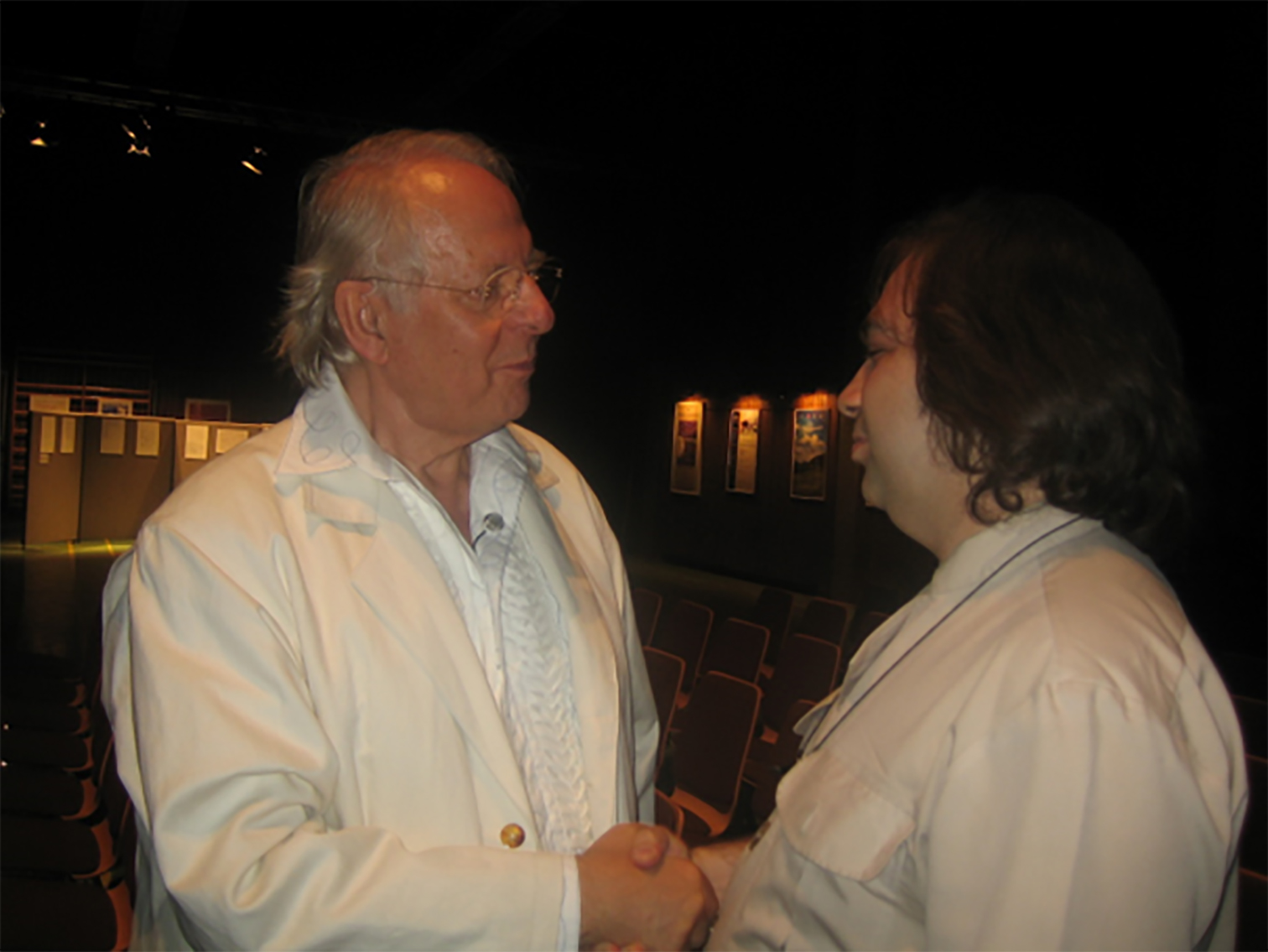
Many years later, in 2008, I wrote another piece for BSO, Illumination, as a special commission for the International Young-Euro-Classic Festival in Berlin and it was of a very different nature.
Interestingly, after the Baku premiere of the symphonic poem, esteemed musicologist Lala Huseynova asked, “Can the title of this work be translated into our language as ‘Xülya’ (‘fantasy’)?”, and I said yes. Indeed, it was a “fantasy,” she put it very accurately. Because actually life itself is a Fantasy Theater, in the figurative sense of the word, maybe in the literal sense, too… Maybe in the sense of Hesse’s magic theater in Steppenwolf, I don’t know…
Roland Barthes, a key representative of structuralism, talked about the “death of the author” back in the 1960s. Your teacher Faraj Garayev also expressed in several interviews the opinion that “Alle Musik ist schon geschrieben” (“all music has already been written”). Later, the Russian composer Vladimir Martynov also wrote about this in his monograph The End of the Time of Composers. What do you think of these ideas? Does the “death of the author” mean the death of art?
These are all rings of the spiral, I mean, links of the chain of historical development. This is because different historical periods view and evaluate the author’s role in the creation of any work through different prisms. For example, for an artisan who made a precious carpet in the medieval East, the most important thing was to achieve the same repetition of the canons created by the masters who had come before him, i.e., there could be no question of any original work or alteration.
In fact, this ANONYMITY was the most valuable and important part of it, that is, you yourself became a canon within this art, your true mastery, your job as a master was to skillfully reproduce the established canons, just as in music, architecture and other fields.
Here the master craftsman himself practically becomes the Creator, or rather, steps into the role of a conduit of His divine energy, and within the Canon there is no room for his author’s ego; rather, any personal expression could be perceived as weakness and incompetence.
Was this only the case in the East? What about Europe?
These rules were also true for medieval Europe, but gradually began to change with the Renaissance, which the Russian musicologist Vyacheslav Medushevsky considered a disaster for music. But the real “disaster”, he believed, in fact, occurred after the French Revolution (in fact, a little earlier in the thinking, in the works of Diderot, Voltaire and others), that is, the God-centered world gave way to anthropocentric thinking, meaning a shift from the divine canons, “mirror forms” of classicism, “pure harmonies”, to human passions, wild emotions and the means of expressing them.
How did the ideas you mentioned translate into music?
We are getting to that: say, it is hard to believe that Berlioz’s Symphonie fantastique was written only half a century after Mozart and Haydn. In it, the composer, breaking all forms and meanings that existed before him, brings human passions to their highest point, and only a little earlier the Inquisition could burn him at the stake for this orchestral performance, this use of instruments and timbres, just because it was a different time.
After that, whether in music or in other art forms, the authorship of artists, i.e., their egos, took over completely, and since only human passions and not God-centered thinking came into art, they could no longer objectively convey the perfection of classicism.
Thus, His Majesty the Ego dominates all art for many years, and artists join in the marathon of creating their own style as if they were Gods, this speed is enhanced by the Industrial Revolution, mechanization in the late 19th century, and the egoism peaks after World War I, the avant-garde dominates the world, coming into prominence, whereas in the early 20th century it was still in a rather marginal position.
It was really the culmination of authorship, every author already not only knew how to find their own style, but certainly knew the supreme objective of destroying the canons that had preceded them, quickly changing styles succeeded each other within just one or two years. For example, Fauvism (that is, “wildness”), the French version of Expressionism, produced exceptionally beautiful works, but the movement itself lasted only a few years, and then Matisse and others changed styles.
But in fact the avant-garde, which completely defeated the wave of romanticism (here we mean all its branches, neo-romanticism, impressionism, postimpressionism, etc.), meant the end of this anthropocentric thinking, the dehumanization of art, which was the final stage in a process that lasted almost the entire twentieth century. By the way, long before Roland Barthes, the famous Spanish philosopher Ortega y Gasset wrote about this in his treatise The Dehumanization of Art. Thus, the canons of the avant-garde, which held the de facto dominant position throughout the twentieth century, destroyed with their unifications the concept of the author developed by Romanticism.
In general, the technique of serialism was inevitably a unification, that is, although it was a technique, it inevitably led to the uniformity of aesthetics and completely erased the individuality of the creative act of any composer. Since this canon was above any authorship, within the framework of this canon the formalized feelings of the author did not matter—it was a new stage of the return to the Middle Ages, or rather, a new link in the historical chain.
Of course, after Wagner’s “endless melody” and “Tristan chord,” the tonal-harmonic musical system was inevitably paralyzed; the possibility of the legal resolution of each tone to any tone automatically led to atonality and organically to chaos. For this reason, the new historical phase needed a new order, a new canon, which finds expression in Schoenberg’s dodecaphony. However, as I already said, serialism, the highest point of this canon, deprived any composer of individuality and dictated an aesthetic born of a purely technological process.
In the second half of the twentieth century, in contrast to earlier ideas about authorship, in which the main place was occupied by the spiritual and biographical experience of the artist, the notion was put forward of a creative act that is not individual and is not associated with the personality of a particular person. The brief essence of the issue is precisely this: the 20th century created the ANONYM through countless revolutions, coups, wars, discoveries/inventions/revelations, impossible speed, and the mass nature born of them, as the French philosopher said.
As for what Faraj said about music, I said in an interview in 2008 that music as an art is going through a crisis at the moment, a period of Restart. The very notion of μούσα, which comes from the ancient Greek language, is being transformed.
In the coming years, the widespread introduction of multimedia will move music into completely different formats. There is no doubt that symphonic music, opera and other classical heritage will remain in purely museum form, Verdi or Tchaikovsky will still be sung in opera houses, and Beethoven or Brahms will be performed in concert halls, but this has nothing to do with the further development of music as an art.
Music can probably no longer be the Kantian “thing in itself” (Ding an sich) as an art, it is now becoming a craft, this much can already be ascertained. In short, the Musique d’ameublement (furniture music) ideals of the French (non)composer Erik Satie have emerged to become an appalling reality at the beginning of the 21st century…
Elmir, your first work after graduation was a piece called “Intra Cancellos” (“In a Limited Space”) for a chamber ensemble, where you seem to achieve the effect of a lack of spatial and temporal dependence within a clear, elaborate structure. What does it mean for a creative person to exist in these two irreconcilable planes, the real and the unreal?
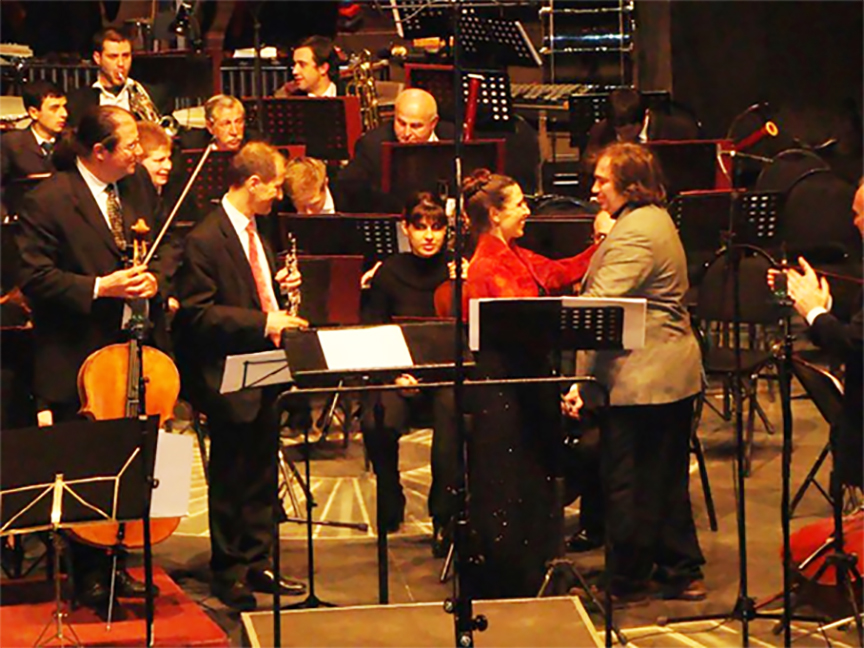
Intra Cancellos was written in the summer of 1994, during summer courses for composers in Sweden, in just one week, and the band of Gothenburg University performed it with the Danish conductor Einar Nielssen…
An artist really lives in a fantasy, but when a work of art is being written—here I mean music—the category of time has to be taken into account first and foremost. Both in the sense of the duration of the work, about which Stockhausen wrote at length in his famous essay “Wie die Zeit vergeht” (“How Time Passes By”) in the 1950s, and in the understanding of the pulse of the present, the modern time in which you live. Without these two factors a piece cannot be good, or interesting at the very least, because it is impossible to live in the present and write an excellent piece in the aesthetics and techniques of the 1940s and 1950s (be it the style of that time, which we can metaphorically call “Azerbaijani romanticism,” or the criteria of the postwar Avant-garde II in Europe). This is basically impossible.
Intra Cancellos was the first piece I wrote after my graduate work at the BMA in Sweden, and during my first composition course. The conditions were that the young composers selected for this course were required to write a new piece in just one week for the instrumental lineup of the Gothenburg University Chamber Ensemble as part of this program.
As the title of the piece suggests, at the time I was very interested in “limited spaces” in art (not minimalism), and this piece is also built on different relations of only 6 tones. Later this “limited space” was repeated in the 1st movement of Candentia I (1995), written for 7 performers (Swiss TaG ensemble), and I never went back to this tonal relationship again…
https://soundcloud.com/xp5/intra-cancellos
As for the “absurd world that does not exist” and the “necessity of its creation”, in fact this world does exist (in Indian philosophy it is called “mayya,” that is, the teaching that the real world is a transitory illusion), and all philosophers of the 20th century have long agreed with the idea that it is absurd.
On the other hand, not all questions have answers, there are often unanswered questions in life, and the brilliant American composer Charles Ives, a “prophet” of the 20th century music, wrote “The Unanswered Question” (1908) at the beginning of the last century, as if symbolizing the forthcoming problems that century will face…
For a certain period of time, about 10 years, you were the artistic director of SoNoR, the first contemporary music ensemble in Azerbaijan, one of whose founders you were. What can you say about the role of SoNoR in your creative work and personal development?
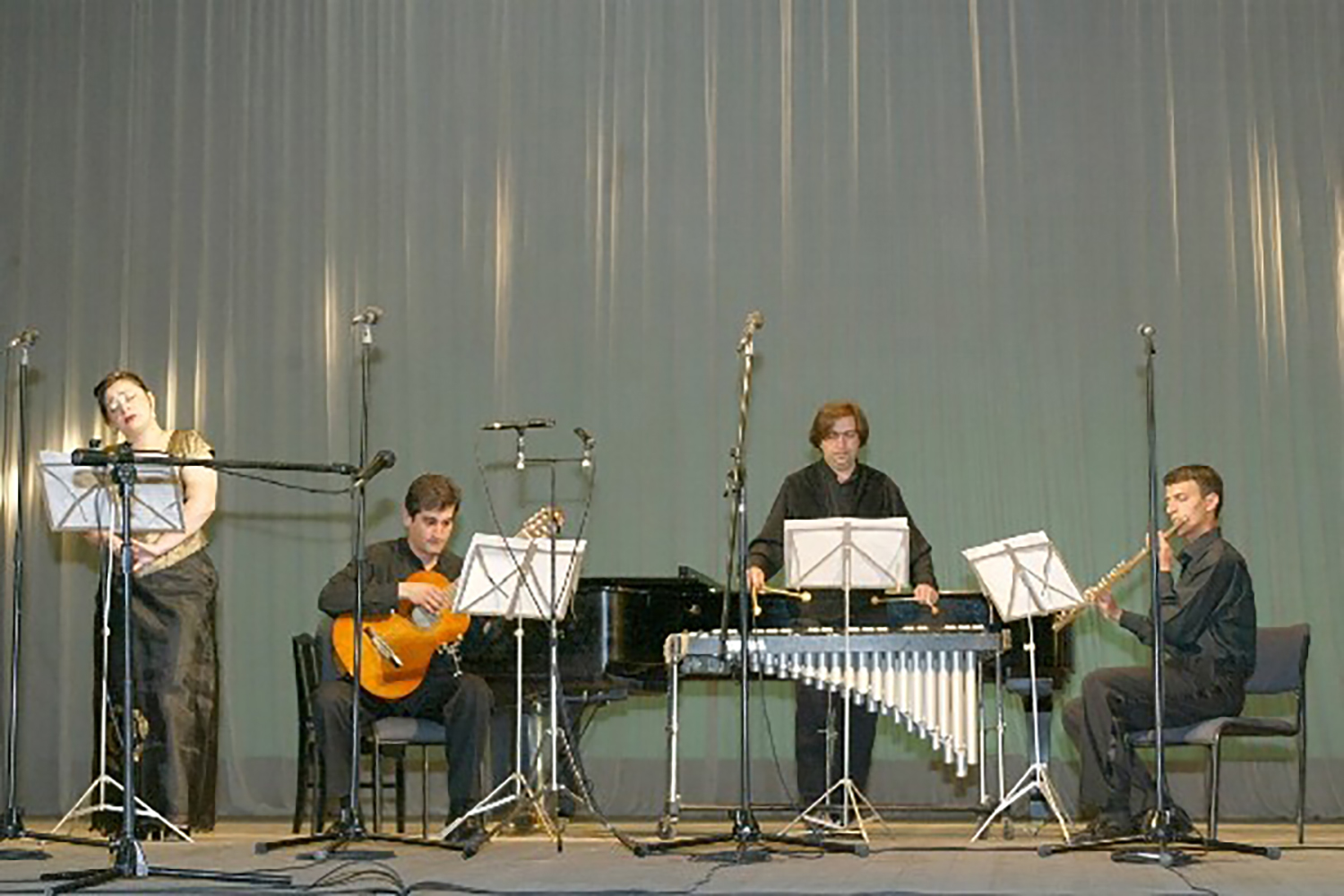
SoNoR was a piece of our youth that we started with passion, a collective phenomenon brought to life by a few enthusiastic musicians (Samir, Nizami, Rovshan and me), a phenomenon of the terrible, disastrous 1990s. That period was full of strange and bizarre events, and disasters, as is always the case with transition periods. A great empire had been destroyed, a tragic war had just ended, and the society was on the brink of a new, completely foreign and frightening era for which it was completely unprepared. Just like in the masterpiece film Underground by Emir Kusturitsa in those years, in Mikhail Bakhtin’s carnival.
In short, there have been great challenges of the time, and the arts have not been spared; for many, these issues have taken an impossible turn. Human society is inert; we too are no strangers to running away into the past and hiding there, especially in times of catastrophic crises.
Our colleague, musicologist Theodor W. Adorno once wrote that “to write poetry (meaning art in general—E. M.) after Auschwitz is barbaric” (Kulturkritik und Gesellschaft, 1949), but as a philosopher he was wrong. Humanity continued to live even after the death camps; our attempts to remain in our “comfort zone” in the face of the big challenges of life are futile.
SoNoR was youth’s answer to these great challenges, sometimes naive, sometimes stubborn, sometimes frivolous, but always full of enthusiasm and passion. We were young, ambitious and enthusiastic, and despite what was going on around us, we managed to make life colorful with our art.
It’s actually an incredible story, I guess everybody remembers how disastrous the situation was in the mid-1990s, it was a time of a decline and a crisis. And at that time a few young people wanted to make contemporary music, maybe it was a form of madness, I don’t know, but it was a lot of fun, even if there were problems. Over the years you only remember the good and forget the bad, and I also remember many funny episodes, from our gigs, concerts and performances, and tours…
Farida Mammadova, our soprano, always carried two large suitcases that were the size of herself (our late Rovshan usually carried them). Before our original concert in Prague in 1999, there was a serious scuffle because Farida and Rovshan got lost, so the dress rehearsal was practically impossible. Imagine, on the one hand, these two went to buy medicine for Farida, and on the other hand, the enraged conductor Freisitzer, our late clarinetist Nizami, Samir, the commotions, mutual accusations flying in the air, worlds colliding, and me in the middle of it all, the concert is about to start… it all seems so impossibly far away now, in distant memories, some in photographs, some in rare audio and video recordings…
Of course, it is not my place to evaluate my own work, but now, a quarter of a century later, we can probably say that the 10 years of work and legacy of this ensemble have become part of the history of our contemporary music…
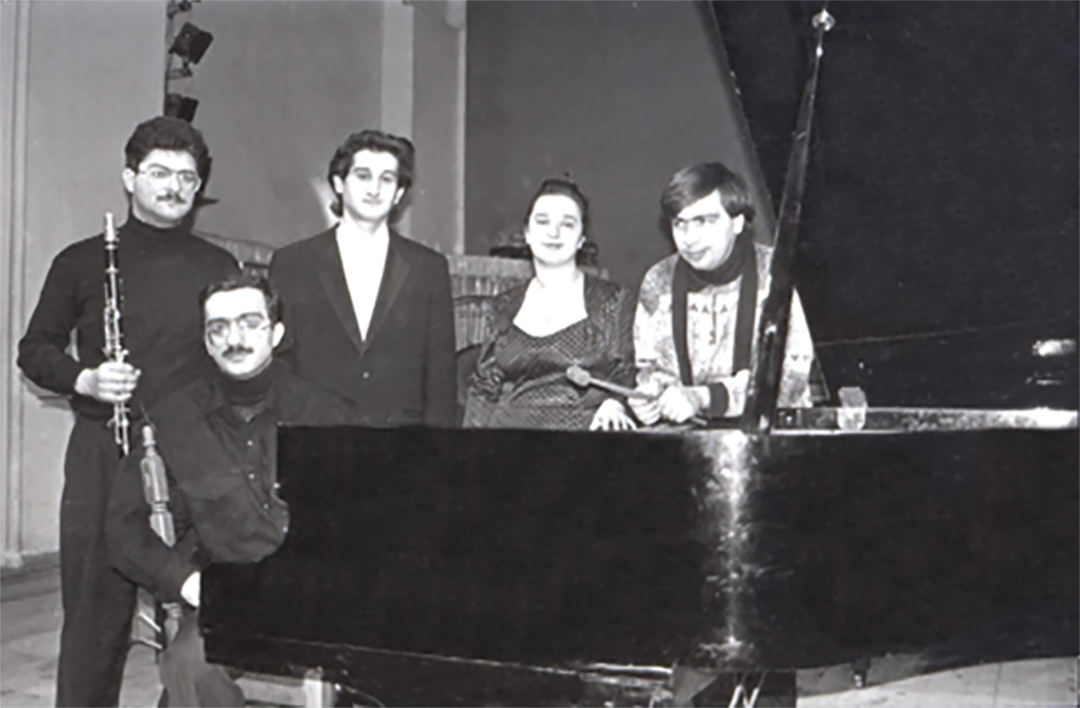
I was once again convinced of this when I saw Samir’s book published last year, SoNoR: Between Two Millennia, dedicated to the group’s work. In the foreword to the book musicologist and our invaluable colleague Turan Mammadaliyeva wrote: “SoNoR… A spectacle of the majestic impact of silence, the smoothness of sound, amazingly subtle, soft terrains…”
It is hard to put it more accurately.
Your works contain many quotations from various authors, and it is noteworthy that they are often not from the works of academic composers. In Fayum Portraits you turn to the Tibetan chorus, in ReAKSİYA to the Rast Mugham, in several of your works to poetic patterns, even to quotations from speeches of political figures of different eras.
This polyphony, this integration of quotations, their logical role in the dramaturgical development testify to the author’s mastery. Is the use of quotations an indication of respect for the original authors and appreciation of their work, or does it itself evoke a creative impulse?
Quotations… Actually, postmodernism, which brought them into art in such a total form, is such a big topic that it would be better to avoid it, see how much time we have spent discussing the “death of the author” earlier. Let me just say that for me syncretism in art is important as a typological feature. Anton von Weber’s concept of “pure music” emerged in the early 20th century and ended after the middle of the 20th century. Postmodern is actually a period, a “ring” in the synthesis of different styles that can easily combine them regardless of differences in characteristics.
The heavy use of quotations, and pastiche, as you mentioned, is very typical of postmodernism, but for me it happens very organically.
For example, when I was working on my Violin Symphony (full title of the work is A Severe Aesthetic Experience from the Lost Noise of Beauty—V.A.), the first movement of the work contains a quotation from Gara Garayev’s concerto (Violin Concerto, 1967), which is as if an organic part of my belonging to the Azerbaijani composing school. In the second part a chord from Vivaldi’s Summer concerto is used for a moment, as an allusion to my violin past (I graduated from the violin class of the A. Zeynalli Music School). Similarly, M. Kagel (Klangwölfe) and R. Wagner (Siegfried-Idyll) quoted there also have a deeply personal meaning. This is a very natural, obvious thing; such historical allusions are also characteristic of postmodern practice.
I mean, it all happens very naturally, not by some theory, it is a kind of pulse of the time in which we live, it is for us a legacy from the heights of the present, a legacy of the “giants on whose shoulders we stand”, as Newton said.
Elmir, you were one of Professor Faraj Garayev’s favorite students. Even many years after graduation, you worked side by side with your master in many projects and worked with great enthusiasm and zeal to organize and popularize contemporary musical life in Azerbaijan.
I wonder what being so close to the master, working with him, means to you? I suppose you are still learning from him…
Faraj is a great school. At the same time, he is a new, big milestone in our music after such a giant as Gara Garayev. That is, from the height of the present, it is clear that even in the second half of the 20th century and even at the beginning of the 21st century not every composer managed to get out from under Gara Garayev’s great and strong influence to open doors to a completely new path.
Maybe this is a very big claim, but I will say it again: in my opinion, only the late Agshin Alizade and Faraj Garayev were able to open new paths in the development of our music and to prove it with their work.
This topic is extensively discussed in a large monograph, which I have practically completed as part of my work at the Humboldt University. This work, based on interdisciplinary theory, is titled “Modernity and Archaicism: Azerbaijan’s Music Culture of the Twentieth Century in the Context of Three (Former) Empires” and is a look at the last 150 years of our music from geographical, political and historical points of view.
In this study, the formation of secular culture of Azerbaijan, in the historical and social conditions under the influence of the vectors of the three great empires (practically civilizational points) in the geography where we exist, is explored purely against the background of the development of our academic (written) music. In fact, if we recall the problematics in the play My Mother’s Book written by Mirza Jalil 100 years ago, then the main idea of this work will be clear to non-musicians as well.

As a teacher Faraj Garayev is simply irreplaceable, studying in his class was truly a blessing for us, his students, but I would write the word Human before his name with a capital letter, even before the title of professor.
Faraj Garayev’s role in the shaping of a new generation of Azerbaijani composers is simply exceptional, both as a creator and as an organizer of musical life. It is a great honor and education for me to have been by his side for many years. The projects, festivals, concert programs, tours and other events we conducted under his guidance, and his trust in me on a purely aesthetic and intellectual level always left me with a great sense of responsibility.
I joined his class for the first time in the summer of 1989, preparing for the conservatory, and after reviewing the samples I had written (of course, they could not be called works) he asked: “Can you imagine your life without doing this?” I was a child, of course, I was lost. It was not easy to answer. So he continued: “If you can live without doing this, then you shouldn’t even start.”
I realized then that the work we do, the work we give our lives to, is not really a profession, it is a mission.
Your collection of essays and articles Totalitarianism and the Avant-Garde was published last year. In my opinion, the essays on cultural-historical and social themes in the book help readers understand many issues more deeply. It is also great that your latest work Epitaph (2022) was performed in Baku recently. Would you share your plans for the future?
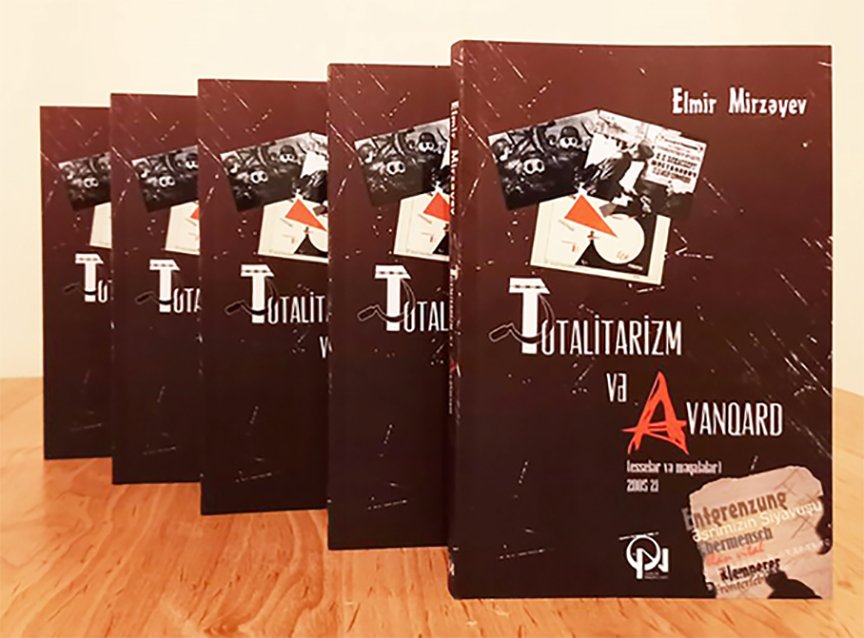
The collection Totalitarianism and the Avant-Garde consists mainly of essays on cultural topics that I wrote for various magazines over the course of fifteen years. The publication of this book was a kind of report for me. And music is a complicated thing… I began working on my latest work, Epitaph, under the influence of the 30-year history of the Khojaly tragedy with its indelible pain…
This work could only be a mystery in a syncretic genre combining both electronic music and pantomime, elements of musical theater in addition to instrumental chamber composition. When the idea for the piece was ripe in my mind and I opened the Sibelius scorewriter program I had almost forgotten about after a 7-year long pause, the first thought that came to my head was “…this is not a big deal, Mussorgsky didn’t write for 10 years…”
But, fortunately, I was able to finish the work, which premiered in Zurich on February 26, 2022, on the 30th anniversary of the Khojaly tragedy… It was also recently performed by the State Trio at the 14th Uzeyir Hajibeyli International Music Festival in Baku. By the way, those interested will be able to hear Epitaph next month, on November 16, performed by soloists of the Cadenza Orchestra.
Interview by Vafa Abbasova (musicologist)