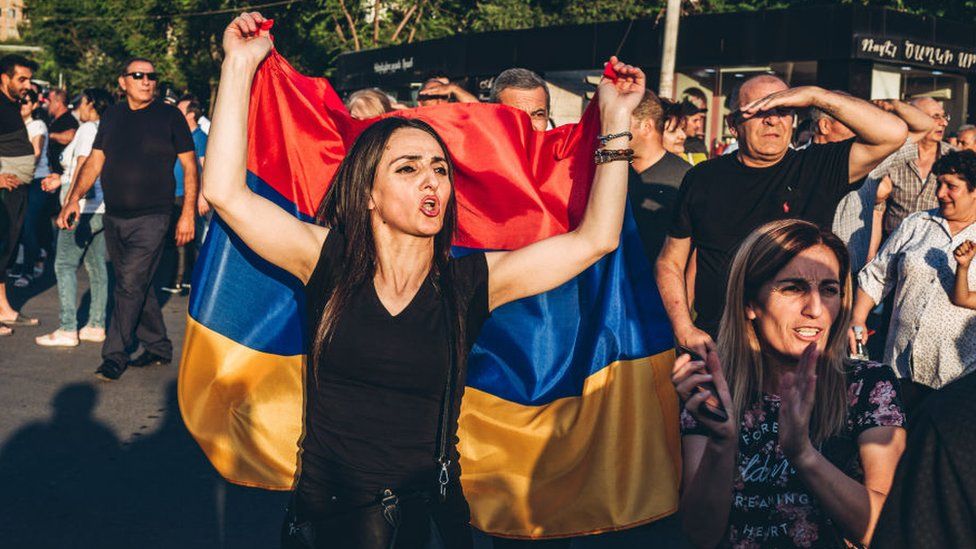
We saw this recently between Armenia and Azerbaijan. It was available for every Armenian, Azerbaijani, and every person on earth to see and hear through all media forms.
Armenia and Azerbaijan at Loggerheads
Among countries involved in a conflict, two countries – Armenia and Azerbaijan – have been at loggerheads in the South Caucasus since the First Nagorno-Karabakh War that brewed and exploded from 1988 to May 1994. The enmity, for the past 30 years, between these two nations was based on Azerbaijan’s claim to its own territorial integrity. Armenia, with the support of Russia, tried to steal and illegally occupy Azerbaijan’s land for 30 years. The war ended with a ceasefire and bled into unnecessary ethnic cleansing and massacres and the displacement of approximately one million Azerbaijanis from Armenia itself; the Nagorno-Karabakh; and the territory of seven surrounding districts. It made Azerbaijanis internally displaced refugees in their own country.
I thought that with the 2020 2nd Nagorno-Karabakh 44-day War, this three-decade bloody dispute would end and peace would settle in. That episode started on September 27, 2020 and ended November 10, 2020 (1 month and 2 weeks), and Azerbaijan liberated most of its territory from Armenia’s illegal occupation.
Sadly, that was not the end of the matter for Armenia though.
This major 2020 escalation was a result of an unresolved conflict between Armenia and Azerbaijan resulting in Azerbaijan’s victory after a signed ceasefire agreement. But the post-war skirmishes continued between the two foes in the region, including substantial military encounters in 2022.
On 12 September 2022, Armenian and Azerbaijani troops were at it again, marking another major escalation in the Armenia-Azerbaijan border crisis of 2021-2022. It ended on September 14, 2022, in a new ceasefire brokered by the United States. Of course both sides paid with deaths and injuries.
Some pundits point out that these recent skirmishes erupted shortly after the Russian military suffered some serious setbacks in its Ukraine invasion, which is seen by Armenia, a puppet regime of Russia, as weakening Russian force projection in the region.
I expected that with so many war casualties suffered by the two countries over the conflict’s decades they would come to their senses. The result should have been a conclusion and peace settlement, not just another ceasefire.
I was mistaken. That’s because a ceasefire only means hostilities are on hold and another escalation is brewing, waiting for a suitable trigger.
Peace v. Fighting
Though Azerbaijan loudly declared it seeks lasting peace, Armenia has not. Armenia does not want to live in peace with its neighbor. Neither does it want to help the South Caucasus progress economically and better standing in the international arena. Armenia says no to peace, not yet.
The hostility of Armenians toward Azerbaijanis that has been installed in the Armenian population’s subconscious these past 30 years is appalling.
Some of those harboring deep-seated hostility now serve as soldiers in the current military encounters.
The two countries are constantly on edge and tension between them is strong, which results in occasional provocations from both sides.
Wiping Out Centuries of Co-Existence
Prior to the 1st Nagorno-Karabakh War, the Armenia and Azerbaijani populations interacted healthily for centuries. Armenians lived in coexistence with Azerbaijanis in Azerbaijan, including the Nagorno-Karabakh and the surrounding districts; Azerbaijanis lived in coexistence with Armenians in Armenia and all over Azerbaijan. That coexistence was nixed with the invasion of Armenia into Azerbaijan’s Nagorno-Karabakh and seven surrounding districts, illegally occupying the territory for 3 decades, from 1994 until 2020.
That war marked the beginning of the elimination of the coexistence and forced separation of the populations. It was fueled by bloodshed and ongoing inciting propaganda that reaches a new peak after new exchanges of gunfire begins along the Armenia-Azerbaijan border.
The animosity is inescapable. The hatred constantly spills into the streets of cities worldwide, where there is an accumulation of Armenian diaspora. Even with living abroad for decades, away from the homeland and from the physical war, Armenian hate propaganda for Azerbaijan is on display. It is overwhelming and inexplicable.
With a large Armenian Diaspora living in Los Angeles, where I reside, one can often witness Armenian protests. Some of those taking place in the city turn violent, against Azerbaijani-origin people and property.
Armenian Soldiers Mistreating Dead Azerbaijani Soldiers
A gruesome video of Armenian soldiers roving among dead and naked Azerbaijani soldiers’ bodies illustrates what hatred can do.
The video shows one Armenian soldier cutting dead Azerbaijani soldiers’ ears off, kicking them and stabbing them with a knife, though already dead. It dawned on me what the hate instilled into these Armenian soldiers can do to a person.
One should then not be at all surprised if some Azerbaijani soldier who has seen the same authentic video got mad and filled with resentment at seeing his comrade being treated so violently and with so much humiliation while already dead. That can of course provoke other soldiers to mistreat opposing soldiers if such an opportunity arises.
Arab Hostility Derives From Education
One can compare the hate toward Azerbaijanis that Armenians grow up with to the way the Arabs treat Jews in the land of Israel. Since the Oslo Agreements of 1993-1995, the Palestinian Authority (PA) in Ramallah has ratcheted up incitement against the Jews in Israel. The education curriculum of young Arabs in the PA is filled with hatred for Jews. It encourages lying about Israel and promotes the murder of Jews which results in almost daily Arab terrorism. Over time, the PA even established a ‘pay for slay’ policy. That policy states the more Jews an Arab terrorist murders the better off their family will be, no matter whether the terrorist has been killed by Israel or incarcerated in an Israeli jail for many years.
Adolf Hitler did the very same. He incited the German population against the Jews and that brought about the systematic murder of 6-million innocent European Jews. Germans developed unfounded hate, instilled in them through vile propaganda from an early age. That hate for Jews spilled into Poland, Ukraine, Latvia, and other European countries where Jews lived and where Nazis operated their propaganda machine.
One can assume that the hate Armenians have for Azerbaijanis is also taught from an early age, embedded in Armenian school textbooks.
Armenian Textbooks Promote Hatred Against Azerbaijan
The entire process of selecting, assessing and adopting the national education textbooks is controlled by the government of Armenia along with the Ministry of Education.
In those Armenian education textbooks appear war-describing words and phrases with negative and dehumanizing qualifications of double sword meaning. The reason for such an approach? According to Armenian sources the state of Azerbaijan was created only after the collapse of the Soviet Union. That mean the long history of the Azerbaijani people is not accepted by Armenia, it has been wiped out.
In the Armenian official history textbooks, the words brutality and vandalism are the most negative qualifiers of Azerbaijanis; in the eyes of the Armenians, the Azerbaijanis most negative actions are their use of anti-Armenian propaganda; the killings of Armenians; massacre and ethnic cleansing of Armenians, all for the purpose of creating a negative image of the enemy.
From the Azerbaijani side one often hears accusations of Armenian massacres and ethnic cleansing, which is well documented by eye witnesses.
Negative attitudes, distrust and intolerance towards each other are sentiments central to Armenian and Azerbaijani societies. All shape deleterious feelings.
If there is tit-for-tat in this conflict, the negative atmosphere toward each other is inescapable since peace between Armenia and Azerbaijan has not been reached yet.
In Conclusion
Since it got rid of the epoch of it’s 70-year Soviet yoke and became independent in August 1991, Azerbaijan has been steadily progressing economically, and enhancing its stature in the Caucasus and beyond. The country is certainly a stabilizing factor in the South Caucasus, a most difficult and politically vulnerable region.
A survey analysis revealed that the vast majority of Azerbaijanis and Armenians would like to see the hatred between the two peoples eliminated. That means peace must be reached as a starting point moving forward.
Since the 2020 44-day war ended, Mr. Ilham Aliyev, the president of the Republic of Azerbaijan has been calling Armenia to sign a peace agreement. That agreement would end the conflict, allowing the two nations to coexist again. Nikol Pashinyan, the Prime Minister of Armenia has not yet arrived at the conclusion that defining indisputable borders between the two countries and signing a peace agreement is the solution to move forward.
Despite the fact that the conflict is still sanctioned and negative attitudes still prevail, many people on both sides – Armenians and Azerbaijanis alike – project readiness to cooperate and communicate. Most people loathe war and want to see it finally resolved peacefully so they can build a safe family nest and have a better future.
Peace means eliminating the distrust toward each other as well as the negative image of one another, a major obstacle to achieving tranquil coexistence and healthy cooperation.
Wiping out negative images in both Armenian and Azerbaijani societies means destroying the boogeyman from an early age.
Positive communication would help people in both states get to know each other. It could start the process of uprooting the make-believe image of the perceived “enemy” stereotypes and help build much-needed mutual trust.
Communication can be perceived as building mutual projects between Armenia and Azerbaijan. Youth projects to be held in a third country would make friends not enemies from an early age. Transformation educational seminars projecting good-will intentions are bitterness healers. Of course one can take this imagination further with other possible hate remedial projects.
I can refer here to the phrase: “Suppose they gave a war and nobody came?” the title of a 1970 American drama-comedy film. The film’s title derived from an American antiwar slogan of the Vietnam War era, propagated by Charlotte E. Keyes in her 1966 article for McCall’s magazine titled “Suppose they gave a war and no one came?”
I tell Azerbaijan, do not lose hope. In the end no one will come to fight another war. The lost backpack of optimistic ethos will be returned to its peace-seeking owner.
Nurit Greenger