According to international historians and Azerbaijani scientists: archaeological monuments and the history of Nakhchivan Autonomous Republic, have demonstrated that this region was first inhabited approximately five thousand years ago; since the Paleolithic period people have been living in Nakhchivan. The ancient culture of Nakhchivan has shaped the economic and cultural environment of the whole region, and European continent.
The development of commerce and growth of local economy at the end of 3rd Millennium B.C. has enabled Nakhchivan to establish its first solid settlements. The ancient discoveries made around Nakhchivan city date back in the second half of 2nd Millennium B.C. All of the ongoing international archaeological projects have acquired a special attention by the Government of President Ilham Aliyev and Chairman Vasif Talibov; the current discoveries consist of painted tableware, bronze items, agricultural tools made out stone and ceramic objects. Other artifacts and cultural samples were found in the local ancient grave sites. Based on these discoveries, material – cultural remnants, scholars assert that the foundation of Nakhchivan city took place during the early II millennium B. C. Perhaps many ancient settlements are located underground, below the modern buildings, as a result archaeological discoveries become ever more difficult.
It is evident that in some places of Old Nakhchivan city, there existed city type settlements, including:
Shahtakhti, Gizilburun and Garabaghlar, established in the 2nd – 3rd Millennium BC, and they continue to attract a growing number of western tourists.
According to Claudius Ptolemy, a Greek geographer and historian who lived in the 2nd century, in his work “Geography”, he mentions the name of Nakhchivan as “Naksuana”. In the coins minted during the Sasanid rulers of the VI Century the name of a city was written in a short form as “Nakhch”. The name of Nakhchivan city was used as “Nǝxçuan” and “Neseva” in the written Middle Ages’ sources, in the minted coins of XI century it appears as “Nǝşava” and in the Eastern sources (XII-XVII centuries) as “Nǝxcǝvan”. For Academician Yagut Hamavini, the city was popular among people with the name of “Nǝxcuan”. There are different etymological meanings of the name “Nakhchivan”. Some researchers relate its meaning with Noah’s legend and try to find connections with the Ark of Noah. They demonstrate that the meaning of Nakhchivan is “the first stop,” or “the first camp”. But other sources state that the Ark of Noah has struck on Gamigaya and stopped at this place, therefore the grave of Noah is in Nakhchivan. Some Middle Age Persian sources think that the word “Nakhchivan” has derived from “nakhsir” having the meaning of a “hunting place”. However, the name of Nakhchivan, in the Iranian and Turkish sources, has been used as “Nagshijahan”. For the first time “Nagshijahan” has been used by Mahammad Ibn Hidushah Nakhchivani, an Azerbaijani historian, in his book “Dastur al – katib fitayin al-maratib”. Indeed, there were different locations carrying the name of “Nagshijahan” in the Eastern countries during the Middle Ages; at the same time it is clarified that the word (on the other cases) was used as a nickname.
Some other researchers relate the name of Nakhchivan city with the tribes of “nakhchi” who had inhabited this territory in earlier times. For them “nakhchi” is a name of a tribe, but ‘van’ is a suffix that means “land”; there is ample information about this tribe, in the Middle Age Sources.
The archaeological investigations held in the territory of Nakhchivan confirm that in III-II millennium B. C. Turkish speaking Nakhchi tribes had lived in this territory for many years. It is these magnificent stories that attract many international tourists who aspire to experience up close the archaeological treasures and early history of Nakhchivan Autonomous Republic.
The recent visit of Mrs. Mary Attick from Pennsylvania (USA), illustrates the growing interest of tourists and scholars towards the marvelous ancient heritage of Nakhchivan, a rare treasure of world history.
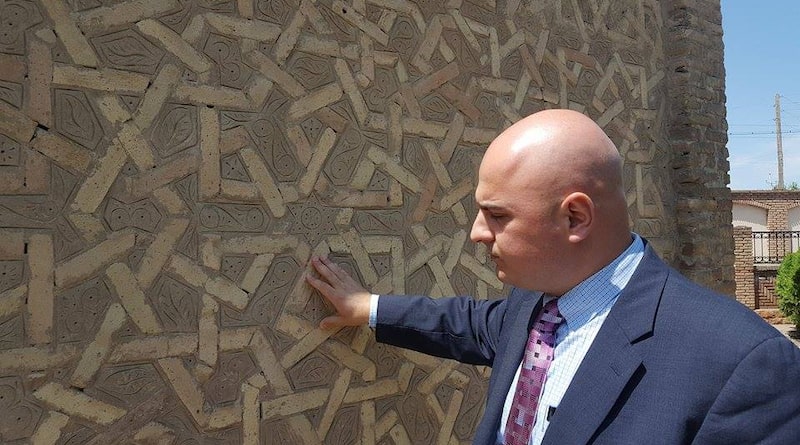
Mrs. Attick and her husband were amazed by the monuments of Momine Khatun Mausoleum, Noah’s burial monument and the natural cave and sanctuary Ashabi-Kahf. According to Attick: “[they] never dreamed of visiting this part of the world! There is so much early history that it is hard to absorb it all. There are many World Heritage sites in Nakhchivan! We hope other people have the opportunity to explore this ancient historical region of Azerbaijan and we know they will be equally impressed by the friendly, kind people and enjoy the magic!” A visit to Nakhchivan, is the best way to enrich one’s knowledge on Eurasian archaeological treasures and sense a five millennia culture embodied within the hard working and kind people of Nakhchivan, Azerbaijan.
Sources:
1. A. Aliyev V. “Old Nakhchivan B.”, 1979; Novruzlu A. I.; Bakhshaliyev V. B. the Archaeological monuments of Nakhchivan and Babek Regions. B., 1995;
2. Habibbayli I. A. “Age of Nakhchivan City, 5 Thousand Years.” Establishment of Nakhchivan Autonomous Republic: history and modernity. B., 2007;
3. Hajiyev I. M. Rzayev F. H. “Once more about the etymology of the word ‘Nakhchivan’”. History and its problems. B., 2007, nr. 2.
Peter Tase is a freelance writer and journalist of International Relations, Latin American and Southern Caucasus current affairs.