Due to the region’s close proximity to the wider Middle East, the Soviet Union sought to use the Caucasus to exert its influence there, particularly in Iran and Turkiye. Today, these two regional hegemons are also vying for influence following the 2020 Nagorno-Karabakh war and ongoing border clashes between Armenia and Azerbaijan.
With Russia evidently resolute about maintaining its post-Soviet sphere of influence across peripheral states, the South Caucasus has found itself yet again a theatre for proxy conflicts. The 2020 war, which ended in Azerbaijan’s favour, was seen widely as a stand-off of sorts between Turkiye and Russia.
Despite their differences in other conflicts such as Syria and Libya, Moscow and Ankara have managed to cooperate and balance relations not only throughout the ongoing military operation in Ukraine, but also in Azerbaijan. The extent of Russia’s complicity in the outcome of the conflict has led to Moscow being accused of betraying its long-time Armenian ally and facilitating Baku’s aggressive posturing, most recently following the 13 September border clashes.
The Armenian government and members of the Armenian public have grown critical and distrustful of Russia’s failure to support their country in their time of need, given that both countries are members of the Collective Security Treaty Organisation (CSTO). Seizing on an opportunity to exploit any potential rift, US House Speaker Nancy Pelosi paid a historic visit to Yerevan last month, condemned Baku and discussed possible security guarantees.
Nevertheless, the hypocrisy of the West and more specifically the EU has been exposed by its unwavering solidarity with Ukraine, in contrast with its apparent abandonment of Armenia, while courting energy-rich Azerbaijan.
For its part, Turkiye is a proponent of pan-Turkism and has been keen on working with Baku to establish the so-called Zangezur corridor, a transportation project bypassing Armenian checkpoints and linking it with Azerbaijan’s Nakhchivan enclave. If realised, this would also undermine Iran’s interests; it shares a land border and maintains strong ties with Armenia. As far as Tehran is concerned, this is a red line as it would lose its role connecting Turkiye with Central Asia, and East and West.
Iran’s arch-foe Israel has also found value in its alliance with the Islamic Republic’s neighbour Azerbaijan; Israel is Baku’s third-largest export destination by supplying the occupation state with 40 per cent of its energy needs. Israel in turn has been the main supplier of arms to Azerbaijan and accounted for almost 70 per cent of arms imports in 2020.
The complex and paradoxical geopolitics of the South Caucasus is such that one can find Israeli flags being waved in Shia-majority Azerbaijan, while Iranian flags have been seen to be raised in Christian Armenia.
The South Caucasus is now set to become even more complicated, thanks to the rivalry between South Asian neighbours Pakistan and India which could find its way to playing out by proxy between Armenia and Azerbaijan.
Following in Turkiye’s footsteps, Pakistan became the second country in the world to recognise Azerbaijan’s independence in December 1991. In June this year they marked 30 years of diplomatic relations. Pakistan is also notable in being the only country in the world that doesn’t recognise Armenia as a state.
This policy stems from Islamabad’s solidarity with Azerbaijan over the Nagorno-Karabakh dispute, most recently over last month’s border clashes, by supporting Baku’s “right to defend its territorial integrity”. In response, Armenia has sided with Pakistan’s nemesis India over the contentious Kashmir issue, which has been fought over three times.
Military ties between Baku and Islamabad have grown over the three decades of their close relations, and were upgraded considerably last year following the first joint military drills between Turkiye, Pakistan and Azerbaijan — “The Three Brothers – 2021” — in Baku. Furthermore, Azerbaijan has previously expressed interest in acquiring Pakistani-Chinese JF-17 Thunder fighter jets.
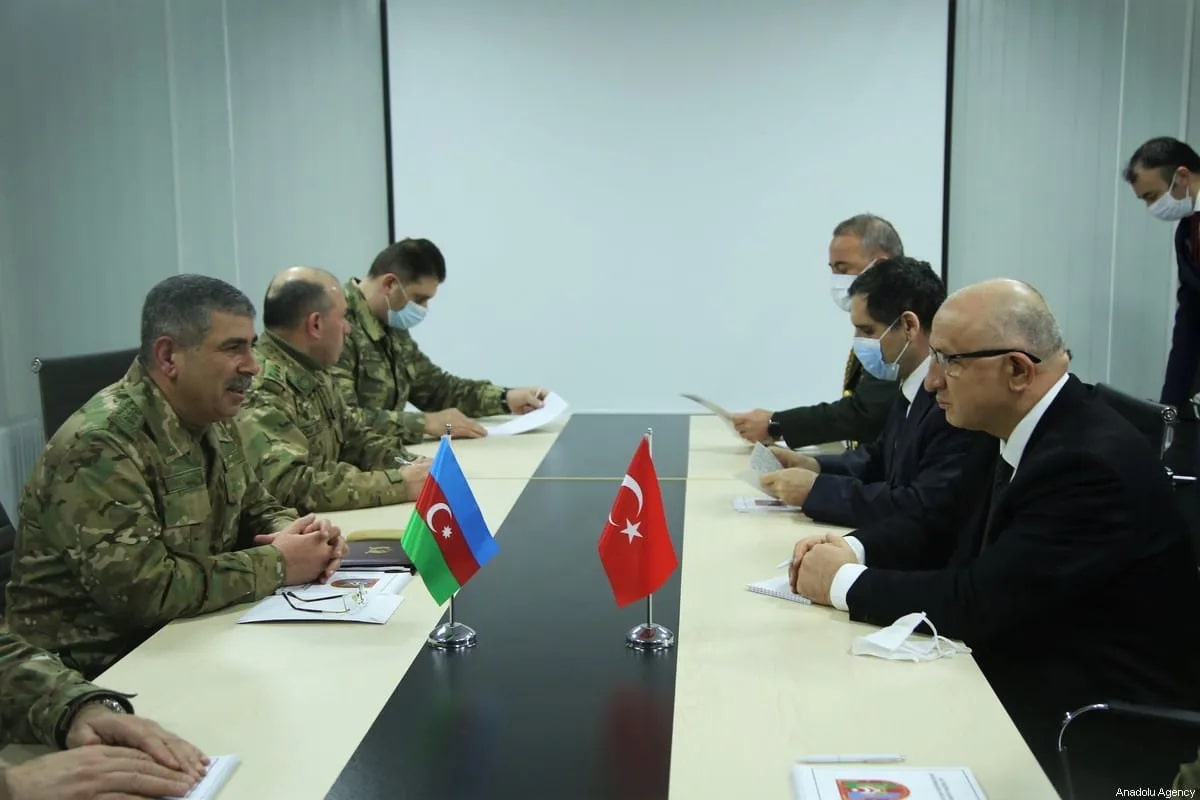
Politically, all three countries signed the Istanbul Declaration in July 2022, aimed at strengthening existing ties, deepening inter-parliamentary dialogue and reiterating support for one another’s territorial claims. Unsurprisingly, India perceives this thriving triple entente with concern. Last week The Economic Times noted that Azerbaijan’s victory against Armenia represents “a possible template for Turkiye-Pakistan military cooperation” and serves as “a warning signal India can no longer ignore”, especially should they one day decide to act jointly in other theatres, “including Pakistan-Occupied Kashmir”.
This coincided with New Delhi’s decision to sign an export order for missiles, rockets and ammunition to Armenia, including the first-ever export of India’s Pinaka multi-barrel rocket launchers. Although the deal’s value has yet to be disclosed, it is reportedly worth $250 million and is to be completed over the next few months.
According to Indian military analyst and retired Air Force pilot Vijainder Thakur, this move signifies not only a breakthrough for India’s overseas arms industry, but also heralds a paradigm shift in the country’s foreign policy of avoiding overt involvement in foreign conflict zones. Tactically, the advent of the Pinaka M-1 with its “fire and disappear quickly” capability is most suited against an adversary known for its heavy reliance on drone warfare.
The South Caucasus wouldn’t be the first proxy theatre for the conflict between Pakistan and India, as the two countries continue to face each other in Afghanistan, with Islamabad’s historic patronage of the Taliban and India’s support of the Northern Alliance and former government of Afghanistan. However, Pakistan could be losing its influence as the Taliban-governed state is open to forging closer ties with India.
“India will have to widen the scope of support to Armenia,” believes Indian Kashmiri scholar and Central Asia expert K N Pandita. “It should train Armenian fighters with the latest war tactics as was done in the case of the Afghan National Army.”
While Pakistan has poor diplomatic relations with Armenia, India has taken a more pragmatic approach and maintained a “principled position” on the Karabakh issue, stopping short of explicitly naming Azerbaijan as the “aggressor” when calling upon it to cease hostilities. Trade is also an important factor to consider, as India became Azerbaijan’s fourth largest export partner in the first six months of 2022 and Baku is unlikely to be willing to jeopardise that by being seen to be too close to Pakistan for India’s liking.
Owing to its geostrategic importance, therefore, the South Caucasus is once again fertile ground for proxy conflicts. During the Cold War, nuclear deterrence between the US and USSR played an important role in ensuring that proxy wars were the main source of military confrontation. Nuclear-armed rivals Pakistan and India may also find themselves engaged in indirect conflict in the South Caucasus although, unlike the Cold War, there will be less of a zero-sum game mentality for the simple reason that business links are important as well.