
According to a 2019 study, 45 million girls worldwide were victims of sex-selective abortions between 1970 and 2017, and more than 97% of those took place in India and China.[1] Some statistical data indicate that the South Caucasus countries—Azerbaijan, Armenia, and Georgia—are the world leaders in sex-selective abortion. However, these studies misrepresent the situation because they are conducted without analyzing the historical demographic process in Azerbaijan, Armenia, and Georgia. In this article we will discuss the sex ratio imbalance in Azerbaijan, as well as in the territories inhabited by Armenians and Georgians.
Irevan Governorate
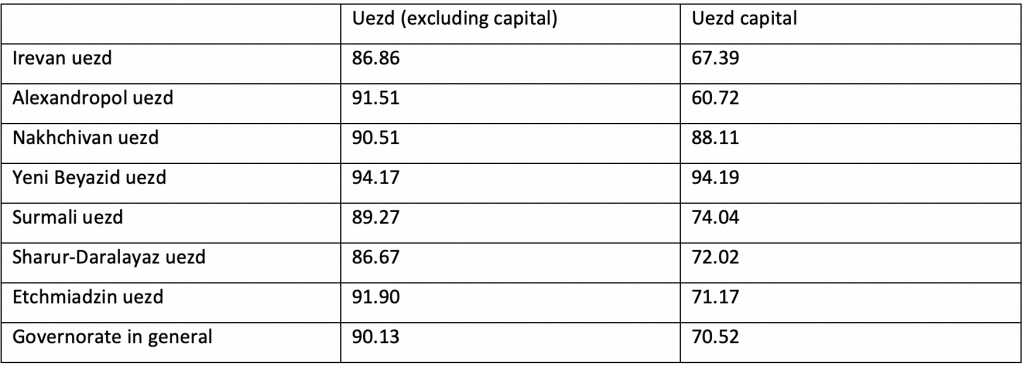
The first consistent source on the demography of the population of the South Caucasus is the first general census of the population of tsarist Russia, conducted in 1897. According to that census, the population of the Russian Empire was 125,680,682, with 101.05 women for every 100 men across the empire. This census revealed that there was a serious disparity in the number of women and men in the South Caucasus, in contrast to other regions of the country. In the Irevan Governorate, where Azerbaijanis and Armenians lived together at the time, this disparity was glaring. Thus, 441,889 of the 829,556 people living in the governorate were men (53.3 percent) and 387,667 people (46.7 percent) were women. Interestingly, the number of women in the cities was much lower than in the uezds (counties). The following table showing the number of women per 100 men illustrates this more clearly:
Table 1. Number of women per 100 men in Irevan Governorate
 Source: Troynitskiy, 1905:VIII.
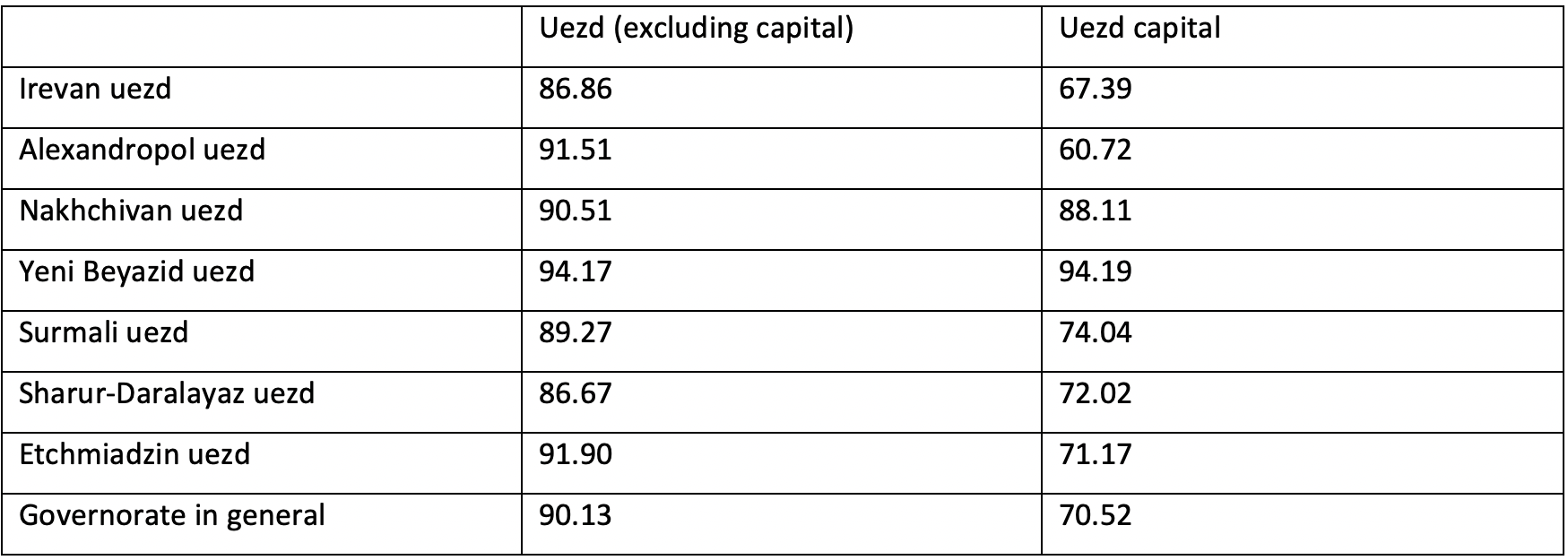
As can be seen from the table, there were more men than women in all uezds and cities of the governorate. Particularly striking is the fact that there were fewer women in urban areas than in rural areas. There was a relative balance in Yeni Beyazid uezd, and the highest imbalance was in Alexandropol uezd. Note that the majority of the population in these 2 uezds were Armenian. The small number of women in Irevan Governorate may also be due to army units stationed in the cities. If we exclude soldiers and officers, the number of women for every 100 men in Irevan Governorate was about 86.
Elizavetpol Governorate
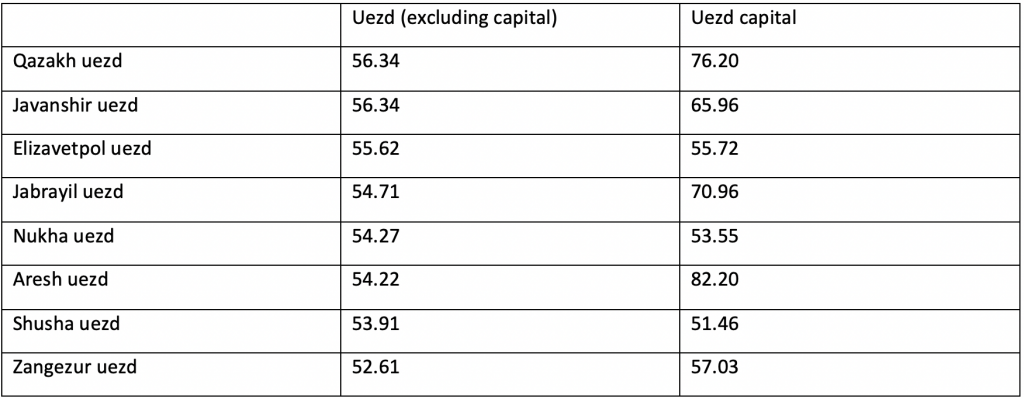
The disparity in the number of men and women in tsarist Russia existed in Elizavetpol Governorate as well. Of the 878,415 residents of the governorate, 480,012 were men (54.6 percent) and 398,403 (45.4 percent) were women. As in Irevan Governorate, in Elizavetpol Governorate the number of women in the uezd capitals was significantly lower than in the uezds themselves.
Table 2. Number of men in Elizavetpol Governorate (%)
 Source: Troynitskiy, 1904:IV.
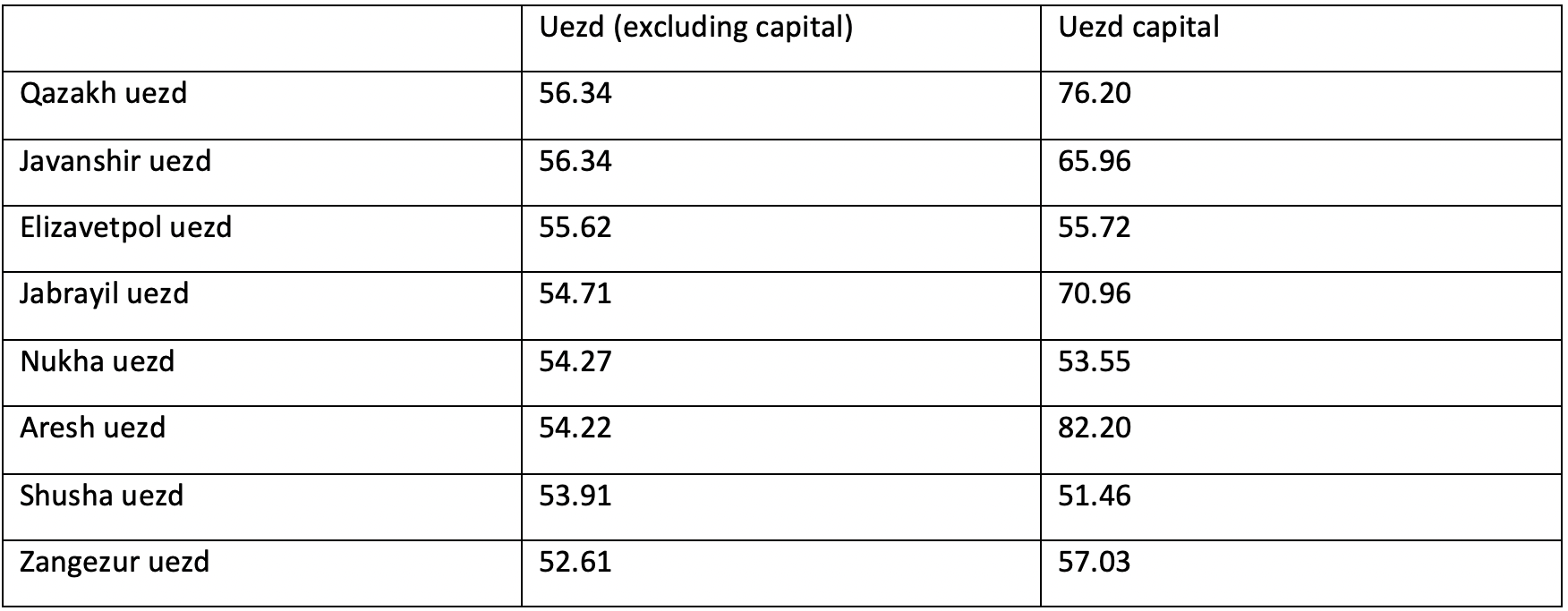
As the table shows, men made up 82 percent in Agdash, 76 percent in Qazakh, and 71 percent in Jabrayil. Agdash was the city with the highest male-to-female ratio (out of 528 people 434 were men, 94 were women) in tsarist Russia.[2] Of the children aged 0-9 in the uezd, 162,399 were boys and 135,221 were girls. According to the 1897 statistics, only Shusha uezd and the uezd capital, Shusha, had a relatively balanced female-to-male ratio.
Baku Governorate and other areas
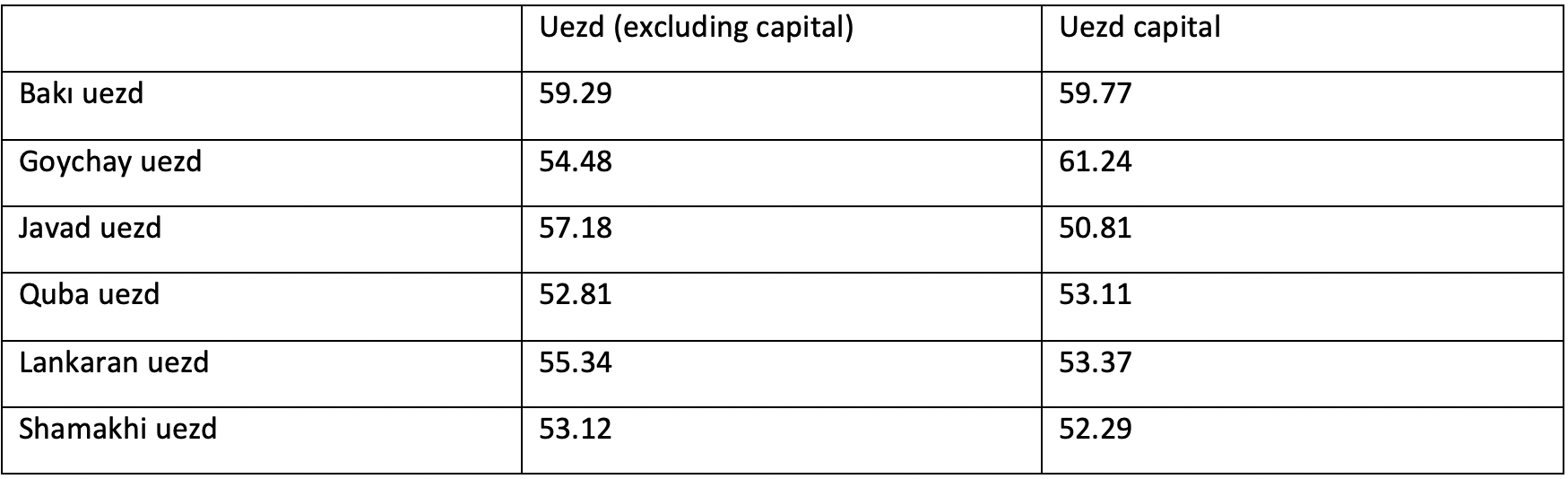
The highest imbalance in the number of women and men in the South Caucasus was observed in Baku Governorate. Of the 826,716 people living in the governorate, 458,065 were men (55.4 percent) and 368,651 (44.6 percent) were women.
Table 3. Number of men in Baku Governorate (%)
Source: Troynitskiy, 1905:1.
The lowest number of women in Baku Governorate was recorded in Baku uezd. Among the uezd capitals, the city of Goychay stood out (1,348 men and 853 women out of a population of 2,201). There was a balance in the female-to-male ratio in Quba uezd and, among the uezd capitals, in the town of Salyan. Similar indicators were recorded in Tiflis Governorate as well. In Borchaly uezd, home to Azerbaijanis of that governorate, 54.8 percent of the population were male, and in Zagatala uezd, 53.9 percent were male (Troynitskiy, 1905:1). In other governorates, where Georgians were a majority, the result was no different. Only in the town of Sighnaghi, the capital of Sighnaghi uezd, the number of women slightly exceeded that of men. The male population in other governorates of the region, including uezd capitals, was higher than the female population. Interestingly, in Dagestan Oblast, which bordered Baku Governorate, the female population exceeded the male population. While the sex ratio among the Avars, Dargins, Lezgins, and Laks inhabiting this region was skewed toward women, there were more men among the Azerbaijanis, Tatars, Armenians, and Georgians living there. This trend among the peoples of the South Caucasus was also observed in other areas. The higher number of men among Azerbaijanis can be linked to both higher rate of male births and Azerbaijani men being exempted from compulsory military service by the officials of tsarist Russia. But the fact that there were more men than women among Armenians and Georgians, who did serve in the army, suggests that this is a demographic indicator characteristic of the region. According to the 1897 statistics, 54.9 percent of the population of Azerbaijan were men and 45.1 percent were women. This is considered the first known and highest figure in the history of Azerbaijan.
Demographic setting in the Soviet period
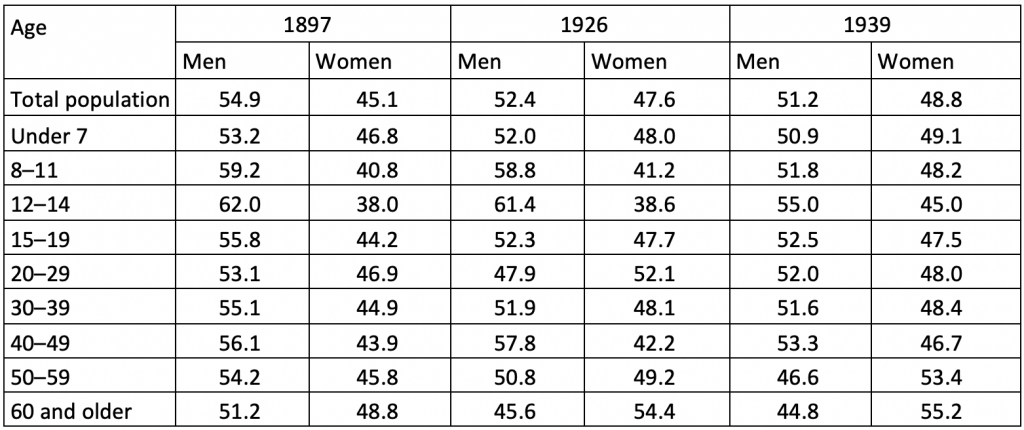
The fall of tsarist Russia in 1917 and the ensuing chaos and wars caused tremendous changes in the gender
 Source: Aliyeva, 2010:36.
With the beginning of the Great Patriotic War in 1941, the gender balance shifted towards women for the first time in Azerbaijan’s history. With 350,000 Azerbaijanis killed in the war, the absolute majority of them men, women now outnumbered men. In 1939-1959 the male population in Azerbaijan increased by mere 110,000, while the female population grew by about 400,000. According to the 1959 Soviet census, women comprised 52.5 percent of the population of the Azerbaijan SSR. At that time there were 1,105 women for every 1,000 men in Azerbaijan. This did not, however, affect the sex ratio at birth. As there were more male births in 1959-1977, the number of women per thousand men dropped to 1,048. In subsequent years, sometimes there were more female and sometimes more male births. The relative balance, which remained until 1989, began to tilt towards boys in 1990.
Situation in modern times
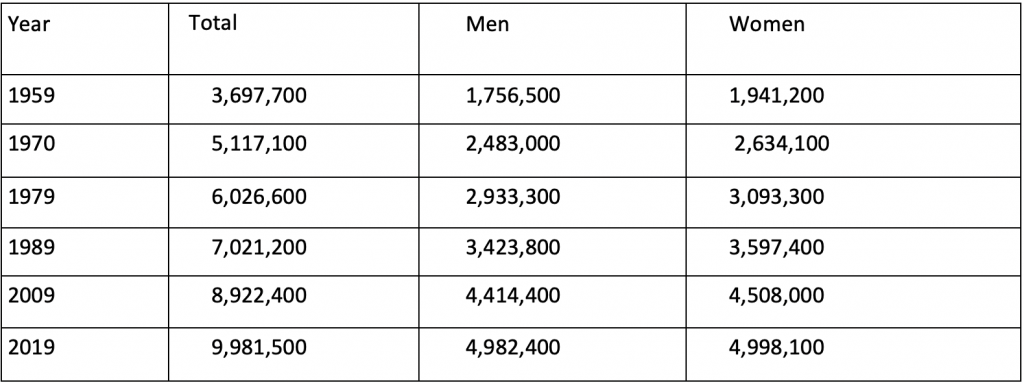
The collapse of the USSR in 1991, the political processes in the country, the war and the wave of migration brought about changes in the population, but did not lead to significant shifts in the gender balance unlike at the beginning of the century. Azerbaijan’s losses during the First Karabakh War did not affect the female-to-male ratio. In 1992, the number of women per thousand men dropped from 1,048 to 1,002 over a 20-year period. According to 2021 statistics, the population of Azerbaijan is 10,119,100 and women make up 50.1 percent of it. With the increase in the male birth rate, men are projected to outnumber women in the coming years.
Table 5. Population growth in Azerbaijan by year (numerical)
 Source: The State Statistical Committee of the Republic of Azerbaijan
Conclusion
International studies on sex-selective abortion rates in Azerbaijan, as well as in Armenia, attempt to explain the situation, using the trend of the last 40 years. For example, an article published in the Journal of Biosocial Science claims that there is a natural correlation between the rates of male and female births before 1992 in both Armenia and Azerbaijan, and it has to do with an increase in the rate of sex-selective abortions in both countries starting from that year. This study takes the 1978-1992 figures as the baseline. In 1978, there were 1,052 women for every 1,000 men in Azerbaijan, while in 1991 the figure was 1,048. Just based on the balance generated over a 24-year period, the authors of the article arrive at the conclusion that the rate of sex-selective abortions in Azerbaijan began to increase in 1992, while practically ignoring the period from 1897 to 1977. Furthermore, the researchers do not explain how the number of women for every 1,000 men, which dropped to 1,028 by 1998, rose to 1,048 the following year. This was a massive shift towards women over one year. In 1999, for the first time in the history of Azerbaijan, there was a decrease in the male population compared to the previous year. With some changes in different years, there is no denying the fact that there are simply more male births in the region. These facts show that the reports of sex-selective abortions in Azerbaijan, as well as in Armenia and Georgia, bear no relation to reality. None of this means, of course, that there are no sex-selective abortions in Azerbaijan at all. Without detailed national statistics on the number of abortions and the reasons they are performed, it is impossible to know the impact of sex-selective abortions on the overall demographics of the country. But the fact that more boys than girls have been born in the Caucasus region in the last 130 years clearly shows that this imbalance is a natural process, and sex-selective abortion has no serious effect on this process.
References
Dimri, A., Gille, V., & Ketz, P. (2021). Measuring sex-selective abortion: How many women abort?
Garenne, M., & Hohmann, S. (2014). Gender saturation in the Southern Caucasus: Family composition and sex-selective abortion. Journal of Biosocial Science, 46(6), 786-796.
https://elar.urfu.ru/bitstream/10995/91877/1/978-5-7996-3044-7_2020.pdf
Aliyeva, F. (2010). О ДЕМОГРАФИЧЕСКОМ СОСТОЯНИИ В АЗЕРБАЙДЖАНСКОЙ ССР В 1920-1940 ГГ. [ON THE DEMOGRAPHIC SITUATION IN THE AZERBAIJAN SSR IN 1920-1940] Vestnik Dagestanskogo Gosudarstvennogo Universiteta. Serija 2. Gumanitarnye nauki = Herald of Dagestan State University. Series 2. Humanities, (4), 33-40.
Motrevich, V.P. (2000). Историческая демография России: учебное пособие [Historical Demography of Russia: Study Guide].
Troynitskiy, I.A. (1904). Первая Всеобщая перепись населения Российской империи 1897. Елизаветпольская губерния [First General Census of the Population of the Russian Empire 1897. Elizavetpol Governorate]. Vol. LXШ.
Troynitskiy, I.A. (1905). Первая Всеобщая перепись населения Российской империи 1897. Эриванская губерния [First General Census of the Population of the Russian Empire 1897. Irevan Governorate]. Vol. LXXI.
Troynitskiy, I.A. (1905). Первая Всеобщая перепись населения Российской империи 1897. Тифлисская губерния [First General Census of the Population of the Russian Empire 1897. Tiflis Governorate]. Vol. LXIX.
Troynitskiy, I.A. (1905). Первая Всеобщая перепись населения Российской империи 1897. Бакинская губерния [First General Census of the Population of the Russian Empire 1897. Baku Governorate]. Vol. LXI.
[1] Liechtenstein has the highest gender disparity at birth in the world.
[2] Such a large disparity may also be due to the number of military personnel in the area.