Russia’s invasion of Ukraine has shattered the entire international system by disrupting the work of numerous international and regional organizations, notably the Organization for Security and Cooperation in Europe (OSCE) – ironically set up to operate for peace and stability from Vladivostok to Vancouver. At the top of the list sits the OSCE’s Minsk Group, a special body tasked with facilitating the Armenian-Azerbaijani peace talks. But was it already dead before the war?
30 Years of Sniping at the Minsk Group
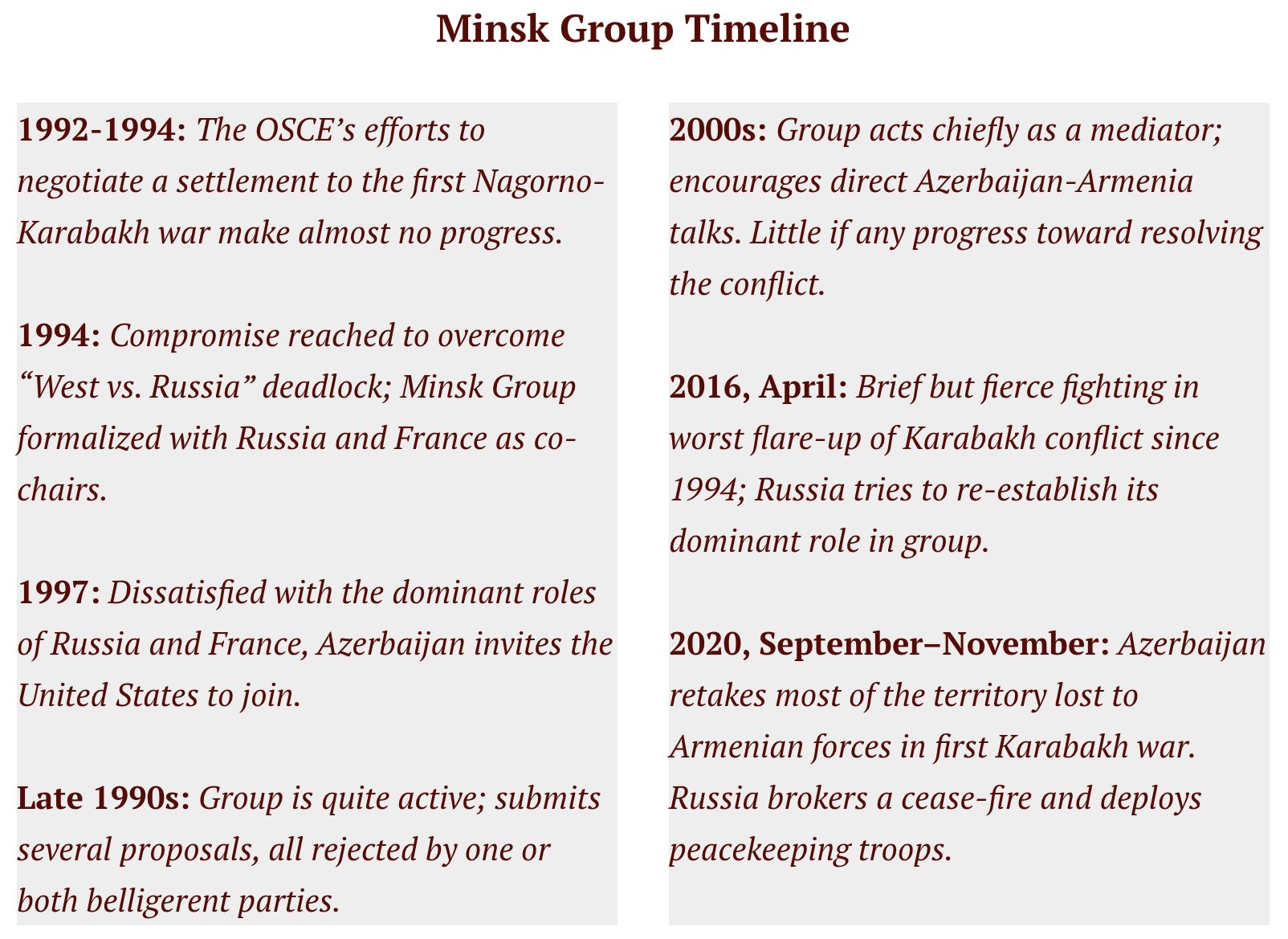
The Minsk Group was created in 1992 when the conflict over Nagorno-Karabakh ballooned into full-out war between the newly independent Armenia and Azerbaijan. As the mediation efforts of the regional powers ultimately failed, the task was passed to the OSCE, then called the Conference for Security and Cooperation in Europe.
For years now, critics of the Minsk Group have claimed that its attempts to mediate the Karabakh peace process turned out to be a complete fiasco and worse, that its efforts had simply prolonged the conflict. The Russian, French, and American co-chairs, in response, often tried to place the onus of negotiating a solution on Azerbaijan and Armenia, arguing the foreign states were merely mediators between the belligerent parties. Despite the co-chairs’ shuttle diplomacy between the capitals, the group’s apparent lack of planning had, since the mid-2000s, generated criticism and distrust in both countries. In Azerbaijan, both the elite and public were dissatisfied with what was seen as equating the aggressor and the victim, and what they saw as the co-chair superpowers’ reluctance to oblige the Armenian occupying forces to withdraw from occupied Azerbaijani territories as demanded by UN resolutions.
In the 2010s, the Minsk Group seemed to have stagnated, unable to present any decent proposals to the warring parties. Ex-Foreign Minister of Azerbaijan Elmar Mammadyarov recalls how he once told the co-chairs that everything would end in a crisis, when one of them exclaimed: “Make a crisis so that we can get out of this deadlock.”
From the Armenian side, critical voices from time to time slammed the Minsk Group usually for impotence to prevent the frequent clashes along the line between Armenian-held and Azerbaijani territory, notably four days of fierce fighting in 2016.
Arguably, the Minsk Group had fallen into a coma even before 2020 as the process had been virtually monopolized by Russia for the past 10 years prior to the outbreak of all-out war in the fall of 2020 as Azerbaijan expelled Armenian forces from most of the territory they held when the 1994 cease-fire took effect. The Russians not only dominated the Armenian-Azerbaijani negotiations, but also provides both sides with weapons despite the arms embargo the OSCE imposed in 1992.
The resentment over the inactivity of the Minsk Group, which was said to have transformed conflict mediation into war profiteering and to have become a sinecure for diplomats who did nothing but enjoy good salaries and luxury trips, was acknowledged by the group’s former U.S. co-chair Richard Hoagland in the spring of 2021: “We stayed in five-star hotels where we were usually assigned suites on the executive floor that gave us access to a private dining room and full bar at no additional expense. We always sought out the best restaurants in the cities where we found ourselves. We lived well while we showed the OSCE flag and reminded Baku and Yerevan that the Minsk Group exists. But to be blunt, very, very little ever got accomplished.”
Not Wanted by the Winning Side
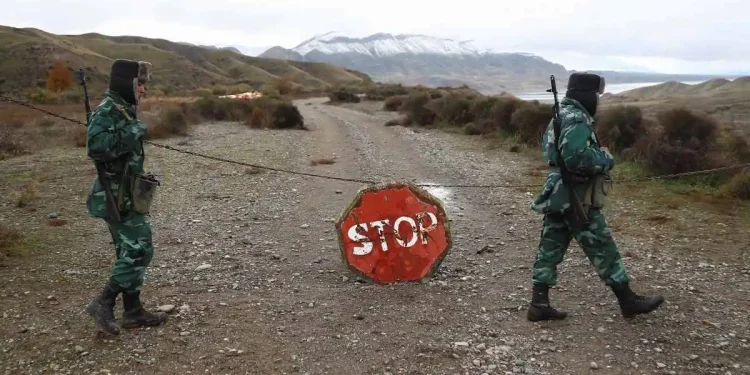
“I did not invite the Minsk Group to come,” President Ilham Aliyev of Azerbaijan said in his nationally televised meeting with the co-chairs on 12 December 2020, a month after the war ended in Karabakh. In triumphant mood, Aliyev explained to the visiting diplomats that Azerbaijan itself had ended the Karabakh conflict, and openly humiliated them, saying that unless “they have something to tell me” on camera, they could leave.
More and harsher criticism came quite recently, in April 2022, when Aliyev accused the Minsk Group of not resolving the problem, but perpetuating “the fact of occupation,” as Armenian lobbying groups “are quite influential in the Minsk Group co-chair countries.”
Although throughout 2021 and 2022 Armenia has invested efforts to reanimate the Minsk Group, its life support was cut off by Vladimir Putin with the invasion in February 2022, after which the coma was followed by brain death.
Several Western diplomats the author has talked to since February said openly that the U.S. and French parties were no longer going to sit down with the Russians within the Minsk Group framework. This probably explains why the group members “promoted” their representatives with new titles such as special envoy to the South Caucasus.
“The Minsk Group is in the process of self-destruction”: this is how the current situation was recently characterized by Aliyev’s foreign policy aide Hikmat Hajiyev. Russian Foreign Minister Sergei Lavrov added his name to the list of mourners at the Minsk Group funeral in April, when he told his Armenian counterpart that the group was no longer able to continue its mediation efforts in the current format, since the United States and France were avoiding doing business with Russia.
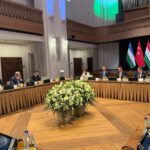
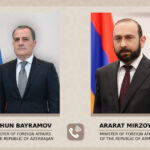
With the Minsk Group virtually defunct, the Armenian and Azerbaijani parties are now exploring new platforms for their negotiations. One of the processes is still “mediated” by the Russians, who do not want to lose their monopoly over the developments, while the EU has activated its efforts through “dining diplomacy.” The foreign ministers of the two countries have also launched direct engagement, which can also be seen as a step forward after the years of conflict and mediated talks.
The Minsk Group was a truly exceptional case in the post-Cold War international relations system because it was one of the few organizations, if not the only, where major international parties with more or less similar views on the task at hand joined together in a constructive partnership. But on the flip side, it was a painful demonstration of how not to do international mediation. While breakthroughs were made in other, more complex conflict situations, the Minsk Group was unable to persuade the belligerents to undertake basic confidence-building measures. The fundamental reason for this difficulty was a philosophical gulf between the Minsk Group’s expectations and the situation on the ground. For instance, when the group drafted proposals with the assumption that Armenia would pull back its forces for the sake of goodwill, Armenia allocated more funds to settle people in areas surrounding Nagorno-Karabakh after expelling the Azerbaijani inhabitants.
The Minsk Group did little to adapt to these evolving realities, until international events drove home the last nail in the coffin of the virtually dead organization.
Rusif Huseynov is a foreign affairs expert specializing in post-Soviet ethnic conflicts. He is the director of the Baku-based Topchubashov Center, an adjunct faculty member at ADA University, and a 2021 ReThink.CEE Fellow at the German Marshall Fund.