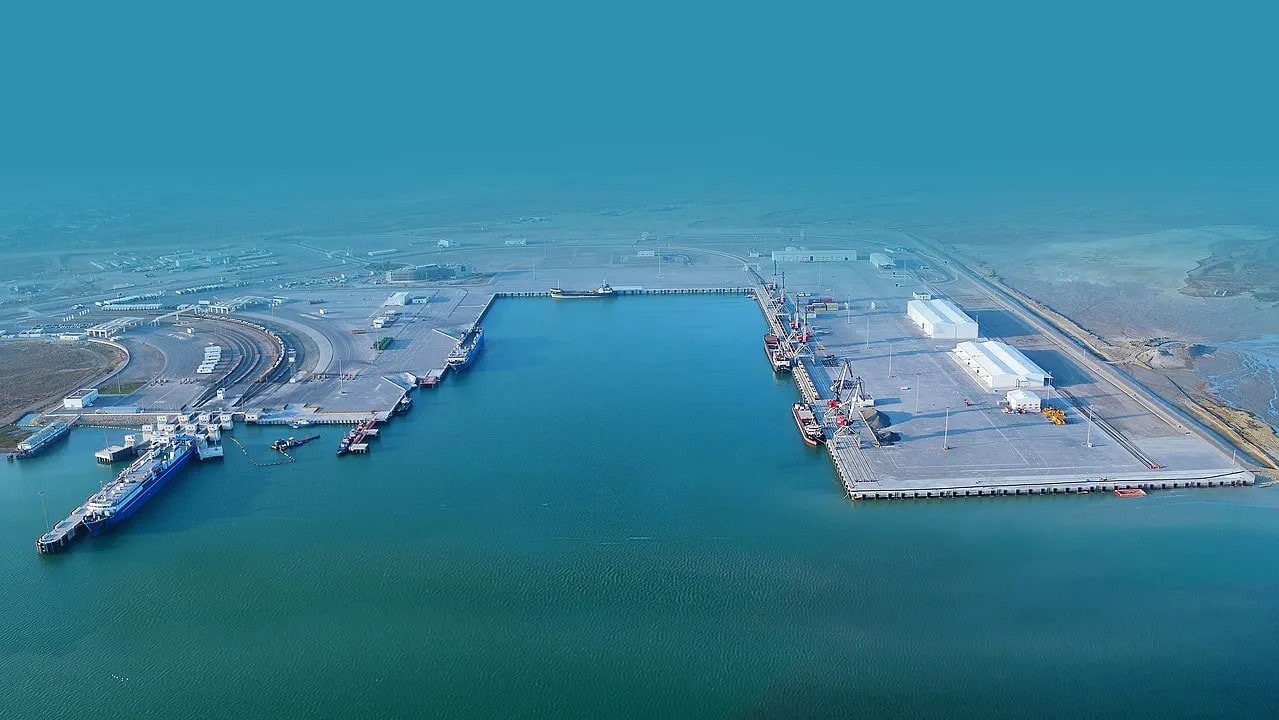
Alat is a township 70 kilometers south of the capital, where the Port of Baku has already been renovated and expanded in two phases from 2012 to 2020.
The Port of Baku is at the western end of the trans-Caspian segment of the Trans-Caspian International Transport Route (TITR, also called the “Middle Corridor”). The TITR runs across Central Asia and the South Caucasus and is designed to facilitate container and commodity transport from east to west.
It is distinct from the “Belt” component of China’s stalled, perhaps even failing, Belt and Road Initiative, which – however one chooses to characterize its progress – has anyway certainly not met its initial expectations.
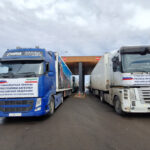
At the end of May, the first Europe-bound block of freight from China’s Tuanjiecun railway station arrived in the Port of Baku on its way to Finland. The Tuanjiecun station is in the Shapingba district of Chongqing municipality in southwestern China. It is about 1,900km nearly due west of Shanghai.
The cargo belongs to the Finnish company Nurminen Logistics and comprises car parts, plastic products, textile equipment, and other non-food products. The Black Sea transit will be by ferry transport from Georgia’s Port of Poti to Romania’s Port of Constanta.
The full distance to Helsinki from Tuanjiecun station is just under 13,000km. An alternative western Black Sea landfall for other shipments could be Bulgaria’s Port of Varna.
Azerbaijan, Kazakhstan and Georgia intend to develop this transportation route more thoroughly. Its potential is estimated at 10 million metric tons or 200,000 containers per year. The three countries plan to establish uniform tariffs for domestic shippers and to improve and simplify the work of carriers in the corridor.
The TITR already had good potential when it was only on the drawing boards, but the international sanctions against Russia and the ongoing physical destruction of Ukrainian infrastructure have diminished the significance of Russia as an export route for goods from Central Asia and China to European markets. This confluence of events greatly increases the TITR’s economic, and also geopolitical, significance.
Plans rumored nearly a decade ago for China to build high-speed rail lines in Russia never got off the drawing boards. Increased maritime-transport costs over the last two years have made overland transport of Chinese goods to Europe even more competitive.
Transit via Russian railways along the China-Russia-Europe route were up roughly by half in 2021 over 2020, exposing unexpectedly low capacity on the main lines plus bottlenecks near ports and border checkpoints.
Yet Russia’s investment plans for increasing its railway capacity have surely been kiboshed by the expenditures involved in its war against Ukraine, not to mention Moscow’s effective militarization of Russian railroads into the indefinite future. Even before the invasion in late February led to new international sanctions against Russia, the volume of Chinese goods transited by Russian railways was already stretched to the limit.
The most recent events are framed by the little-noticed Joint Statement on Enhanced Strategic Partnership signed by Kazakhstan and Turkey on May 11, which underlines their bilateral commitment to the TITR and its further enhancement.
This bilateral cooperation anchors the TITR in Greater Central Eurasia with two significant countries having important geoeconomic profiles, each in its own region. Kazakhstan in particular, along with Azerbaijan, thus stands to benefit from the international sanctions against Russia, for this and other reasons.
In the still broader picture, these events have all come to pass just as the Turkic Council, first established in 2009, has transformed itself in November 2021 into a regular international organization, the Organization of Turkic States (OTS).
Official Chinese observers, rather than seeing the OTS as a contributor to geopolitical stability such as they suppose the Shanghai Cooperation Organization to be, consider that it adds “extreme uncertainty.”
Yuan Peng, the president the Beijing-based China Institutes of Contemporary International Relations wrote, for example, that it is “obvious that [the OTS] is aiming at [becoming] something beyond an ‘organization.’”
What the OTS does, of course, is to provide Kazakhstan and other Turkic states in Central Asia with a “vector” of foreign policy potentially enabling them to avoid being squeezed between China and Russia.
It establishes the Turkic identity as still more central than it already is, to Central Asian self-conceptions. It gives Turkey a stable platform for projecting its “soft power” into Central Asia, enhancing its established economic cooperation and even introducing this cooperation into the military-production sector.
During the visit by Kazakh President Kassym-Jomart Tokayev to Ankara, where he signed the Joint Statement with Turkish President Recep Tayyip Erdogan, the two countries agreed to produce Turkey’s Anka drone in Kazakhstan, a cooperation that will include transfer, maintenance and repairs.
Cargo from China to Turkey has already been using the Port of Baku for nearly two years. According to Tokayev, cargo transportation time from Khorgos, on Kazakhstan’s border with China, to Istanbul, which used to take 60 days, now takes only 13 days.
With the Phase II expansion of the Port of Baku complete, it will be able to handle 25 million tons of general cargo annually, including 500,000 twenty-foot equivalent units (TEUs) in containers. All of this infrastructure development occurred over the past decade, without the anticipation that Russia would launch an all-out war against Ukraine.
Ports being further developed for the TITR on the eastern coast of the Caspian Sea include Kuryk in Kazakhstan and Turkmenbashi in Turkmenistan. Kuryk’s current annual capacity is 4.1 million tons, including 240,000 TEUs, which volume is intended to be increased to almost 6 million tons by some time next year.
Turkmenbashi’s capacity is currently 4 million tons per year, including 400,000 TEUs. Of course, capacity is not equivalent to actual volumes of transit; but the TITR is coming to fruition just as freight transportation across Russia seems to be crumbling and maritime-transport costs continue to rise relative to overland-transport costs.
The TITR’s entry to service is drawing attention to the trans-Caspian route and confirming its viability. This is occurring in conditions of the threat of energy starvation in Europe and elsewhere.
The oncoming success of the TITR is therefore already re-animating interest, among world energy-industry leaders, in the Trans-Caspian Gas Pipeline from Turkmenistan to Azerbaijan, and even the Trans-Caspian Oil Pipeline from Kazakhstan to Azerbaijan.
The self-directed buildup of Azerbaijan’s multimodal transit infrastructure over the past decade only makes such possibilities more interesting and feasible.
Robert M Cutler is a Fellow of the Canadian Global Affairs Institute.