Khojaly in the Soviet period
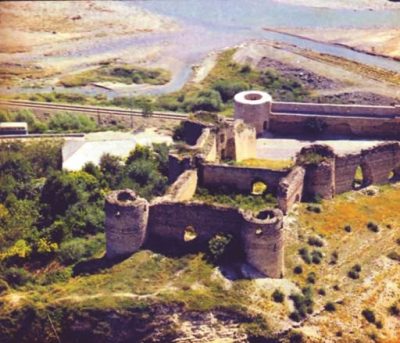
According to official records, 172 Azerbaijanis and 52 Russians lived in Khojaly in 1912. In 1923, Khojaly became part of the NKAO as a small village inhabited by Azerbaijanis. The population of the village began to grow rapidly during the Soviet period. Although Armenians initially lived in the village, their numbers decreased over time, and the last Armenian left the village in the early 1980s. In 1988, the population of the village of Khojaly was close to 2,000.
The proximity of Khojaly to the center of the region, Stepanakert, and its flat terrain increased the strategic importance of the village. This factor became more apparent after the Miatsum movement for the annexation of Nagorno-Karabakh to Armenia. In terms of population, Khojaly was the second largest Azerbaijani-populated settlement in Nagorno-Karabakh after Shusha.
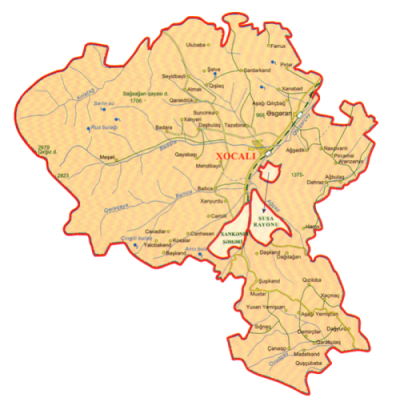 The road passing through Khojaly, connecting Stepanakert and Askeran and leading to a major Azerbaijani city of Agdam, added to its importance. Besides, the only airport in Nagorno-Karabakh was located here. From 1988, major construction works were under way in Khojaly to create a foothold against Armenian separatism. In addition, the resettlement of Azerbaijani refugees from Armenia and Meskhetian Turks to the region began (Human Rights Watch/ Helsinki (formerly Helsinki Watch) Report, 1992:20).
With the Azerbaijani refugees from Stepanakert and some other settlements in Nagorno-Karabakh, the population of the village increased from 2,135 to 6,300 in 1988-1991.[1] The Azerbaijan SSR gave Khojaly the status of a town. From 1990, the airport was controlled by an OMON unit to organize the defense of the town. However, after Azerbaijan, as well as Nagorno-Karabakh, declared independence in 1991, the Soviet army began to withdraw from the region. Thus, the land communication with Khojaly, which remained within the NKAO, was cut off. From the fall of 1991, Khojaly was under blockade.
Khojaly before the attack
After the internal troops of the USSR left Karabakh, the only communication between Khojaly and other settlements of Azerbaijan was by helicopters. From January 1992, the power supply to the town was also cut off.[2] The Armenian side, having prepared itself to resolve the conflict using military means, lost no time in acting. From early February onwards, the Azerbaijani-populated villages of Malybeyli, Garadagli and Agdaban were occupied. At least 99 civilians were killed and 140 wounded in the process. (Cornell, 2000:81).
The next main target was Khojaly. An Azerbaijani woman from Khojaly recalls those days: “After Armenians seized Malybeyli, they made an ultimatum to Khojaly… and that Khojaly people had better leave with a white flag. Alif Gajiev [the head of the militia in Khojaly] told us this on 15 February, but this didn’t frighten me or other people. We never believed they could occupy Khojaly.” (Human Rights Watch/ Helsinki (formerly Helsinki Watch) Report, 1992:20). At that time, the people of Khojaly could get news from the outside world only on generator-powered radios. Deprived of basic necessities, Khojaly residents began to leave the town in January 1992. Government officials followed the population. The last helicopter flight from the town to other parts of Azerbaijan was made on February 13, 1992. More than 300 civilians were evacuated from the town then.
 Every day after February 13, the residents of Khojaly were promised helicopters on the radio, but it never happened. All this time, Khojaly was under fire. On February 12 and 13, the Armenian army shelled Khojaly from the direction of Tazabin and Mehdiyabad from BMP vehicles. Two civilians were wounded and several houses were destroyed. On February 13, the Armenian military equipment began to move towards Dashbulak, Tazabin, and Askeran. On February 16, 1992, the chief of General Staff, Shahin Musayev, was informed the “the town of Khojaly continues to receive massive fire from infantry fighting vehicles and armored vehicles. The situation in the town is critical. Urgent measures should be taken to carry out the evacuation of civilians and, in particular, to protect the airport, which is a strategically important facility.”(Velimamedov, 2019:33).
Attempts to lift the blockade of Khojaly
Azerbaijani government officials were aware of the situation in Khojaly. On December 17, 1991, Elman Mammadov, the head of the executive power of Khojaly, wrote in a telegram addressed to President Ayaz Mutallibov: “As a result of attacks of Armenian armed groups, settlements of Nagorno-Karabakh inhabited by Azerbaijanis have fallen under the enemy control. A heavy attack on Khojaly is being prepared to open the road between Stepanakert and Askeran. The Armenians will do their best to exterminate us. Frequent flights of Armenian helicopters prove this. I ask you to immediately take necessary measures to organize the defense of Khojaly. Khojaly is a strategically important point for Azerbaijan. We are waiting for urgent help.”[3]
Upon receiving this telegram, Ayaz Mutallibov instructed State Secretary Midhat Abbasov to take the necessary measures. Some time later Midhat Abbasov informed the president about the measures to be taken: “The heads of the Ministry of Internal Affairs, Ministry of National Security, Ministry of Defense and other government agencies have been instructed. A general decision has been made on the measures to be taken.”
At the end of December 1991, the Khojaly District Prosecutor Atakishi Atakishiyev sent a telegram to President Mutallibov and Prosecutor General Murad Babayev. The telegram read: “It’s all going to be over for us soon, you must understand what we are saying. The population wants to leave Khojaly. We haven’t received any help from the Ministry of Defense. Mr. President, if the population leaves Khojaly, the Stepanakert-Askeran road will be open. Please help us. Not a single office, not a single enterprise, not a single kolkhoz or sovkhoz is functioning in Khojaly. There is no medical equipment for emergency treatment of the wounded. There are no bandages. We are waiting for your help immediately, otherwise it will be too late. We need help urgently.”[4]
Ayaz Mutallibov once again contacted the Ministry of Defense and demanded that the necessary help be provided. After problems arose with the evacuation of the population from Khojaly by air, the only way to transport the civilian population out of Khojaly was through the Agdam-Askeran-Khojaly corridor. A major military operation was required to cross this land corridor. The plan for such an operation was drafted in late January-early February by Major General Dadash Rzayev, Deputy Minister of Defense for Combat Operations, and his staff.
On February 6, 1992 the offensive began, but the Azerbaijani troops were able to liberate only the villages of Khramort and Farrukh of Askeran District.[5] Having encountered strong resistance from the Armenian troops, the Azerbaijani army was forced to halt the offensive. A few days later, having launched a counter-offensive, the Armenian army recaptured the villages of Khramort and Farrukh. The next operation to create a land corridor from Khojaly was to take place in mid-February. Measures had already been taken to prepare for the operation again and additional military equipment had been received from Baku. According to the plan, the army was to deliver a counterstrike from Khojaly in the direction of Askeran and from Agdam in the same direction, break through the Armenian frontline and, merging the forces advancing from Khojaly and Agdam, form an Agdam-Askeran-Khojaly land corridor. However, the operation was never executed with the dismissal of Fahmin Hajiyev, who would participate in the fighting.
 On February 14, the Ministry of National Security reported to the president on the military personnel and equipment in Khojaly: “Local battalion – 80 persons; National Army soldiers – 20 persons; local police officers engaged in airport security – 80 persons; automatic weapons – 200-250 units; Alazan rocket launcher – 2 units; artillery gun (102mm caliber) – 1 unit (rounds are running out); automatic grenade launcher (AGS-17) – 1 unit; grenade launcher (GP-25) – 4 units. There is no electricity in the town, there is an extreme shortage of military equipment, grenade launchers and anti-tank bombs.”(Velimamedov, 2019:34).
On the eve of the occupation of Khojaly, the political situation in the country was unstable as well. On February 18, 1992, the Azerbaijan Popular Front Party delivered an ultimatum to Mutallibov, demanding his resignation within 10 days. Thus, the country was plunged into a domestic political chaos. The army began planning a new operation to lift the blockade of Khojaly at the end of February. Bad news about Khojaly started to arrive from Agdam. On 25 February 1992, Tamerlan Garayev, Deputy Chairman of the Supreme Soviet, brought an encrypted message from Agdam to President Ayaz Mutallibov: “The forces in Khojaly and Umudlu are almost exhausted. Due to the lack of support (helicopters have not flown for several days) the resistance to the Armenian troops is weak. Urgent measures must be taken to save Khojaly and Umudlu from the siege. For this purpose, it is necessary to send a responsible person to Agdam and instruct him to organize these measures within 24 hours. I await your decision.” (Velimamedov, 2019:35).
But it was already too late.
The attack on Khojaly
Armenian General Arkady Ter-Tadevosyan, who planned the attack on Khojaly, justified the attack on the town with 2 reasons.
- Stepanakert was regularly shelled from Khojaly by Azerbaijani Army’s BM-21 (Grad).
- Helicopters were incapable of supplying the growing demand for fuel and military equipment as the fighting intensified. The Khojaly airport was vital for the use of airplanes. (Ter-Tadevosyan, 2007:568).
Ter-Tadevosyan had been preparing for the operation for three weeks. A total of 487 Armenian soldiers took part in the Khojaly operation. For the first time in the Karabakh war, Armenian units used armored vehicles— two units of BRDM, and one 100-mm Rapira antitank gun. The main focus of the attack was Khojaly airport, and that is where the heaviest fighting broke out. The detachment under command of Alif Hajiev guarding the airport territory fought against superior enemy forces for several hours. Almost the entire group was killed in an unequal combat. The surviving soldiers managed to blow up the air traffic control tower so that it would not fall into the hands of the Armenians. Alif Hajiyev himself along with the surviving soldiers helped the residents of Khojaly to move towards Agdam (Human Rights Watch/ Helsinki (formerly Helsinki Watch) Report, 1992:21). It was there that he was killed while rescuing the civilians.
Major Tofig Huseynov, the commander of the Khojaly self-defense battalion, left the town with them to organize the protection of civilians fleeing towards Agdam. On the way to Agdam, Tofig Huseynov’s detachment was ambushed. In an unequal battle, severely wounded, Tofig Huseynov allowed the enemy soldiers to approach him and blew up himself and the nearby Armenian soldiers with a grenade (Velimamedov, 2019:44).
Ter-Tadevosyan writes about the Khojaly battle: “The offensive began at 10 p.m. and the fighting went on for about a day and a half. The resistance was most persistent in the area of a nine-story building. Two Alazan rocket launchers, one of which was captured in Khojaly itself, and two large-caliber machine guns previously positioned on nearby heights were used to suppress the resistance. Our losses in the Khojaly operation were 8 men, while the enemy lost 23 men killed.” (Ter-Tadevosyan, 2007:569).
Part of the population started to leave Khojaly soon after the assault began, trying to flee in the direction of Agdam. There were armed people from the town’s garrison among some of the fleeing groups. The refugees left in two directions:
1) from the eastern side of the town in the north-east direction along the river, passing Askeran to their left, and
2) from the northern side of the town in the north-east direction, passing Askeran to their right (a smaller number of refugees fled using this route).[6]
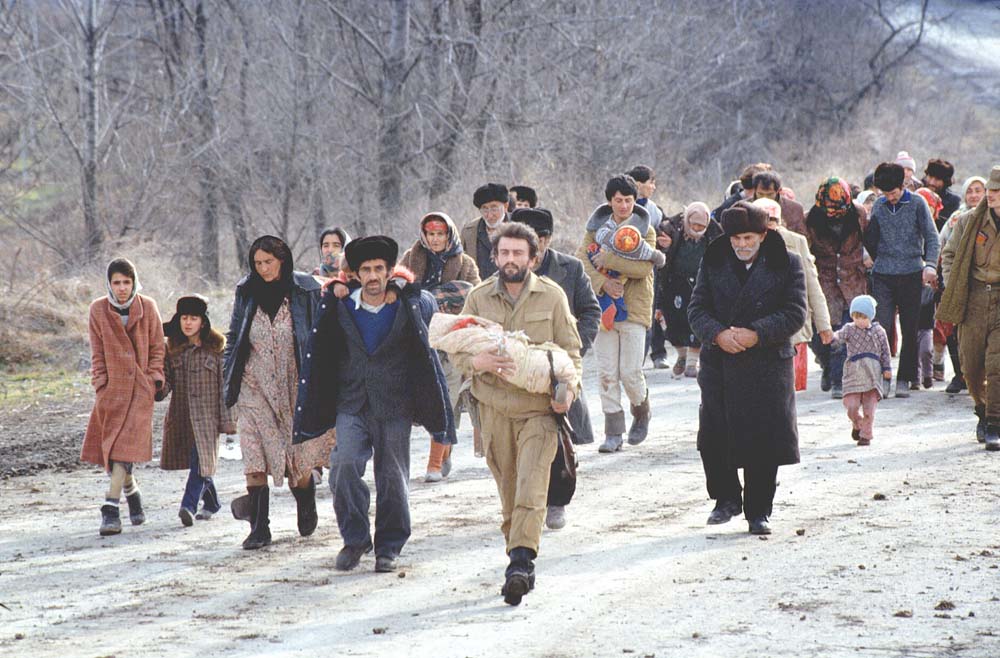
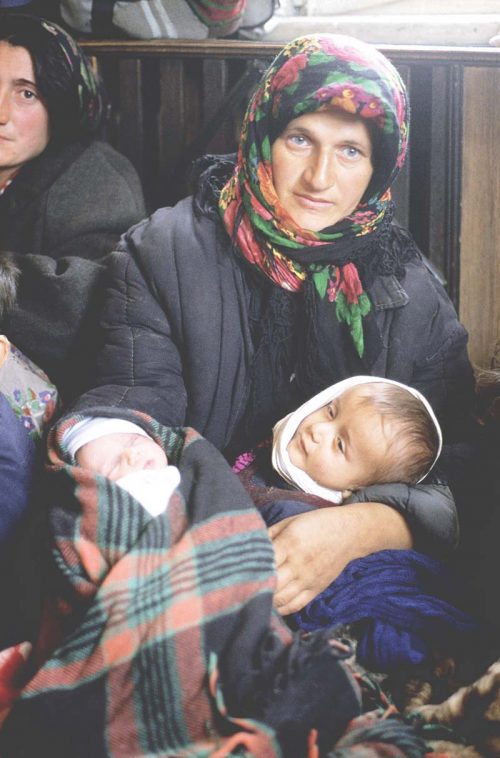
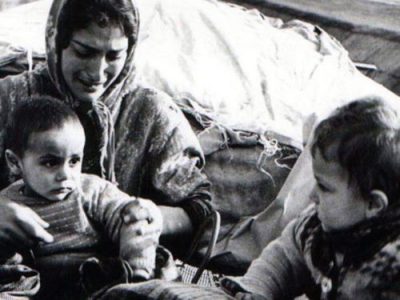
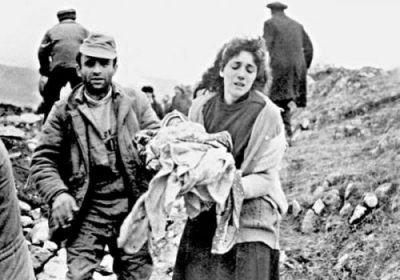
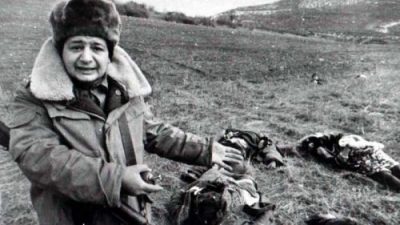
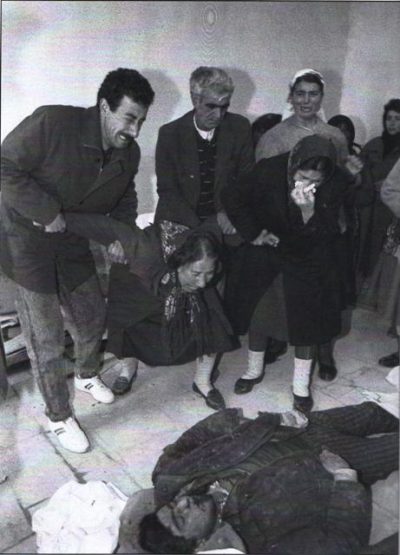 Thus, the majority of civilians left Khojaly, while around 200-300 people stayed in the town, hiding in their houses and basements. It is also reported that about 300 residents took shelter in the school basement. Some residents of Khojaly at 3 a.m. decided to get out of the basement and move towards Agdam, as the Armenians entering the town were instructing the refugees to do so (Human Rights Watch/ Helsinki (formerly Helsinki Watch) Report, 1992:21). The Armenians fired on the “caravan of refugees” as the first group was accompanied by armed garrison soldiers. In a panic, part of the group strayed from the route and headed directly to the location of Armenian military units, where they were killed. Most of the deaths occurred in the direction of the village of Nakhchivanik. It is still not quite clear why some of the refugees moved in this direction after crossing the Gargarchay. Initially, it was assumed that the Popular Front battalion in this area deliberately steered the people toward the Armenians. Deaths of more civilians would have created an additional opportunity for the Popular Front to oust Mutallibov.[7]
Later developments in the country confirmed this. Refugees heading in the second direction also came under fire, despite the provision of a corridor. Casualties here were on a smaller scale compared to the first group. When the town was occupied by the Armenian armed forces, some 300 civilians remained in it, 86 of whom were Meskhetian Turks. By March 28, 1992, more than 700 residents of Khojaly, who remained in the town and had been captured in the direction of Agdam, were handed over to Azerbaijan.[8] Many of them were women and children. According to the Karabakh newspaper, issue of March 26, 1992, 476 civilians were killed in Khojaly.[9] The fate of 150 hostages, including 68 women and 26 children, remains unknown to this day. According to the Human Rights Watch report, more than 200 civilians were killed in Khojaly. However, the organization says that these figures come from the Agdam morgue, and estimates the possible total number of deaths at 500-1,000 (Human Rights Watch, 1994:6).
The role of the 366th Motorized Rifle Regiment in the tragedy
A treaty establishing the Joint Armed Forces of the Commonwealth of Independent States was to be signed at the CIS Conference of Heads of State on February 14, 1992 in Minsk.
Prior to the meeting at which this treaty was to be discussed, the Azerbaijani parliament held discussions on the country joining the treaty. Before Mutallibov spoke to the MPs on the issue, Russian President Boris Yeltsin had called him and promised that the 366th Regiment would be withdrawn from Stepanakert. As the main condition for this, Yeltsin asked Azerbaijan to join the treaty on the establishment of the Joint CIS Armed Forces.
Nevertheless, under pressure from the Popular Front MPs, the parliament decided that Azerbaijan would not be joining the treaty establishing the Joint CIS Armed Forces.
A dispute broke out between President Ayaz Mutallibov and Commander-in-Chief of the Joint CIS Armed Forces, Marshal Yevgeny Shaposhnikov, at the meeting of CIS heads of state in Minsk on February 14, 1992. Mutallibov demanded from Shaposhnikov the immediate withdrawal of the 366th Regiment from Stepanakert. But Shaposhnikov ignored all Mutallibov’s demands and responded as follows: “The 366th Regiment will remain in Stepanakert as long as necessary.” (Velimamedov, 2019:36). The involvement of this regiment in the Khojaly operation 11 days after this meeting was intended as punishment for Azerbaijan. Although the commander of the regiment stated that it had not been involved in the attack on Khojaly, eyewitnesses say otherwise. The 2nd and partially 3rd Battalions of the 366th Regiment took part in the Khojaly operation. The commander of the 3rd Battalion, Captain Yevgeny Nabokov, received a reward of 1.5 million dollars.[10] After the capture of Khojaly, he fled to South America with his parents and his Armenian wife.
The group led by the commander of the 2nd Battalion, Major Ohanyan, was fully involved in the operation. Almost all of the 2nd battalion consisted of Armenians. An officer of the 366th Regiment, Captain Markushin, witnessed the above events. Sergei Tushov, Captain of the 366th Regiment, recalls the events: “75-80% of the regiment were Armenians. Since the end of 1991, the moral-psychological situation in the regiment was disastrous, the officers were drunk all the time. There was a semi-open trade of weapons, ammunition and military equipment with Armenian bandits. On February 23, the commander of the regiment decided to station battalions in Armenian villages. The 1st Battalion was stationed in the village of Chanakhchi and the 3rd Battalion in the village of Ballyja near Khojaly. On March 1, Armenians completely took over the regiment. The 2nd Battalion, where the commander was Major Ohanyan, voluntarily went over to the Armenian side with all equipment and weapons. On March 2, the entire personnel of the 366th regiment were taken by helicopters to the town of Vasiani in Georgia. All the Armenians except Major Arutyunov, Captain Arutyunyan and Warrant Officer Petrosyan, who had gone to Yerevan, remained in Khankendi.” (Akhundova, 1993:53-54).
Russian sources also report that the 366th Regiment took part in the Khojaly operation. It is mentioned in the March 11 issue of the Krasnaya Zvezda newspaper: “Despite firm orders from the district command, some servicemen of the 366th Motorized Rifle Regiment still took part in the combat actions near Khojaly on the side of Karabakh Armenians. At least, two such cases were registered. During the evacuation of the regiment’s personnel, paratroopers searched several soldiers and found large amounts of money in their possession, including foreign currency.”(Akhundova, 1993:61-62).
According to President Mutallibov, the Khojaly tragedy was Russia’s punishment for Azerbaijan: if the Popular Front had consented to Azerbaijan joining the treaty on the establishment of the Joint CIS Armed Forces of Azerbaijan, the 366th Regiment would have left Khankendi and the Khojaly tragedy would not have happened (Velimamedov, 2019:46). However, there is still no concrete evidence of Russia’s involvement. All humanitarian organizations, including Human Rights Watch, report that the Russian military involved in the incident did so under the orders of the command.
Armenian attempts to shift the blame to Azerbaijan
 Although Armenians have admitted that civilians suffered during the attack on Khojaly, they have taken no action against the perpetrators of these war crimes.[11] They usually accuse Azerbaijan of using Khojaly residents as human shields and claim that some of the dead were killed by Azerbaijani units.
These allegations are especially exaggerated by pro-Armenian journalists and writers in our days as well. In an interview with Czech journalist Dana Mazalova, Ayaz Mutallibov blamed the opposition, saying that the bodies left on the Agdam road had been later disfigured.
Mazalova, who did not hide her sympathies for the Armenians, concluded that the Khojaly massacre had been committed by Azerbaijanis and circulated the interview in this form. Armenia happily took the same position. It even defended this version in an official letter to Human Rights Watch.
In their response to the Armenian government, Human Rights Watch said that they were surprised that Karabakh Armenians were trying to blame Azerbaijanis for their actions, and that the Nagorno-Karabakh Armenians were directly responsible for the massacre. [12]
Ayaz Mutallibov said that Mazalova had distorted his words, and called shifting the blame for the Khojaly massacre on Azerbaijanis extremely shameful. Be as it may, statements by both former Armenian President Serzh Sargsyan and other Armenian military clearly show that the massacre was deliberate. Serzh Sargsyan on the Khojaly massacre: “Before Khojaly, the Azerbaijanis thought that they were joking with us, they thought that the Armenians were people who could not raise their hand against the civilian population. We were able to break that stereotype. And that’s what happened.” (De Waal, 2008:201).
Furthermore, Monte Melkonian’s brother Markar Melkonian linked the February 26 attack on Khojaly to the Sumgayit events. This day was chosen to take revenge (Melkonian, 2005:214). Some of the Armenians involved in the attack on Khojaly were also refugees from Sumgayit (De Waal, 2008:199-201).
This is how Svante Cornell describes the significance of the Khojaly massacre for the Armenians: “The Khojaly massacre to a large extent spared the Karabakh Armenians the trouble of evicting civilians from the Azerbaijani regions they were to conquer in 1993: as Armenian forces moved in, civilian Azeris had already fled their homes, fearing a massacre of the Khojaly type were they to have stayed. It is very possible that the aim of the Khojaly massacre was to create precisely this type of fear.” (Cornell, 2000:83).
Lies told to the Azerbaijani public about Khojaly
The events in Khojaly were concealed from the Azerbaijani public for some time. At about 6 p.m. on February 26, 1992, Minister of Internal Affairs Tofik Kerimov reported that “Khojaly is being attacked by Armenians, two people are killed and some wounded, the situation is bad, but there is no reason for panic.” Rasim Agayev suggested disseminating this information through the media and began to prepare a draft of the announcement. Some time later, at 7 p.m., Kerimov came up with another lie: “We were able to land two helicopters in Khojaly, Azerbaijani groups launched an attack on Askeran, the spirits of the defenders of Khojaly are high, we managed to secure the town.” On the basis of this information from the Minister of Internal Affairs Rasim Agayev prepared an official announcement saying that, according to the Azerbaijani Ministry of Internal Affairs, Khojaly was under our control, and only two people had been killed. According to the report of the parliamentary commission investigating the Khojaly events, the Minister of Internal Affairs Tofik Kerimov explained the attempt to conceal the truth about Khojaly by saying that he “saw how ill the President looked and did not want to upset him, so to comfort him I said that only two people had been killed…” (Velimamedov, 2019:45).
Plans to liberate Khojaly and Mutallibov’s resignation
 Considering the Russian factor in the occupation of Khojaly, Mutallibov sent a telegram to Marshal Shaposhnikov on February 28, 1992 informing him that Azerbaijan would join the Joint CIS Armed Forces. According to Mutallibov, Marshal Shaposhnikov welcomed this decision of the president of Azerbaijan. Shaposhnikov promised to withdraw the 366th regiment from Stepanakert and return Khojaly to Azerbaijan. During the consultations with Shaposhnikov, it was decided to conduct a joint operation to liberate Askeran and Khojaly with the support of the 23rd Motorized Rifle Division and the 104th Airborne Division. After the discussions, units of the 23rd Motorized Rifle Division and the 104th Airborne Division began moving to Agdam. On March 3, Army General Nikolai Popov arrived in Agdam. At a meeting with representatives of Agdam District, General Popov said that he would accomplish his assigned task and provide assistance to Azerbaijan. But the events in Baku did not allow this (Velimamedov, 2019:46).
A session of the Supreme Soviet of Azerbaijan was held on March 5-6, 1992. The building of the Supreme Soviet was surrounded by numerous supporters of the Azerbaijan Popular Front Party and the Azerbaijan National Independence Party. The protesters announced that they would not let the MPs and the president out of the building until President Ayaz Mutallibov resigned. From the first minutes of the session, APF MPs seized the initiative. The video shot by Chingiz Mustafayev at the site of Khojaly massacre was demonstrated at their demand. Members of the opposition parties began to hurl accusations at the president.
President Mutallibov was accused of: working for the Jewish lobby by Iskender Hamidov, selling Khojaly to the Armenians by Etibar Mamedov, working for Moscow by Shadman Huseynov, and serving the Russian imperialism by Tofik Gasimov.
The Parliament was adjourned until the following day, but the people who surrounded the building did not allow the MPs to leave. MPs and the president therefore had to spend the night in the parliament. The confrontation continued on March 6, 1992. In the evening of March 6, 1992, Mutallibov was forced to resign after continued pressure from the opposition. During these events in Baku, the Russian army carried out the Askeran and Khojaly operations. On March 3-4, 1992, a large caravan of Russian troops arrived in Agdam (footage of the Russian army arriving in Agdam can be viewed here). According to the commandant of Agdam Jamal Ahmadov, the military caravan consisted of 125 units of equipment. The Russian army positioned itself near the village of Shelly in Agdam, and the fighting began.
 The attack on Askeran began at about 12 p.m. on March 6, 1992. The objective was to take Askeran and Khojaly, as well as the important heights of Aggadik and Dashbashi. In the course of the attack the line of defense of Armenian groups was broken and the troops entered Askeran. However, at about 6 p.m., after receiving the news of Mutallibov’s resignation, the Russian army withdrew from action. Tahmasib Novruzov, a member of the Agdam branch of the Popular Front, recalls that day: “In the evening of March 6, 1992, I called Baku, talked to Oktay Gasimov, Panah Huseynov, Isa Gambar and Iskender Hamidov and asked them to suspend the demand for the resignation of Mutallibov until the operation to capture Askeran was over, because if Mutallibov resigned before the end of the operation, the Russian troops would withdraw and go back to Ganja. But I was unable to convince them. By nightfall, the Armenians had regained full control of Askeran.”
Thus, because of infighting, Azerbaijan lost the opportunity to turn the tide of the Karabakh war in its favor and take control of Askeran and Khojaly. (Velimamedov, 2019:47).
References
Cornell, Svante (2000) Small Nations and Great Powers. A Study of Ethnopolitical Conflict in the Caucasus.
De Waal, Tomas (2003) Black Garden: Armenia and Azerbaijan Through Peace and War.
Human Rights Watch/Helsinki (formerly Helsinki Watch) Report (1992) Bloodshed in the Caucasus.
Human Rights Watch (1994) Azerbaijan: Seven Years of Conflict in Nagorno-Karabakh.
Melkonian, Markar (2005) My Brother’s Road: An American’s Fateful Journey to Armenia.
Akhundova, Elmira (1993) Khodzhaly. Khronika genotsida (Khojaly. The Chronicle of the Genocide)
Ter-Tadevosyan, Arkadiy (2007) Analiz boyevykh deystviy v Artsakhe (v period s iyulya 1991 po iyul’ 1992 gg.) (Analysis of Combat Operations in Artsakh (From July 1991 to July 1992)), Voprosy strategii i bezopasnosti (Issues of Strategy and Security) (Armen Ayvazyan), Book II.
Velimamedov, Mamed (2019) Ocherki po Karabakhskoy voyne (Essays on the Karabakh War)
Notes
[1] Report by the Memorial Human Rights Center “On Mass Violations of Human Rights in Connection with the Armed Capture of the Town of Khojaly on the Night of 25 to 26 February 1992”, p. 4
[2]Report by the Memorial Human Rights Center “On Mass Violations of Human Rights in Connection with the Armed Capture of the Town of Khojaly on the Night of 25 to 26 February 1992”
[3] http://anl.az/xocali/x_qazet/Azerbaycan.-2009.-22fevral.-S.3..pdf
[4] http://www.anl.az/down/meqale/kredo/2019/fevral/636171(meqale).pdf
[5] Report by the Memorial Human Rights Center “On Mass Violations of Human Rights in Connection with the Armed Capture of the Town of Khojaly on the Night of 25 to 26 February 1992”, p. 3
[6] Report by the Memorial Human Rights Center “On Mass Violations of Human Rights in Connection with the Armed Capture of the Town of Khojaly on the Night of 25 to 26 February 1992”, p. 5
[7] European Courts of Human Rights, Case of Fatullayev v. Azerbaijan, Application no. 40984/07, Strasbourg, 22 April, 2010 https://dejure.az/ru/node/1370
[8] Report by the Memorial Human Rights Center “On Mass Violations of Human Rights in Connection with the Armed Capture of the Town of Khojaly on the Night of 25 to 26 February 1992”, p.8
[9] Report by the Memorial Human Rights Center “On Mass Violations of Human Rights in Connection with the Armed Capture of the Town of Khojaly on the Night of 25 to 26 February 1992”, p.7
[10] Tatyana Chaladze: “For the massacre in Khojaly, Russian battalion commander received one and a half million dollars”
[11] Report by the Memorial Human Rights Center “On Mass Violations of Human Rights in Connection with the Armed Capture of the Town of Khojaly on the Night of 25 to 26 February 1992”, p. 9
[12] Response to Armenian Government Letter on the town of Khojaly, Nagorno-Karabakh https://www.hrw.org/news/1997/03/23/response-armenian-government-letter-town-khojaly-nagorno-karabakh