
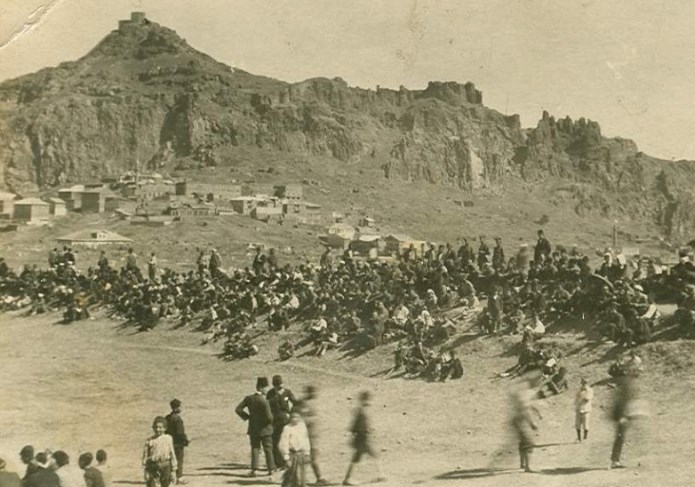
The documents show that parting with the land of their grandfathers and great-grandfathers became a real tragedy for the Azerbaijani deportees.
The secret report “On the sentiments among the Azerbaijani population of Armenia in connection with the upcoming resettlement to the Azerbaijan SSR” prepared by Major General Grigoryan, Minister of Internal Affairs of the Armenian SSR, dated May 3, 1948, said, “We have recorded numerous instances of Azerbaijanis voicing their unwillingness to move to the new places of residence, some of them visiting the cemeteries, where they mourned the graves of their relatives and prayed that they would not be resettled.”
There were also individual petitions. Some of them were very daring in content and once again proved that the process of resettlement was not carried out on a voluntary basis.
For instance, Javakhir Kazim gizi Nazarova wrote in her letter to Joseph Stalin dated April 11, 1948: “Our village has existed for 130 years. For 130 years my ancestors were born, lived and died here. On April 7, 1948, our entire village was ordered that all of us Azerbaijanis must move to the Azerbaijan SSR. Although the resettlement is mandatory, not a single resident of our village, including me, wants to move. I don’t know on what this order is based, I only know that it contradicts our Constitution, the fundamental law of the USSR. Therefore, I think Soviet law should protect and defend my rights as clearly defined by our constitution.”
There were appeals of a different nature as well. On April 23, 1948, residents of the village of Nuvedi, Meghri region, wrote to Stalin. Their village had been taken out of the Zangilan section of Jabrayil region of the Azerbaijan SSR by the decision of the Transcaucasian Central Executive Committee on February 18, 1929 and annexed to the Armenian SSR. Now the Azerbaijani population of the village was to leave the village, and the authors of the appeal asked not to resettle them, but for the village to be returned instead to Zangilan region of the Azerbaijan SSR, part of which it had been.
The first settlers from the Armenian SSR to the Kur-Araz Lowland began to arrive in June 1948. According to the memo of the Ministry of State Farms of the Azerbaijan SSR dated June 19, 1948, 44 Azerbaijani families arrived in the first trains and were accommodated in the state farms of Zhdanov region.
According to the documents, the trains arriving from the Armenian SSR stood at the railway stations for days, and only pressure from the top forced the local officials responsible for receiving the settlers to unload those trains.
For example, according to a cable received in 1950 from Garadonlu, settlers did not vacate 11 cars of the train for three days. Another cable says that 18 cars with settlers from Armenia, who arrived in Aghjabadi region in April 1951, were not unloaded for five days. The archival documents indicate numerous complaints of the settlers about terrible housing, cultural and general conditions.
Numerous examples of the disadvantaged position of the settlers can be found in the memos of the Resettlement Department of the republic sent to the Council of Ministers of the Azerbaijan SSR. They show that compatriots were not welcomed with open arms in the Azerbaijan SSR.
The settlers found themselves in extremely challenging conditions. Regional administrations ignored the signals, as well as the complaints of the displaced persons regarding their difficult living conditions. Regional organizations did not ensure that the migrants received the benefits and pensions their war veterans and invalids and mothers of many children were entitled to. School education and cultural services for settlers were poorly organized.
As a result, 132 households of 529 Azerbaijanis were resettled from the NKAO to Khanlar region under the pretext of internal displacement in 1949. Thus, the Azerbaijanis were relocated outside the NKAO, although the memo of the head of the Resettlement Department to the Council of Ministers of the Republic of Azerbaijan dated May 27, 1949 proposed relocating this population to the Mardakert region of the NKAO, especially since this region was part of the Kur-Araz Lowland. The settlers themselves insisted on it.
Nevertheless, all measures stipulated by the resettlement plan could not be implemented on time. On July 5, 1948, the Chairman of the Council of Ministers of the Azerbaijan SSR T. Guliyev in his letter to the Deputy Chairman of the Council of Ministers of the USSR V.M. Molotov asks for permission to accommodate some of the Azerbaijani population being resettled in 1948 to the Kur-Araz Lowland to other regions due to the lack of housing. At the same time, it was indicated that it would be difficult for the population resettled from mountainous areas to get used to the climate of the Kur-Araz Lowland.
Unfortunately, no response followed. The results of the resettlement in 1948 showed that it was not easy to accommodate even 10,000 people in the regions of the Kur-Araz Lowland. Most of the settlers were housed in cattle sheds, some huddled in small shacks, sharing them with several other families, or moved to other regions.
Under such conditions, the plan to resettle 40,000 people in 1949 and provide them with housing and farmland was unrealistic.
For this reason, in his report to the Deputy Chairman of the Council of Ministers of the USSR G. Malenkov dated December 13, 1948, Chairman of the Council of Ministers of the Azerbaijan SSR T. Guliyev summed up the results of 1948 and concluded that, due to the inadequate living conditions in the Kur-Araz Lowland, namely, the lack of housing, farmland, water supply, sanitary and prophylactic institutions, etc., he considered it expedient for no more than 12,000-15,000 people to be resettled from the Armenian SSR to the Azerbaijan SSR in 1949, with permission to resettle people from the mountainous regions of the Armenian SSR to the mountainous regions of the Azerbaijan SSR, extending to them the benefits stipulated by the decree of the Council of Ministers of the USSR of December 23, 1947.
Interestingly, this issue had been settled with the government of the Armenian SSR and 15,845 people were to be resettled to Azerbaijan in 1949. However, as follows from the memo of the head of the Resettlement Department under the Council of Ministers of the Azerbaijan SSR N.D. Allakhverdiyev to the head of the Chief Resettlement Department under the Council of Ministers of the USSR S.D. Cheremushkin dated August 27, 1949, only 500 households, or 2,000 people, were resettled from the Armenian SSR to the Kur-Araz Lowland in the Azerbaijan SSR in the first 7 months of 1949, and 800 households of 3,500 people were prepared for resettlement from the Armenian SSR in September.
Such a slow rate of resettlement and the small number of households relocated from the Armenian SSR was explained by the fact that of the 24 regions and 64 collective farms of the places included in the resettlement plan for 1949, 20 regions or 57 collective farms were in the mountainous areas of the Armenian SSR. Despite the ongoing outreach work, the population, knowing about the resettlement being officially voluntary, did not want to move to the Kur-Araz Lowland of the Azerbaijan SSR for climate considerations.
Thus, the leadership of the republic hinted at changing the resettlement plan and reducing the number of settlers. But on September 27, 1949, the response cable from S. Cheremushkin to the Chairman of the Council of Ministers of the Azerbaijan SSR T. Guliev came with the order to strictly adhere to the plans and deadlines established by the decrees of the Council of Ministers of the USSR, and to report on the implementation of those decrees and on the measures taken to ensure the fulfilment of the resettlement plan within the specified time frame.
Despite subsequent requests from the Azerbaijani leadership, no changes were made to the resettlement plan. As a result, 20,741 people (4,740 families) were resettled to the Kur-Araz Lowland of the Azerbaijan SSR in the period from 1948 to 1949, i.e., 41.5% of the target figure.
The resettlement plan was not fulfilled not only in 1948-1949, but also in 1950, when 50,000 Azerbaijanis were to be resettled. Despite the instructions from Moscow, life itself made adjustments to the resettlement time frame, and on September 6, 1950, the Council of Ministers of the USSR adopted a new decree “On the resettlement to the collective farms of the Kur-Araz Lowland of the Azerbaijan SSR in 1951-1955.”
This decree implied the resettlement of 15,000 households of collective farmers and other Azerbaijani population from the Armenian SSR within the specified time frame.
Thus, prolonging the resettlement process, Moscow strove to finally achieve the desired figure of 100,000 people specified by the previous decrees of December 23, 1947 and March 10, 1948. However, according to the memo of the Head of the Resettlement Department of Azerbaijan N.D. Allahverdiyev dated September 17, 1952, only 38,767 people were resettled from the Armenian SSR to the Azerbaijan SSR during the period from 1948 to 1952.
Official documents explained this by the negligence of local leaders, individual agencies and organizations, and the slow pace of construction of housing for settlers in their new places of residence. As a result, as of January 1, 1951, half of the resettled families were not provided with housing. The prolonged adaptation period was aggravated by a malaria epidemic. Under these conditions, a reverse outflow of the Azerbaijani population to Armenia began.
As follows from the letter of S. Cheremushkin, Head of the Chief Resettlement Department of the USSR, in 1950 alone, 743 families of settlers left the collective and state farms of the Azerbaijan SSR, or 22.5% of those resettled over one year. The main reason for the return, as Cheremushkin writes, was poor living conditions in the new place of residence, the lack of housing, and unsatisfactory medical and sanitary services, which led to an increased incidence of diseases among the settlers.
Soon, there was a stir in the leadership of the Armenian SSR around the issue of the returning Azerbaijanis. In May and June of 1951, the Council of Ministers of the Armenian SSR, the Resettlement Department, local regional executive committees, were sending endless cables and letters to the Council of Ministers of the Azerbaijan SSR, to the Chief Resettlement Department under the Council of Ministers of the USSR, starting a very vocal campaign regarding the increasing number of returning settlers.
In response, the leadership of the Azerbaijan SSR demanded from the local Resettlement Department a report on the returnees. By the decree of the Council of Ministers of the republic, employees of the Resettlement Department of the Azerbaijan SSR, headed by N. Allahverdiyev, traveled to Armenia in June-July 1951, where, working together with the local executive committees, they updated the lists of returnees.
It turned out that not 376, but 217 households (872 people) had returned to the Armenian SSR before July 1, 1951. The report of the Resettlement Department submitted to the Council of Ministers of the republic also indicated that the list of returnees in S. Karapetyan’s cable included those who had been imprisoned or had served in the army during the resettlement.
However, on June 7, 1951, the government of the republic adopts a special decree for the implementation of practical measures for the return of settlers who had left the areas of planned resettlement without authorization and for their settlement in the regions and collective farms of the Kur-Araz Lowland.
After the death of Joseph Stalin in 1953 and the change of leadership in both republics, the flow of returnees to Armenia increased. In April 1954, a delegation of the Ministry of Agriculture of the republic, headed by Deputy Minister M. Poladov, traveled to the Azerbaijani-populated regions of the Armenian SSR to find out the reasons for their return. In his memo, Poladov points out that the main reason for the return of the settlers was the lack of essential living conditions in the Kur-Araz Lowland and climate conditions unsuitable for the Azerbaijanis relocated from the mountainous regions of Armenia.
The total of about 1,500 households returned to their former places of residence in the Armenian SSR by April 1954. As a result, according to the letter of the Minister of Agriculture of the Azerbaijan SSR to the Central Committee of the Communist Party of Azerbaijan and the Council of Ministers of the republic dated October 13, 1953, 11,914 households (53,000 people) out of the planned 100,000 were resettled from the Armenian SSR to the Kur-Araz Lowland of the Azerbaijan SSR in the period from 1948 to 1953.
However, this figure does not account for those Azerbaijanis who settled without authorization in other regions of the republic and those who returned to Armenia.
A steady decline in the intensity of the process of resettlement of Azerbaijanis from the territory of Armenia began in the second half of the 1950s.
The mass displacement of Azerbaijanis from Armenia also coincided with the process of replacing local Turkic toponyms. In the period from 1945 to 1950 alone, over 240 Turkic toponyms in the territory of the Armenian SSR were replaced with Armenian ones.
Even when the resettlement campaign lost its intensity, the gradual, slow exodus of Azerbaijanis, who had felt their position of second-class citizens in Armenia, became inevitable and little by little took on the form of a constant trend up until the collapse of the USSR.
Aze.Media