
For example, the Jews call the territory of the Kingdom of Davi—the lands from Dan to Beersheba—the inheritance left to them by their forefather Yahweh, or their homeland. Claiming that this fact is also referenced in the Bible, they strive to prove that these lands belong to them, the Israelites (not the Palestinians). (Shain, 2007:1).
As a result, a 1948 UN resolution called for the establishment of both Israel and a Palestinian state in the ancient Israeli-Palestinian territories, but only one was established. The issue of recognizing Palestine as a state (Palestinians gaining the right to self-governance) remains relevant but unresolved. Despite the material, moral, military and economic aid provided to Palestine by the entire Arab world, and even other non-Arab Muslim countries, the Palestinians have not yet been able to regain their “independent homeland.” It should be noted that the diaspora, supported by the state of Israel, also plays a vital role in this.
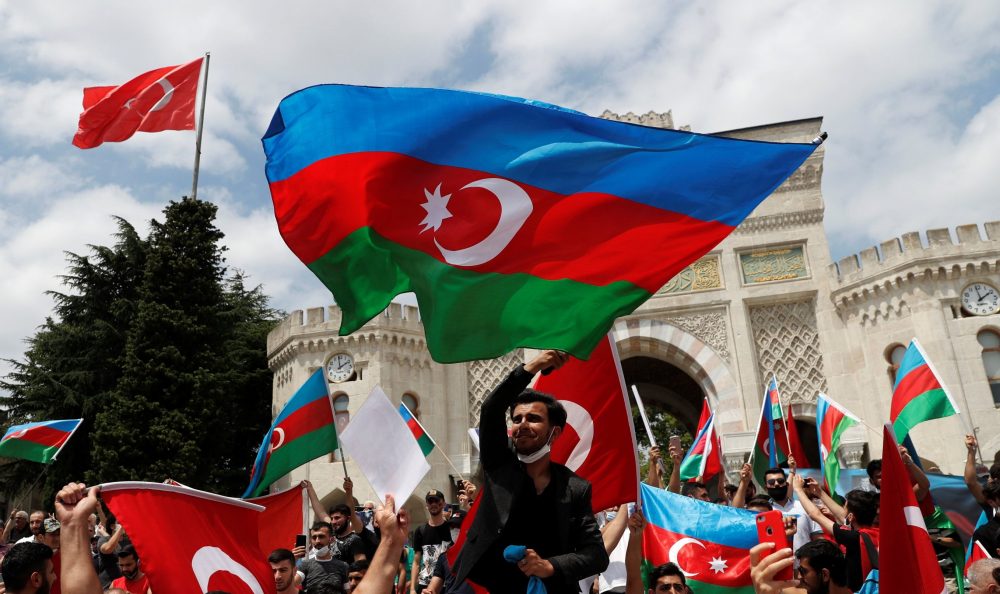
Similarly, the Armenians live with the dream of a “Greater Armenia”. They claim there was a state called “Greater Armenia” they invented, which existed during the reign of a ruler named Tigranes the Great in 83-69 BC. At that time, the territory of Armenia allegedly spanned from the Black Sea to the Caspian Sea, encompassing a vast area. Claiming the existence of an ancient Armenian state between 328 and 428 BC, the Armenians are trying to prove to the world that Karabakh (Artsakh, according to the Armenians) is an ancient Armenian land, and that Azerbaijan as a state was founded only in 1918. Armenian Prime Minister Pashinyan’s shameless statement in a debate with Azerbaijani President Ilham Aliyev at the Munich Security Conference on February 15, 2020, that “there was no Azerbaijan on the map of the word when the Armenian king Tigranes negotiated with Roman military leader Pompey” is a clear indication of regular Armenian shamelessness.
I have no intention to talk in this article about the history of Azerbaijan (either Northern or Southern Azerbaijan in Iran), or about the existence of the ancient Caucasian Albania and Atropatene in these lands and the name of that territory eventually taking the shape of the word “Azerbaijan”, or dwell on the fact that in the ancient geographer and historian Strabo’s Geography, Arsakh-Karabakh is indicated as the territory of Caucasian Albania, and that the lands of Karabakh were ruled by ancient Armenia only between 371 and 387. I just would like to remind you of a point that Armenians seem to have forgotten: modern international law does not take as its basis events that took place before our era.
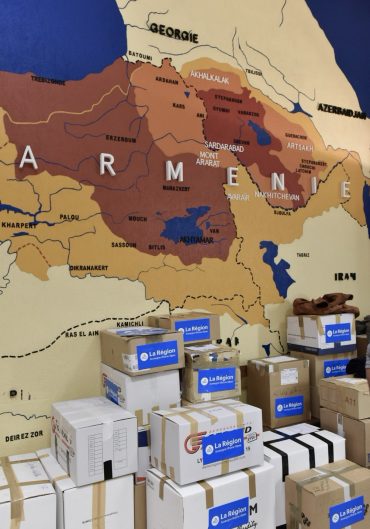 The borders of the Armenian and Azerbaijani states established in 1991 after the collapse of the USSR are known to the entire world. We can even go back a little and mention the fact that Karabakh was recognized as the territory of Azerbaijan at the same time (January 1920) as the Azerbaijani and Armenian republics, both established on the same day on May 28, 1918, were recognized de facto by the world powers at the Paris Peace Conference. However, the Armenian citizens and the Armenian diaspora living abroad, who ignore all this, lost in the euphoria of their fabricated “ancient history”, were seriously mobilized to get their claims and lies across to the world. Their claims are even so persistent that the French, the strongest political and moral supporters of the Armenians, are not afraid to publicize this “Greater Armenia” map at major events. For example, on October 5, 2020, an event organized by a former President of the French Republicans Laurent Wauquiez in the Auvergne-Rhône-Alpes region of France featured a map of Greater Armenia showing the eastern regions of Turkey and the western regions of Azerbaijan within the Armenian border. The event was organized in support of the Armenians in the recent events in Karabakh, and the boxes of medical supplies in front of the map were the humanitarian aid to be sent to the Armenians (photo from Twitter @laurentwauquiez). Undoubtedly, this event was held with the support of the Armenian diaspora.
What is a diaspora?
The word “diaspora”, translated from Greek as “scattering,” means that a community migrates to lands far away from the lands to which they belong, and settles there, thereby scattering the nation around the world. The word was first used to describe the migration of inhabitants of the ancient Greek city-states to distant lands to form new colonies. It was later used to describe the Jews exiled from the lands of ancient Israel by the Babylonians in 586 BC and from province of Judea by the Romans in 136 AD.
However, just being scattered around the world does not in itself create a diaspora. The first condition for the formation of a diaspora is institutionalization. In other words, organization. The process of diaspora formation goes through the following stages:
– Settlement of immigrants in a country away from home. In particularly at this stage, if the host community is harsh and hostile to the immigrants, it further strengthens their social ties with the compatriots, stimulating the formation of a diaspora.
– Organization of activities of a fully formed diaspora. The establishment of the institution of diaspora, the strengthening of the organization is accompanied by its growing ability to make an impact on the economy of the host country.
– Expansion of the diaspora. The strength is in numbers here. A small diaspora disintegrates faster and integrates more quickly into the society of the host country. In a strong and numerous diaspora, however, an ethnic minority can better maintain its identity and unite more strongly to organize itself as a supportive force for the homeland. In particular, many diasporas can suggest and adopt formulas that will work in favor of the state, which members of the diaspora call “homeland,” by influencing the local government. In this respect, for example, Laguerre (2006:6) emphasizes the difference in strength of the Haitian diaspora in France, the United States and Canada, and points out that the Jewish diaspora, which has a strong influence in the United States, has a much weaker influence in the European Union. This is due not only to the strength of the diaspora, but also to the government structure that creates the mechanism for their influence on the state apparatus.
Social functions of a diaspora:
– Preservation of national identity: Ensuring that people living far from their homeland preserve their national identity, especially culture and language.
– Economic integration: In particular, large diasporas can build economic networks that play a significant role in the economy of the host country. These networks contribute to easier economic integration of other diaspora members into the society.
– Social protection: Representatives of the diaspora ensure the protection of their members in various economic and social problems.
– Adaptation: Being a part of the diaspora, representatives of an ethnic minority can adapt in a foreign environment more quickly and comfortably.
– Assistance in upbringing and socialization: Diaspora helps to create and maintain the ties to the homeland, training and education for children of people living far from the homeland. Setting up educational institutions offering education in the native language and publishing newspapers and magazines in the native language play a crucial role in this work.
The importance of a strong diaspora
In addition to the social functions of a strong diaspora, its most important function is to serve the homeland. In particular, the growing globalization of the last few decades, the “shrinking of the world”, in other words, the relationship between people and communities not being measured in distance, news of events in the home country spreading rapidly by means of rapidly developing technology and citizens or compatriots abroad being unable to remain silent and calm about those events, the revitalization of diaspora organizations in these conditions, and most importantly, expanding activities of diaspora organizations of countries in a state of conflict, such as Albanians, Armenians, Jewish-Israelis, Indo-Sikhs, Tamil, Palestinians, etc.—all this stimulates a more detailed study of diaspora organizations.
A large diaspora does not mean a strong diaspora. One of the main prerequisites for a strong diaspora is that immigrants can be involved in organizational activity, such as:
– ensuring support and unity among members of the diaspora;
– being fully mobilized for joint action during possible conflicts and ideological struggles with other diasporas;
– expanding the activities of diaspora members in the host country, (formally and informally) encouraging and supporting their participation in voting and political processes;
– increasing the opportunities for diaspora members to influence the foreign policy of the host country and the home country;
– ties of diaspora members with the homeland, relevant activities here, organization of dual citizenship system.
Diaspora organizations abroad have recently become more active in countries in a state of conflict. In these diasporas, we can witness, in particular, a desire to return to the homeland, a spiritual attachment to it, a radical attitude to and view of relevant political processes. However, just as these moral claims provoke controversy and conflict, it is also emphasized that in some cases diasporas can contribute to the peace-building process. In other words, diaspora organizations of countries in a state of conflict are either moderate, peacekeeping or radical, inciting the conflict. The choice of form may depend on the factor of external aggression directed at the ethnic identity of the diaspora, as well as on the attitude of the homeland government. For example, the Albanian diaspora organized both military aid and peacekeeping rallies in support of Kosovo’s independence from Serbia in 2008. As a result of this activity, Kosovo is now officially recognized by 98 of the world’s 193 (UN member) countries.
After the rekindling of the Armenian-Azerbaijani war over Nagorno-Karabakh on September 27, we can say that the Armenian side sees its only salvation in the recognition of the so-called “Artsakh Republic” in Nagorno-Karabakh by the world powers, and the Armenian diaspora is working hard. Their work has not been in vain either. Today, as a result of the actions of the Armenian diaspora (according to Armenian sources), some countries, such as France, the Netherlands, Belgium, Austria, Luxembourg, Uruguay, and some territorial units (cities, local governments or autonomous regions), such as Michigan (USA), Alfortville ( France), Geneva (Switzerland), Basque Country (Spain), Fort Lee (USA), Milan (Italy), Ode de Saint (France), Limone (France), Vienna (France), Fowler (USA), Catalonia (Spain), Ryde (Australia), New South Wales (Australia), Bouches-du-Rhône (France), Sayaxché (Guatemala) adopted resolutions supporting the position of the “Republic of Arsakh” and criticizing Azerbaijan. According to the Armenians, these resolutions allegedly de facto recognize the so-called republic. However, although the spirit of criticism of Azerbaijan is there in the text of the resolutions, it is clear that the issue of recognition is not on the agenda. In 2012, when the speaker of the Uruguayan parliament arrived in “Artsakh” with a delegation and met with the “officials” of the “republic”, the Armenians had high hopes that Uruguay would be the first state to de jure recognize the so-called republic. However, Azerbaijan’s official note to Uruguay, its tough stance and the strength of its diplomacy prevented it, and to date no state, not even Armenia itself, has dared to make such a move.
I am not referring to the “Republic of Artsakh” as the “Nagorno-Karabakh Republic”, because its map introduced to the world includes 7 districts occupied by Armenians. This, in fact, gives us grounds to say that the Armenians never intended to peacefully return the occupied territories (at least 7 districts around Nagorno-Karabakh), and that the 28-year negotiations in the OSCE and on other platforms only preserve the status quo, in other words, that they serve the Armenian interests. The activity of the Armenian diaspora confirms this. In general, the introduction of a draft resolution in parliament does not mean its adoption and implementation. For example, during the military operations on the Azerbaijani-Armenian border on July 12, 2020, a draft resolution (motion) in the British Parliament on the military aggression of Armenia against Azerbaijan was proposed by 6 parliamentarians and rejected by 2. Similarly, the issues raised by Armenians in the parliaments of various countries through MPs supporting them do not mean their victory. However, these can be considered an indicator of the activity and, consequently, success of the Armenian diaspora, albeit a small one.
What was the Azerbaijani Diaspora doing meanwhile?
According to the news feed on the official website of the State Committee on Work with Diaspora, the diaspora mainly focuses on promotional activities, but few people are involved in this work and they are not able to organize large campaigns (like the ones organized by the Armenians).
Table: SWOT Analysis of the activities of the Azerbaijani Diaspora in 2019
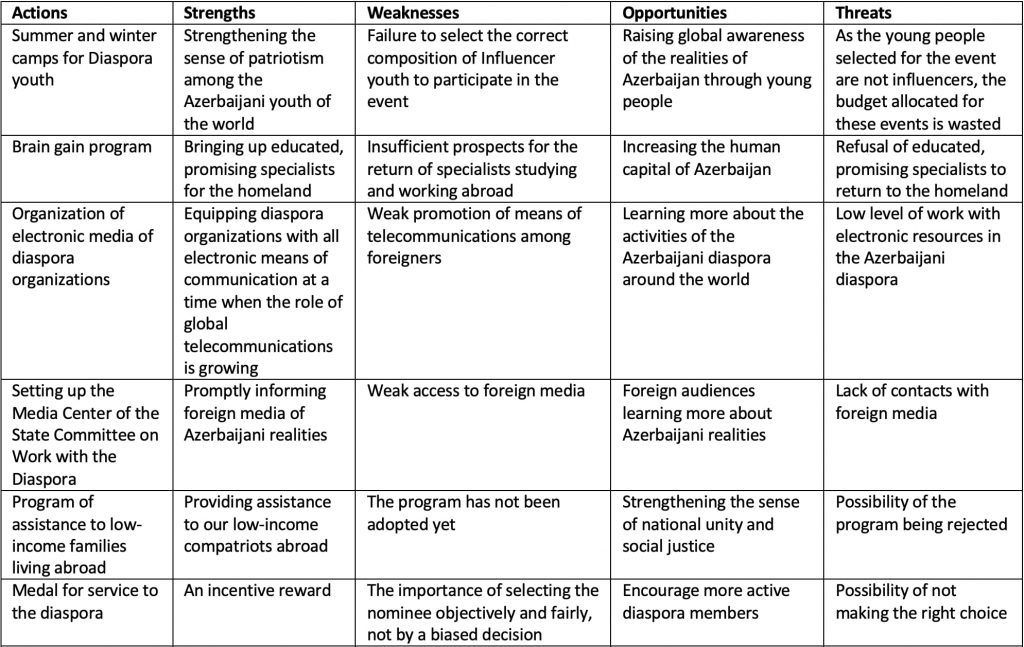
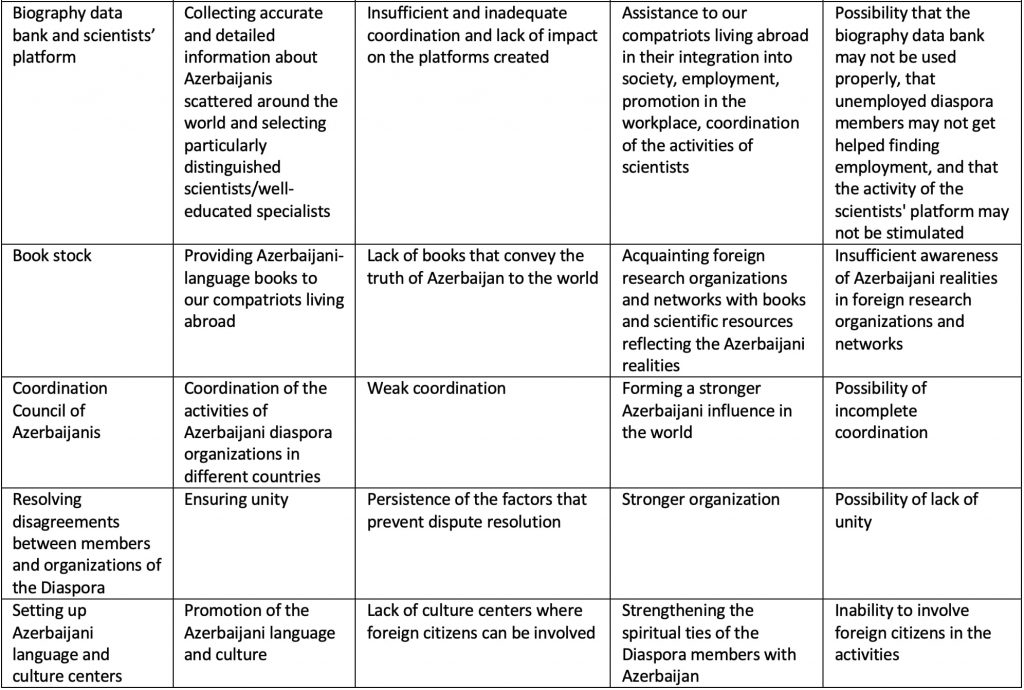 As can be seen from this SWOT Analysis prepared on the basis of the 2019 Annual Report of the State Committee on Work with the Diaspora, although the main efforts of the Azerbaijani Diaspora are focused on propaganda, this activity is more oriented towards the Azerbaijani community and very weak on foreigners. In the future, assistance should be provided to the employment of Azerbaijanis living abroad in local administration, government and other bodies of their host countries, in general, to the adaptation and development of Azerbaijanis in their countries of residence, and their participation in local governance. Thus, attention should be paid to establishing a mechanism of influence on foreign countries, cooperation with foreign politicians and public officials, in particular, strengthening contacts with foreign media. The organizational aspect of all this can be mastered by studying the work of the Jewish diaspora, which managed to establish one of the strongest diaspora organizations in the world.
Aze.Media